
1. Introduction: The AI Revolution in Manufacturing
Manufacturing is going through a major technological transformation. One of the biggest drivers of this change is AI in manufacturing, which is helping factories become faster, smarter, and more efficient. From predicting machine failures to improving product quality, artificial intelligence is changing how products are designed, produced, and delivered.
Across the world, manufacturing companies are investing heavily in artificial intelligence in manufacturing to build what are often called smart factories. These factories use advanced technologies such as machine learning, computer vision, robotics, and predictive analytics to improve production processes and make better decisions using data.
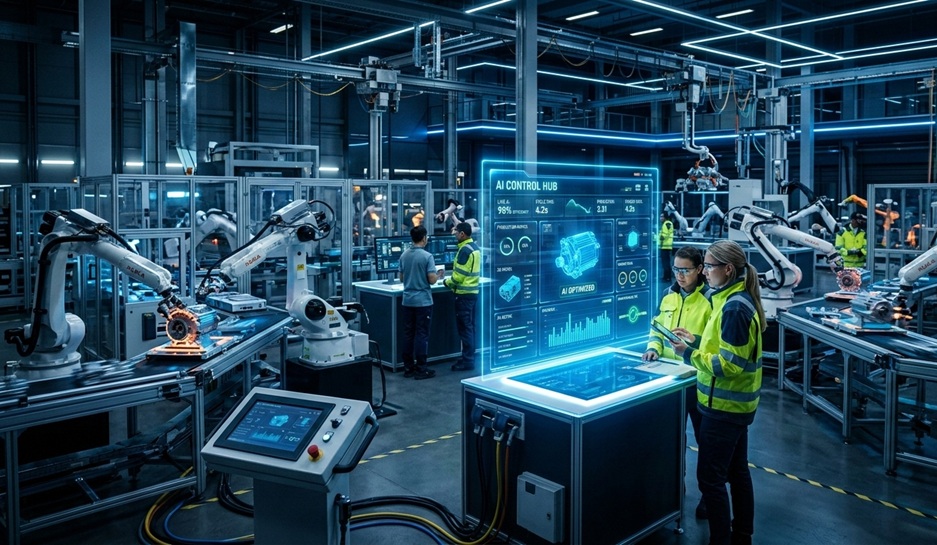
Many experts believe that AI is becoming essential for modern manufacturing. Traditional factories relied heavily on manual monitoring and fixed production processes. Today, manufacturers are using AI systems that can analyse massive amounts of data in real time and automatically optimise operations. This shift allows companies to produce goods more efficiently and respond quickly to changes in market demand.
One of the main reasons manufacturers are adopting AI faster than many other industries is the constant pressure to reduce costs and increase productivity. Global competition has intensified, and companies must deliver products faster while maintaining high quality. AI-powered automation helps factories reduce operational costs, minimise downtime, and improve production efficiency.
Another key driver is the growing demand for industrial automation. As labour costs rise and skilled workers become harder to find, manufacturers are turning to AI-powered machines and robotics to support human workers and handle repetitive tasks. AI systems can also analyse production data to detect inefficiencies and suggest improvements, making the entire manufacturing process more intelligent.
Recent data shows how quickly AI adoption is growing in the sector. Around 78% of manufacturers are now using AI solutions, compared with 70% the previous year, showing rapid growth in adoption across the industry. Companies using AI have reported an average 23% reduction in downtime thanks to predictive maintenance and automated monitoring systems.
The market itself is expanding quickly. The global AI in manufacturing market was valued at about $7.49 billion in 2025 and is expected to reach more than $27 billion by 2034, reflecting strong investment from manufacturers worldwide.
These figures clearly show that AI is no longer just an experimental technology. It is becoming a critical tool for manufacturers that want to remain competitive in the age of digital transformation and Industry 4.0.
In simple terms, AI in manufacturing is helping companies work smarter rather than harder. By combining data, automation, and intelligent algorithms, manufacturers can reduce costs, improve efficiency, and create higher-quality products. This is why businesses across automotive, electronics, pharmaceuticals, and heavy industry are investing billions in AI technologies to build the factories of the future.
2. What Is Artificial Intelligence in Manufacturing?
Artificial Intelligence in manufacturing refers to the use of intelligent computer systems that can analyse data, learn from patterns, and make decisions to improve factory operations. In simple terms, AI in manufacturing helps machines and software perform tasks that normally require human thinking, such as analysing production data, detecting problems, or predicting equipment failures.
Instead of relying only on manual monitoring, manufacturers now use AI manufacturing solutions to automate complex processes and improve efficiency. These systems can quickly process large amounts of information from machines, sensors, and production lines. As a result, factories can operate more smoothly, reduce errors, and increase productivity.
Today, many modern factories are becoming smart factories, where smart manufacturing technologies connect machines, software, and data systems. AI plays a key role in this transformation by helping companies optimise production, reduce downtime, and maintain high product quality.
According to the World Economic Forum, advanced technologies such as AI, robotics, and the Industrial Internet of Things are helping create the next generation of digital manufacturing systems, often referred to as Industry 4.0.
Core Technologies Used in AI Manufacturing
Artificial intelligence in manufacturing is not just one technology. It is a combination of several powerful tools that work together to improve industrial processes. These industrial AI systems use advanced algorithms, sensors, and connected devices to monitor and optimise production.
Below are the key technologies that power AI-driven factories.
Machine Learning
Machine learning is one of the most important technologies used in AI manufacturing solutions. It allows computer systems to learn from data and improve their performance over time without being directly programmed.
In manufacturing, machine learning algorithms analyse production data to identify patterns and predict potential problems. For example, they can detect when a machine is likely to fail so maintenance teams can fix it before a breakdown occurs. This approach, known as predictive maintenance, helps manufacturers reduce costly downtime and extend the life of their equipment.
Computer Vision
Computer vision enables machines to “see” and analyse visual information using cameras and AI algorithms. This technology is widely used for automated quality inspection in factories.
For instance, cameras installed on production lines can check products for defects such as scratches, cracks, or incorrect assembly. AI systems can analyse images much faster and more accurately than humans, ensuring consistent product quality.
Computer vision is widely used in industries such as automotive, electronics, and food manufacturing, where precision and quality control are critical.
Robotics
Robotics is another essential part of smart manufacturing technologies. Modern industrial robots are often powered by AI, allowing them to perform complex tasks with high accuracy.
AI-driven robots can assemble products, move materials, package goods, and even collaborate safely with human workers. These robots are often called collaborative robots, or cobots, because they work alongside people rather than replacing them.
Using AI-powered robotics helps manufacturers increase production speed, reduce manual labour, and improve workplace safety.
Predictive Analytics
Predictive analytics uses AI algorithms to analyse historical and real-time data to predict future events. In manufacturing, this technology helps companies anticipate problems before they happen.
For example, AI systems can monitor equipment performance and detect small changes that indicate a potential failure. By predicting maintenance needs early, manufacturers can avoid unexpected machine breakdowns and reduce repair costs.
Predictive analytics is widely used in industrial AI systems to improve production planning, maintenance scheduling, and supply chain management.
Natural Language Processing (NLP)
Natural Language Processing (NLP) allows computers to understand and interpret human language. While it is often associated with chatbots and virtual assistants, it also plays a role in modern manufacturing environments.
In factories, NLP can help workers interact with AI systems using voice commands or text queries. For example, engineers can quickly access machine data, maintenance reports, or operational insights simply by asking a question.
This technology makes AI manufacturing solutions easier to use and improves communication between human workers and digital systems.
Industrial Internet of Things (IIoT)
The Industrial Internet of Things (IIoT) connects machines, sensors, and devices across the factory floor. These connected devices continuously collect data about machine performance, temperature, energy use, and production output.
AI systems analyse this data to improve operational efficiency and identify problems early. When combined with smart manufacturing technologies, IIoT creates a connected ecosystem where machines communicate with each other and share information in real time.
According to research by McKinsey, factories that successfully implement IIoT and AI can significantly improve productivity and reduce operational costs.
How AI Works in a Manufacturing Environment
To understand the role of AI in manufacturing, it is helpful to look at how these systems operate inside a factory. AI-driven production typically follows three main steps: data collection, data analysis, and automated decision-making.
Data Collection from Machines
The process begins with data collection. Sensors, cameras, and connected devices installed on machines continuously gather information about production activities. This may include machine performance, production speed, temperature levels, energy consumption, and product quality.
These sensors are part of the Industrial Internet of Things, which allows machines to share data with central systems in real time.
AI Analysis
Once the data is collected, industrial AI systems analyse it using machine learning algorithms. The AI software looks for patterns, unusual behaviour, or performance issues that might affect production.
For example, if a machine starts operating outside its normal range, the AI system can detect the issue immediately and alert technicians before a breakdown occurs.
Automated Decision Making
The final step is automated decision-making. Based on its analysis, the AI system can recommend or even automatically take actions to optimise production.
For instance, it may adjust machine settings to improve efficiency, schedule maintenance to prevent downtime, or reroute production tasks to another machine.
This ability to monitor, analyse, and act quickly is what makes AI manufacturing solutions so valuable. It allows factories to operate with greater precision, lower costs, and improved productivity.
The Role of AI in Smart Manufacturing
As more companies adopt smart manufacturing technologies, AI is becoming the central intelligence that connects machines, data, and human workers. By using AI in manufacturing, companies can build smarter production systems that continuously learn and improve.
In the coming years, industrial AI systems will play an even greater role in helping manufacturers create more flexible, efficient, and sustainable factories. Businesses that invest in these technologies today are likely to gain a strong competitive advantage in the rapidly evolving global manufacturing industry.
3. Key Reasons Manufacturing Companies Are Investing in AI
Manufacturing companies around the world are investing heavily in AI in manufacturing because it helps them improve efficiency, reduce costs, and make better decisions using data. As global competition increases, manufacturers need smarter and faster ways to run factories, manage supply chains, and maintain product quality.
Modern AI manufacturing solutions allow factories to analyse large amounts of production data in real time. This helps companies identify problems early, optimise operations, and make informed decisions that improve overall performance.
Below are some of the main reasons why manufacturers are adopting smart manufacturing technologies and industrial AI systems.
3.1 Improving Production Efficiency
One of the biggest advantages of AI in manufacturing is its ability to improve production efficiency. AI systems analyse production data and identify ways to optimise workflows, reduce delays, and increase output.
Traditional production lines often follow fixed schedules and manual monitoring. However, AI production efficiency tools can automatically adjust production processes based on real-time conditions. This makes factories more flexible and efficient.
AI helps with manufacturing process optimization in several ways:
- analysing production performance data
- identifying bottlenecks in production lines
- adjusting machine settings automatically
- improving production scheduling
For example, an AI system can monitor machine performance during production. If it detects that a machine is operating slower than normal, the system can automatically adjust the settings or redistribute tasks to other machines to maintain productivity.
Smart scheduling is another important feature of AI manufacturing solutions. AI can analyse factors such as machine availability, worker schedules, and order demand to create the most efficient production plan.
According to research by McKinsey, manufacturers that successfully adopt advanced analytics and AI technologies can improve productivity by 10–20%.
3.2 Predictive Maintenance Reduces Downtime
Unexpected machine failures are one of the most expensive problems in manufacturing. When a critical machine stops working, the entire production line may need to shut down, leading to delays and financial losses.
This is where predictive maintenance AI plays an important role.
Instead of waiting for machines to break down, AI systems continuously monitor equipment using sensors and data analysis. These smart factory maintenance systems can detect early signs of wear or malfunction before a failure occurs.
AI monitors factors such as:
- machine vibration
- temperature changes
- pressure levels
- operating speed
By analysing this data, the system can predict when a machine is likely to fail and alert maintenance teams in advance.
For example, if AI detects unusual vibration or temperature changes in a motor, it may recommend maintenance before the machine breaks down.
The benefits of predictive maintenance AI include:
- preventing unexpected machine breakdowns
- reducing maintenance costs
- increasing production uptime
- improving equipment lifespan
According to Deloitte, predictive maintenance powered by AI can reduce equipment downtime by 30–50% and lower maintenance costs by 10–40%.
3.3 Better Quality Control With Computer Vision
Maintaining high product quality is essential in manufacturing. Even small defects can lead to customer complaints, product recalls, and financial losses.
AI-powered computer vision manufacturing systems are helping companies improve quality control by automating the inspection process.
These systems use cameras and AI algorithms to examine products during production. The AI analyses images in real time and compares them with quality standards to detect defects.
This type of AI quality inspection offers several advantages:
- faster inspection speeds
- higher accuracy than manual checks
- reduced human error
- lower production waste
For example, in electronics manufacturing, computer vision manufacturing systems can detect extremely small defects such as scratches, cracks, or incorrect component placement.
In automotive factories, AI cameras can inspect vehicle parts to ensure they meet strict safety and quality standards.
Because AI can analyse thousands of images per minute, it makes the inspection process much faster and more reliable than manual inspection.
3.4 Cost Reduction and Operational Efficiency
Reducing operational costs is a major reason why manufacturers are investing in AI manufacturing solutions. AI helps companies optimise resources, reduce waste, and improve operational efficiency across the entire factory.
Several areas where AI contributes to AI cost reduction manufacturing include:
Optimised Energy Consumption
AI systems can analyse energy usage across machines and production lines. This helps manufacturers reduce unnecessary energy consumption and lower electricity costs.
Workforce Efficiency
AI tools can assist workers by automating repetitive tasks and providing real-time insights. This allows employees to focus on higher-value work.
Automated Logistics
AI-powered manufacturing automation solutions can optimise internal logistics, such as moving materials between production stages and managing warehouse operations.
Studies show that companies adopting AI and automation technologies can reduce operational costs by 20–30%, depending on the industry and level of implementation.
These savings make AI a valuable investment for manufacturers looking to remain competitive.
3.5 Supply Chain Optimization
Manufacturing companies depend heavily on efficient supply chains. Delays in raw materials or inaccurate demand forecasting can disrupt production and increase costs.
AI is helping companies improve AI supply chain management by analysing large datasets and predicting future demand more accurately.
With intelligent logistics systems, manufacturers can:
- forecast product demand
- optimise inventory levels
- identify supply chain risks
- improve delivery planning
For example, AI can analyse historical sales data, seasonal trends, and market demand to predict how many products a company will need to produce.
It can also detect potential supply chain disruptions, such as delays from suppliers or shortages of raw materials.
By predicting these problems early, companies can take action to avoid production delays.
This level of visibility and forecasting is one of the key reasons why many companies are investing in AI-driven supply chain technologies.
3.6 Workforce Productivity and Human-AI Collaboration
A common misconception is that AI in manufacturing will replace human workers. In reality, AI is designed to support employees and make their work safer and more efficient.
Modern factories are increasingly using collaborative robots, also known as cobots. These robots work alongside humans to perform repetitive or physically demanding tasks.
Examples of AI workforce productivity tools include:
- AI-assisted robotics for assembly tasks
- smart manufacturing dashboards for real-time production monitoring
- AI-powered safety systems that detect hazards
For example, AI systems can monitor worker safety by identifying dangerous situations on the factory floor, such as equipment malfunction or unsafe behaviour.
Meanwhile, smart manufacturing dashboards allow managers and engineers to view production data in real time, helping them make faster and better decisions.
By combining human skills with industrial AI systems, manufacturers can improve productivity while also creating safer and more efficient workplaces.
Final Insight
The growing adoption of AI in manufacturing shows that artificial intelligence is becoming a core technology for modern factories. From manufacturing process optimization and predictive maintenance AI to AI supply chain management, these technologies are transforming how products are made.
Companies that invest in smart manufacturing technologies today are positioning themselves for long-term success in an increasingly competitive global market.
4. Top AI Applications in Manufacturing
Artificial intelligence is transforming how factories operate. Today, many manufacturers are adopting AI in manufacturing to automate processes, improve productivity, and make better decisions using data. These technologies are helping companies move from traditional factories to modern smart manufacturing technologies that are more efficient, flexible, and data-driven.
Below are some of the most important AI applications in manufacturing that are shaping the future of the industry.
4.1 Smart Factories
One of the most significant applications of AI in manufacturing is the development of smart factories. A smart factory uses advanced technologies such as artificial intelligence, sensors, robotics, and connected machines to automate and optimise production processes.
In a traditional factory, machines often operate independently and rely on human supervision. However, in a smart factory, machines are connected through digital systems and continuously share information with each other.
With smart factory technology, AI systems can analyse production data in real time and make automatic adjustments to improve efficiency. For example, if one machine slows down or stops working, the system can quickly adjust the production schedule or redirect tasks to other machines.
Some key features of smart factories include:
- real-time production monitoring
- automated decision-making
- connected machines and sensors
- improved resource management
These systems allow manufacturers to operate with greater accuracy and flexibility. As a result, companies can produce goods faster while maintaining high quality standards.
4.2 Industrial Robotics
Another important application of industrial automation AI is the use of intelligent robots in manufacturing. Industrial robots have been used in factories for many years, but modern robots are becoming more advanced thanks to artificial intelligence.
AI-powered robots can perform complex tasks such as assembling products, welding parts, packaging goods, and handling materials. Unlike traditional robots that follow fixed instructions, AI-enabled robots can adapt to changing conditions and learn from data.
Many factories are also adopting collaborative robots, often called cobots. These robots are designed to work safely alongside human workers. They assist with repetitive or physically demanding tasks while humans focus on more complex responsibilities.
Using industrial robotics powered by AI offers several advantages:
- higher production speed
- improved accuracy and precision
- reduced manual labour
- safer working environments
Industries such as automotive, electronics, and metal manufacturing widely use AI-powered robots to increase efficiency and productivity.
4.3 Predictive Analytics
Predictive analytics is another powerful AI application in manufacturing. It uses historical data and machine learning algorithms to predict future outcomes and identify potential problems.
Manufacturing equipment generates large amounts of data through sensors and monitoring systems. AI analyses this data to detect patterns and predict events such as machine failures or production delays.
For example, if AI detects unusual changes in temperature or vibration in a machine, it can predict that the equipment may fail soon. Maintenance teams can then repair or replace the part before a breakdown occurs.
This approach is often called predictive maintenance, and it offers several benefits:
- reduced equipment downtime
- lower maintenance costs
- improved production reliability
- longer machine lifespan
By using predictive analytics, manufacturers can plan maintenance activities more effectively and avoid unexpected disruptions.
4.4 AI-Powered Quality Control
Maintaining consistent product quality is essential for manufacturing companies. AI is helping manufacturers improve quality control through advanced inspection systems.
AI-powered quality control uses cameras, sensors, and machine learning algorithms to inspect products during the production process. These systems analyse images and detect defects that may not be visible to the human eye.
For example, in electronics manufacturing, AI can identify tiny cracks, scratches, or incorrect component placement. In automotive production, AI can inspect parts to ensure they meet strict safety standards.
The benefits of AI quality inspection systems include:
- faster inspection processes
- greater accuracy
- reduced product defects
- less production waste
Because AI can analyse thousands of images in seconds, it significantly improves the speed and reliability of quality control in modern factories.
4.5 Autonomous Supply Chains
AI is also transforming supply chain management in manufacturing. Many companies are now using AI-driven autonomous supply chains to manage inventory, logistics, and supplier relationships more efficiently.
An AI-powered supply chain system can analyse data from sales, production, and suppliers to predict demand and plan deliveries more accurately.
For example, AI can predict when raw materials might run out or identify potential delays from suppliers. The system can then automatically adjust inventory levels or recommend alternative suppliers.
Using industrial automation AI in supply chains offers several advantages:
- better demand forecasting
- improved inventory management
- faster logistics planning
- reduced supply chain risks
These intelligent systems help manufacturers maintain smooth operations even when market conditions change.
Why These AI Applications Matter
The growing adoption of AI in manufacturing shows that artificial intelligence is becoming a key part of modern industrial operations. Technologies such as smart factory technology, industrial robotics, and predictive analytics are helping companies build more efficient and resilient manufacturing systems.
As manufacturers continue investing in smart manufacturing technologies, AI will play an even bigger role in improving productivity, reducing costs, and supporting innovation across the global manufacturing industry.
5. Real-World Examples of AI in Manufacturing
The use of AI in manufacturing is no longer just a future concept. Many industries are already using AI manufacturing solutions to improve production speed, maintain quality, and reduce costs. From automotive factories to food processing plants, companies are applying smart manufacturing technologies and industrial AI systems to make their operations more efficient and reliable.
Below are some real-world examples of how different industries are using artificial intelligence in their manufacturing processes.
Example 1: Automotive Industry
The automotive industry is one of the earliest and largest adopters of AI in manufacturing. Car manufacturers use AI technologies to automate complex tasks on vehicle assembly lines and improve production efficiency.
Modern automotive factories use industrial automation AI and robotics to assemble thousands of parts that make up a vehicle. AI systems can analyse production data in real time and adjust the assembly process to avoid delays or errors.
For example, AI-powered robots can perform tasks such as:
- welding car body components
- installing engines and parts
- painting vehicles with high precision
- inspecting finished vehicles for defects
These robots use sensors and machine learning algorithms to ensure that every step of the production process meets strict quality standards.
Many car manufacturers also use AI-driven predictive maintenance systems to monitor factory equipment. These systems can detect early signs of machine wear and schedule maintenance before a breakdown occurs.
By using smart factory technology, automotive companies can increase production efficiency while maintaining high safety and quality standards.
Example 2: Electronics Manufacturing
Electronics manufacturing requires extremely high precision because even the smallest defect can cause a product to fail. To solve this challenge, many electronics manufacturers use AI-powered quality inspection systems.
In electronics factories, computer vision systems powered by AI analyse images of circuit boards during production. These systems can detect tiny defects that may not be visible to the human eye.
For example, AI can identify problems such as:
- misaligned electronic components
- damaged circuits
- missing parts
- microscopic cracks on circuit boards
This type of AI quality inspection allows companies to check thousands of components in seconds. It significantly improves accuracy compared with manual inspection.
Using industrial AI systems in electronics manufacturing helps companies maintain consistent product quality while reducing production waste and inspection time.
Example 3: Pharmaceutical Manufacturing
The pharmaceutical industry is another sector where AI in manufacturing is becoming increasingly important. Drug production requires strict quality control and precise manufacturing processes to ensure medicines are safe and effective.
Pharmaceutical companies use AI manufacturing solutions to analyse large amounts of production and research data. AI helps optimise drug production processes and improve manufacturing efficiency.
For example, AI can help pharmaceutical manufacturers:
- optimise chemical production processes
- monitor drug quality during manufacturing
- predict potential issues in production batches
- improve research and development processes
AI-driven systems can also analyse clinical and laboratory data to help researchers develop new medicines faster.
Because the pharmaceutical industry must meet strict regulatory standards, smart manufacturing technologies help ensure that production processes remain consistent and compliant with safety regulations.
Example 4: Food Processing Industry
The food processing industry is also adopting AI in manufacturing to improve food quality, safety, and production efficiency.
Food manufacturers use AI systems to monitor production lines and ensure that food products meet hygiene and quality standards. Cameras and sensors can inspect food products in real time and detect defects such as contamination, incorrect packaging, or damaged items.
For example, AI systems can:
- check food colour, shape, and size
- detect foreign objects in food products
- monitor packaging accuracy
- track product quality during processing
AI can also analyse production data to ensure that food processing machines operate at the correct temperature and speed.
Using industrial automation AI helps food manufacturers reduce waste, improve product consistency, and maintain high safety standards.
Why Real-World AI Applications Matter
These examples show how AI in manufacturing is transforming multiple industries. Whether it is vehicle assembly, electronics production, pharmaceutical manufacturing, or food processing, AI technologies are helping companies build smarter and more efficient factories.
By using AI manufacturing solutions, businesses can improve productivity, reduce operational costs, and maintain high product quality. As smart manufacturing technologies continue to develop, more industries will adopt industrial AI systems to remain competitive in the global market.
6. Benefits of AI Investment for Manufacturers
Investing in AI in manufacturing offers significant advantages for companies looking to stay competitive and efficient. By adopting AI manufacturing solutions, businesses can transform traditional factories into smarter, faster, and more reliable production environments. The benefits of AI in manufacturing are both practical and measurable, impacting every part of the production process.
Here are the major AI manufacturing advantages explained in simple terms:
- Increased Productivity – AI systems optimise production lines, automate repetitive tasks, and allow factories to produce more goods in less time.
- Reduced Operational Costs – By improving efficiency and automating processes, AI helps lower energy use, reduce waste, and decrease labour costs.
- Improved Product Quality – AI-powered inspection systems detect defects faster and more accurately than humans, ensuring consistent quality.
- Faster Decision Making – Real-time data analysis from AI systems allows managers to make quicker and more informed decisions.
- Reduced Machine Downtime – Predictive maintenance powered by AI identifies potential equipment failures before they happen, keeping production running smoothly.
- Better Demand Forecasting – AI can analyse historical data and market trends to predict product demand, helping companies manage inventory more efficiently.
- Enhanced Workplace Safety – AI systems monitor the factory environment and worker activity, identifying hazards and preventing accidents.
By leveraging these benefits of AI in manufacturing, companies can not only save money and time but also create a safer, smarter, and more competitive factory. Investing in AI manufacturing solutions is no longer optional—it is a key strategy for long-term success in today’s fast-paced industrial world.
7. Challenges of Implementing AI in Manufacturing
While AI in manufacturing offers many advantages, implementing these technologies is not without challenges. Companies must carefully plan their AI adoption strategies to overcome obstacles and ensure a smooth transition to industrial AI systems. Understanding these AI implementation challenges helps manufacturers prepare for successful deployment.
Here are the key challenges manufacturers face when adopting AI manufacturing solutions:
1. High Initial Investment
One of the biggest barriers to AI adoption is the cost of setting up AI systems. Building a smart factory requires investment in:
- AI software and hardware
- Industrial robots and sensors
- Data storage and computing infrastructure
These initial costs can be significant, especially for small and medium-sized manufacturers. However, the long-term benefits of AI manufacturing solutions, such as increased productivity and reduced operational costs, often outweigh the upfront investment.
2. Data Integration Issues
AI systems rely on accurate and consistent data to make decisions. In manufacturing, data comes from multiple sources, such as machines, sensors, production logs, and supply chain systems.
Combining this data into a single system can be difficult. Many factories still operate with legacy machines that do not easily connect to modern AI platforms. Integrating old and new systems is a common industrial AI adoption barrier.
To overcome this, manufacturers often need to upgrade their machines, standardise data formats, and implement robust data management systems.
3. Skill Gap
Implementing AI in manufacturing requires employees who understand both production processes and AI technology.
Many manufacturers face a shortage of workers with expertise in:
- machine learning and data analysis
- AI-powered robotics
- smart factory management
This skill gap can slow down AI adoption and limit the effectiveness of AI systems. To address this, companies invest in employee training, hire AI specialists, and partner with technology providers to bridge the knowledge gap.
4. Cybersecurity Concerns
Smart factories rely on connected devices, cloud systems, and industrial networks. This connectivity exposes factories to potential cyber threats.
Industrial AI systems need strong security measures to protect sensitive data and prevent operational disruptions. A single cyberattack can halt production, damage equipment, or compromise product quality.
Manufacturers must invest in:
- secure networks and firewalls
- encrypted data storage
- regular monitoring of AI systems for vulnerabilities
8. Future of AI in Manufacturing
The future of AI in manufacturing is bright and full of possibilities. As industrial AI systems become more advanced, factories are evolving from traditional production lines into fully connected, intelligent, and highly efficient operations. Companies that invest in AI manufacturing solutions today are preparing to stay competitive in an increasingly automated and data-driven world.
Here’s what the future looks like for AI in manufacturing:
1. Fully Smart Factories
Factories of the future will be fully automated and connected, often called smart factories. In these factories, machines, sensors, and AI systems communicate with each other in real time to optimise production.
Smart factory technology will allow manufacturers to:
- adjust production schedules instantly based on demand
- monitor equipment health automatically
- reduce waste and energy use
- improve overall efficiency
This level of automation will make factories faster, more flexible, and more cost-effective than ever before.
2. AI-Powered Robotics
Industrial robots are becoming smarter with AI. In the future, AI-powered robotics will perform even more complex tasks alongside human workers.
These robots will be able to:
- learn from experience to improve performance
- collaborate safely with humans on the factory floor
- handle delicate or high-precision tasks
- adapt to changes in production without reprogramming
This combination of humans and collaborative robots will increase productivity while making work safer.
3. Predictive Analytics and Real-Time Insights
The future of AI in manufacturing will see even greater use of predictive analytics. AI systems will continuously analyse data from machines, supply chains, and production lines to anticipate problems before they happen.
Manufacturers will be able to:
- predict equipment failures with high accuracy
- optimise inventory and supply chains automatically
- forecast production demand and market trends
- make faster, data-driven decisions
By using industrial AI systems, factories will operate more efficiently and respond quickly to changing conditions.
4. Generative AI in Design and Production
Generative AI is expected to play a major role in designing products and production processes. It can suggest new designs, improve manufacturing methods, and simulate outcomes before production begins.
This technology will help companies:
- create innovative products faster
- reduce prototyping costs
- optimise material usage and reduce waste
- streamline production planning
Generative AI is a key part of the next phase of smart manufacturing technologies.
5. Autonomous Supply Chains
The supply chain of the future will be powered by AI supply chain management systems. These systems will operate almost autonomously, predicting demand, managing inventory, and even coordinating with suppliers.
Key benefits include:
- fewer delays and stockouts
- smarter logistics and transportation
- better risk management and supplier selection
- more responsive production planning
Autonomous supply chains will allow manufacturers to deliver products faster and more reliably than ever before.
6. Sustainable and Green Manufacturing
AI will also help manufacturers focus on sustainability. By optimising energy use, reducing waste, and improving resource management, AI in manufacturing will support environmentally friendly production.
Factories of the future will be able to:
- monitor energy and water consumption in real time
- reduce carbon emissions with smarter processes
- recycle materials more efficiently
- comply with environmental regulations automatically
This aligns with global trends toward green and responsible manufacturing practices.
The future of AI in manufacturing is about smarter, safer, and more efficient factories. Industrial AI systems will continue to revolutionise production by combining automation, predictive insights, robotics, and data-driven decision-making.
Companies that embrace AI manufacturing solutions now will not only improve efficiency and reduce costs but will also lead the industry in innovation, quality, and sustainability. The factories of tomorrow will be intelligent, flexible, and fully prepared to meet the demands of a fast-changing global market.
9. How Businesses Can Start Using AI in Manufacturing
Implementing AI in manufacturing can seem complex, but with a clear plan, businesses of all sizes can start their AI transformation manufacturing journey. A step-by-step approach ensures that companies adopt the right technologies, train their workforce, and gradually scale AI solutions for maximum impact.
Here’s a simple guide to help manufacturers get started with AI manufacturing solutions.
1. Identify Automation Opportunities
The first step in any AI implementation strategy is to identify areas where AI can add the most value. Look for repetitive, time-consuming, or error-prone tasks in your production line, supply chain, or quality control processes.
Examples include:
- repetitive assembly tasks
- manual inspection of products
- machine monitoring and maintenance
- inventory management
Focusing on high-impact areas ensures that initial AI projects deliver measurable results quickly.
2. Collect Manufacturing Data
AI systems rely on data to make intelligent decisions. Before implementing AI, gather data from your machines, sensors, production logs, and supply chain systems.
Important data types include:
- machine performance and downtime records
- production speed and quality metrics
- energy and resource usage
- historical maintenance and repair logs
Collecting accurate and consistent data is critical for effective AI manufacturing solutions.
3. Start with Predictive Maintenance
A good starting point for AI adoption is predictive maintenance. This allows manufacturers to prevent unexpected machine failures by using AI to monitor equipment performance in real time.
Benefits of starting with predictive maintenance include:
- reducing machine downtime
- lowering maintenance costs
- improving overall production efficiency
Starting with one use case helps teams gain experience with industrial AI systems before expanding to other areas.
4. Invest in AI Platforms
Once opportunities and data are identified, invest in AI software platforms that suit your needs. These platforms provide the tools to analyse data, automate processes, and integrate AI into your factory systems.
Look for platforms that support:
- real-time data analysis
- predictive analytics
- machine learning
- integration with existing equipment
Choosing the right platform is a key part of a successful AI implementation strategy.
5. Train Workforce
AI is most effective when combined with skilled human workers. Train your workforce to understand and work alongside AI systems.
Training should cover:
- operating AI-powered machines and robots
- analysing AI-generated insights
- monitoring and maintaining AI systems
- safety protocols when working with smart machines
Upskilling employees ensures that AI supports workers rather than replacing them.
6. Scale AI Solutions
After initial success, gradually scale AI across more production lines, factories, or supply chain processes. Monitor results carefully and refine your AI transformation manufacturing strategy.
Scaling may include:
- expanding predictive maintenance to all machines
- implementing AI quality inspection across multiple product lines
- integrating AI into supply chain and logistics management
- adding AI-powered robotics for complex tasks
By scaling carefully, companies can maximise the benefits of AI while minimising disruption.
10. Why Businesses Should Partner With AI Automation Experts
Adopting AI in manufacturing can be a game-changer for companies, but implementing AI on your own can be complex and time-consuming. This is where partnering with AI automation experts, such as Cor Advance Solutions, makes a big difference. Working with experienced AI service providers ensures that manufacturers get the most value from their AI manufacturing solutions while avoiding common pitfalls.
Here’s why businesses benefit from collaborating with AI automation specialists:
1. Faster Deployment
AI experts have the tools, experience, and processes needed to implement AI quickly and efficiently. Instead of spending months figuring out software, integration, and machine learning models, companies can start seeing results sooner.
With industrial AI systems, fast deployment means:
- production lines become more efficient quickly
- predictive maintenance systems start reducing downtime
- AI quality inspection tools catch defects faster
Partnering with experts accelerates the journey from planning to real-world results.
2. Expert AI Strategy
AI automation providers bring specialised knowledge in smart manufacturing technologies. They can help companies identify the best areas for automation, select the right AI platforms, and develop a customised AI implementation strategy.
An expert strategy ensures that:
- investments target high-impact areas
- AI solutions integrate seamlessly with existing systems
- measurable results, such as increased efficiency and reduced costs, are achieved
This guidance is especially valuable for companies new to AI transformation manufacturing.
3. Cost Efficiency
Building AI solutions in-house can be expensive and risky. Partnering with AI service providers can reduce costs by:
- avoiding trial-and-error implementations
- providing pre-tested AI solutions
- optimising resources and labour
Using expert AI manufacturing solutions allows companies to achieve maximum impact with minimal waste of time, money, and effort.
4. Scalable AI Solutions
AI needs to grow with your business. Experienced AI automation providers design systems that are flexible and scalable, so manufacturers can expand AI capabilities across production lines, factories, and supply chains.
With scalable industrial AI systems, businesses can:
- add new AI-powered robots or inspection systems as production grows
- expand predictive maintenance across multiple machines
- integrate supply chain AI solutions across global operations
This ensures that AI continues to deliver value as your business evolves.
AI in Manufacturing Market Growth (Statistics Section)
The rapid adoption of AI in manufacturing is not just a trend—it is supported by strong global market growth and increasing investment from industrial companies. Across sectors such as automotive, electronics, energy, and consumer goods, manufacturers are integrating artificial intelligence in manufacturing to automate processes, improve product quality, and make smarter decisions based on data.
Below are some key statistics that show how quickly the AI manufacturing market is expanding worldwide.
Global AI in Manufacturing Market Size
The global market for AI in manufacturing has grown rapidly over the past few years as companies invest in smart factory technologies and automation.
According to a report by Precedence Research, the global AI in manufacturing market was valued at around USD 5.07 billion in 2023 and is expected to reach approximately USD 68.36 billion by 2032.
This strong growth shows how important artificial intelligence in manufacturing is becoming for modern industrial operations. Manufacturers are using AI systems for several applications, including:
- predictive maintenance
- quality inspection
- supply chain optimisation
- production planning
- industrial robotics
These technologies allow factories to analyse huge amounts of operational data and make faster, more accurate decisions.
Another market study estimates that the AI manufacturing market was valued at about USD 5.94 billion in 2024 and is expected to grow to more than USD 68 billion by 2032, highlighting the growing investment in smart manufacturing solutions.
In simple terms, companies are moving towards AI-powered factories where machines, sensors, and software work together to improve productivity and efficiency.
CAGR Growth Projections
The growth rate of the AI in manufacturing market is one of the fastest among industrial technologies.
Several industry reports highlight strong compound annual growth rates (CAGR):
- The market is expected to grow at a CAGR of about 33.5% between 2023 and 2032, according to industry research.
- Another analysis estimates the market could grow from USD 7.60 billion in 2025 to over USD 62 billion by 2032, representing a CAGR of 35.1%.
- Some reports also estimate a 31.2% CAGR between 2025 and 2034, driven by the rising demand for automation and smart factories.
This rapid growth is mainly driven by:
- increasing demand for industrial automation
- the rise of Industry 4.0 technologies
- growing adoption of predictive maintenance systems
- the need to reduce operational costs and downtime
Because of these benefits, manufacturers are accelerating their AI investments across production and supply chain operations.
AI Adoption Rates Across Manufacturing Industries
AI adoption in manufacturing is also rising quickly across different sectors.
Research shows that about 52% of industrial companies have already implemented AI in at least one business function.
However, only around 12% of manufacturers have fully scaled AI across their entire operations, meaning there is still huge growth potential for the future.
Industry leaders are particularly optimistic about AI:
- 83% of manufacturing executives believe AI is a critical driver of innovation and growth.
- 67% of manufacturers plan to increase their AI budgets by at least 20% in the coming years.
AI is being widely used in several areas of manufacturing, including:
- Predictive maintenance – reducing machine downtime by 30–50%.
- Quality inspection – AI computer vision can detect defects with up to 90% accuracy.
- Production optimisation – AI can improve manufacturing throughput by 20–30%.
These improvements explain why more companies are investing in AI-powered automation and smart factory systems.
What These Statistics Mean for the Future
The numbers clearly show that AI in manufacturing is entering a high-growth phase. As global competition increases and factories become more digital, artificial intelligence will play a central role in how products are made.
For manufacturers, investing in AI-powered manufacturing technologies is no longer optional. It is becoming a key strategy to improve efficiency, reduce costs, and remain competitive in the age of smart factories.
In the coming years, we can expect even faster adoption of industrial AI solutions, especially in areas such as robotics, predictive analytics, and digital twin technology.
Conclusion
Manufacturing companies around the world are investing heavily in AI in manufacturing because it offers clear and measurable benefits. From improving production efficiency and reducing downtime to enhancing product quality and optimising supply chains, AI manufacturing solutions are transforming traditional factories into smarter, more competitive operations.
AI is no longer just an optional tool—it has become essential for companies that want to maintain a competitive advantage in a fast-moving global market. Businesses that adopt AI early gain significant benefits, including higher efficiency, lower operational costs, and increased profitability.
The key takeaway is clear: the sooner manufacturers start their AI transformation manufacturing journey, the faster they can reap the rewards. By identifying opportunities for automation, implementing predictive maintenance, investing in AI platforms, and training their workforce, companies can build smart factories that are ready for the future.
Now is the time for manufacturers to embrace industrial AI systems, leverage smart manufacturing technologies, and take the first steps toward a more efficient, innovative, and profitable production process.
Frequently Asked Questions (FAQ)
1. What is AI in manufacturing?
AI in manufacturing refers to the use of artificial intelligence technologies like machine learning, computer vision, robotics, and predictive analytics to optimise production processes, monitor equipment, and improve product quality. These AI manufacturing solutions help factories operate smarter, reduce errors, and make faster data-driven decisions.
2. Why are manufacturing companies adopting AI faster than other industries?
Manufacturers are adopting AI faster due to high competition, demand for automation, and the need to reduce costs. Industrial AI systems enable real-time monitoring, predictive maintenance, and smart production, making factories more efficient and adaptable than ever. Early adoption also helps companies stay ahead in the era of smart manufacturing technologies.
3. What are the benefits of AI in manufacturing?
The benefits of AI in manufacturing include increased productivity, reduced operational costs, improved product quality, faster decision-making, and lower machine downtime. AI-powered systems also enhance supply chain management, predict demand, and improve worker safety, making AI manufacturing solutions a vital investment for modern factories.
4. Why is AI important for manufacturing?
AI is important for manufacturing because it drives efficiency, quality, and competitiveness. By automating repetitive tasks, predicting equipment failures, and analysing production data, industrial AI systems help companies reduce waste, improve output, and make informed decisions faster than traditional methods.
5. How does AI improve factory efficiency?
AI improves factory efficiency by optimising production lines, automating routine tasks, and providing real-time insights from machines and sensors. AI manufacturing solutions can adjust schedules, predict maintenance needs, and reduce errors, allowing factories to produce more with less time and resources.
6. What are examples of AI in manufacturing?
Examples of AI in manufacturing include predictive maintenance, AI-powered quality inspection, industrial robotics, autonomous supply chains, and smart factory systems. Industries like automotive, electronics, pharmaceuticals, and food processing use these AI manufacturing solutions to improve speed, accuracy, and overall productivity.
7. Is AI replacing manufacturing jobs?
AI is not replacing jobs but enhancing them. Collaborative robots (cobots) and AI tools assist workers in repetitive or dangerous tasks, allowing employees to focus on higher-value work. AI adoption increases workforce productivity and safety while enabling humans and machines to work together efficiently.
8. What industries use AI manufacturing the most?
Industries leading in AI adoption include automotive, electronics, pharmaceuticals, aerospace, and food processing. These sectors benefit from industrial AI systems for predictive maintenance, quality inspection, robotics, and supply chain optimisation, making their production faster, safer, and more cost-effective.