
1. Introduction: The Rise of AI Automation in E-commerce
The e-commerce industry is evolving rapidly, and AI automation for eCommerce is becoming one of the most powerful technologies driving this transformation. Online stores today generate enormous amounts of data from customer browsing behaviour, purchase history, product searches, and interactions. Artificial Intelligence (AI) helps businesses analyse this data and automate processes that improve efficiency, customer experience, and sales growth.
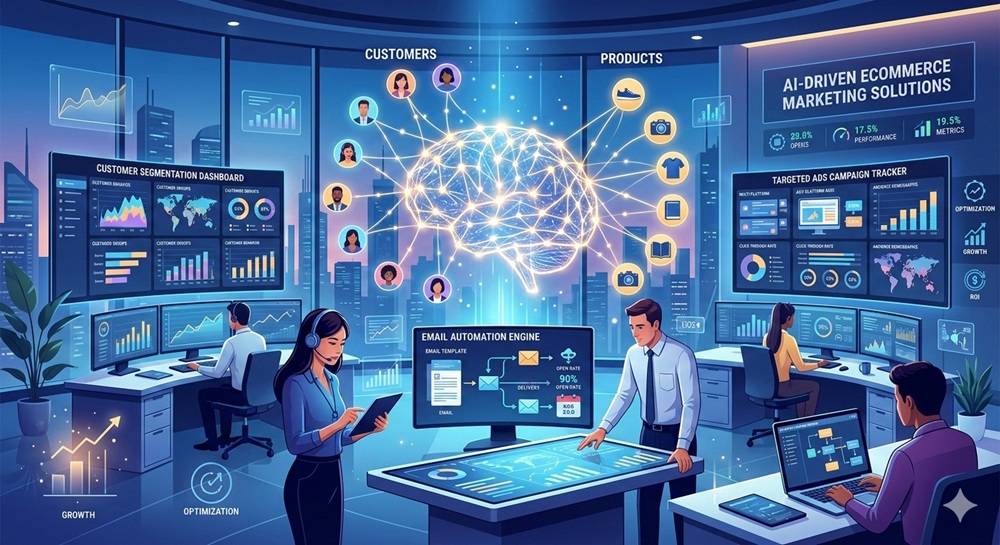
In simple terms, AI automation for eCommerce means using intelligent technologies such as machine learning, predictive analytics, and natural language processing to automate tasks that previously required human effort. These technologies enable online stores to understand customer behaviour, recommend relevant products, optimise pricing, and deliver personalised experiences automatically.
How AI Automation is Transforming E-commerce Businesses
Modern online retailers are using AI powered eCommerce solutions to streamline operations and make smarter decisions. AI systems can analyse millions of customer interactions in seconds and identify patterns that humans may not notice. This allows businesses to improve marketing strategies, optimise inventory, and create personalised customer journeys.
For example, AI-powered recommendation systems suggest products based on browsing history and purchase behaviour. These recommendations significantly influence customer decisions. Studies show that AI-driven product recommendations can generate up to 35% of eCommerce sales, demonstrating how powerful AI automation can be for increasing revenue.
AI is also transforming customer service. AI chatbots can instantly answer customer questions, guide shoppers through product choices, and assist with order tracking. In fact, research shows that AI chatbots now handle around 60% of customer service queries and resolve many issues within minutes, improving response time and reducing operational costs for online retailers.
Because of these capabilities, AI automation tools for online stores are no longer optional. They are becoming essential for businesses that want to compete in the modern digital marketplace.
Growing Demand for Personalised Shopping Experiences
One of the biggest reasons businesses are adopting eCommerce AI solutions is the growing demand for personalised shopping experiences. Today’s consumers expect online stores to understand their preferences and offer relevant products, discounts, and recommendations.
Research shows that 75% of customers are more likely to buy from websites that provide personalised experiences, while personalised product recommendations significantly increase customer satisfaction and engagement.
Another industry study reveals that 67% of online shoppers expect brands to personalise their shopping experiences, and retailers that use AI-driven personalisation often see higher customer retention and sales growth.
This shift in consumer expectations means businesses must adopt intelligent technologies to deliver personalised experiences at scale. AI makes this possible by analysing large amounts of customer data and automatically tailoring recommendations, emails, promotions, and search results for each shopper.
Why Modern Online Stores Must Adopt AI-Powered Automation
The competition in e-commerce is increasing every year. Thousands of new online stores enter the market daily, making it difficult for businesses to attract and retain customers. This is where AI powered eCommerce automation becomes a competitive advantage.
AI automation helps online retailers in several important ways:
- Automating repetitive tasks such as customer support and order processing
- Delivering personalised product recommendations
- Optimising pricing strategies using real-time data
- Predicting customer demand and managing inventory more efficiently
- Improving marketing campaigns through intelligent customer targeting
These improvements directly impact business performance. Studies show that AI-driven personalisation can increase e-commerce revenues by 10–15% and significantly improve conversion rates.
Additionally, the global market for AI in e-commerce is growing rapidly. Industry research indicates that the AI ecommerce market was valued at over $5 billion and is expected to grow at more than 24% annually through 2030, highlighting how quickly businesses are investing in intelligent automation technologies.
This growth clearly shows that AI automation is shaping the future of digital commerce.
Key Statistics About AI Adoption in E-commerce
Several industry reports highlight how quickly AI is being adopted by online retailers:
- Around 89% of retailers are already using or testing AI technologies in their e-commerce operations.
- Approximately 71% of eCommerce websites now offer AI-driven product recommendations.
- AI-based personalisation can increase conversion rates by 15–20% for online stores.
- Many retailers report higher customer lifetime value and improved retention after implementing AI solutions.
These statistics demonstrate that AI automation is not just a technological trend. It is becoming a critical strategy for improving customer experience and business growth in e-commerce.
Cor Advance Solutions: Helping Businesses Implement AI Automation
At Cor Advance Solutions, we help businesses adopt AI automation for eCommerce to improve efficiency, increase sales, and deliver personalised customer experiences. Our team focuses on building practical eCommerce AI solutions that are affordable, scalable, and easy to integrate with existing platforms.
We provide a range of AI automation tools for online stores, including:
- AI-powered customer support chatbots
- Intelligent product recommendation systems
- Automated marketing and customer segmentation
- Predictive analytics for demand forecasting
- AI-driven data insights for smarter business decisions
Our goal is to help small and medium-sized businesses harness the power of AI powered eCommerce technologies so they can compete with larger retailers and grow faster in the digital marketplace.
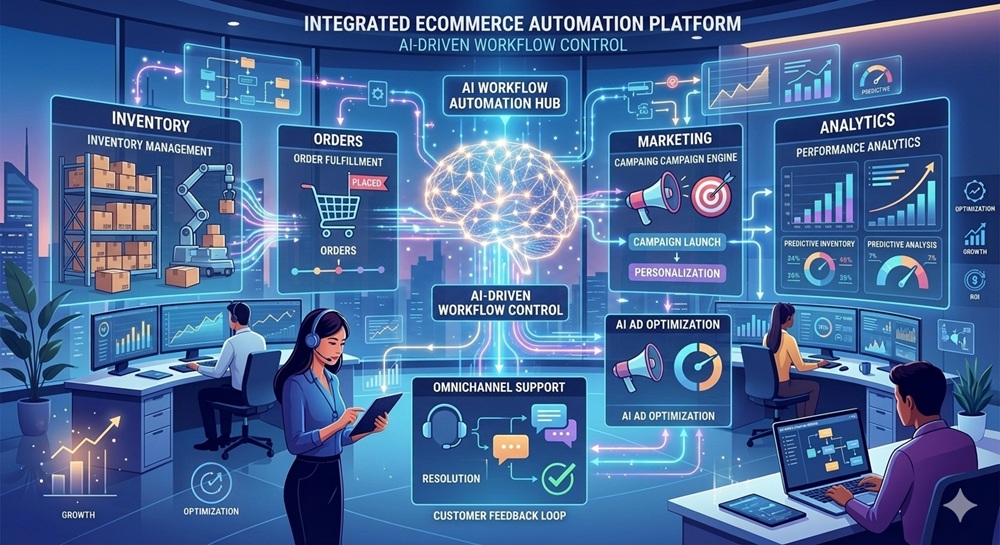
By combining advanced technology with real business expertise, Cor Advance Solutions enables companies to automate operations, personalise customer experiences, and unlock new opportunities for growth.
2. What is AI Automation in E-commerce?
AI automation in e-commerce means using Artificial Intelligence (AI) together with automated systems to manage and improve online store operations. Instead of relying only on human effort, intelligent systems analyse data, learn patterns, and automatically perform many tasks.
In simple terms, AI powered ecommerce automation allows online stores to work smarter. It helps businesses analyse customer behaviour, automate marketing campaigns, manage inventory, recommend products, and improve customer support.
Modern online stores generate large amounts of data every day. AI systems study this data and understand how customers behave — what they search for, what they buy, and how they interact with a website. Using this information, businesses can create better shopping experiences and increase sales.
Because of these advantages, many companies are now adopting AI driven online shopping technologies to stay competitive in the fast-growing digital market.
2.1 Definition of AI Automation
Explanation of Artificial Intelligence + Automation in Online Retail
AI automation combines two powerful technologies:
Artificial Intelligence (AI)
Artificial Intelligence refers to computer systems that can analyse data, recognise patterns, and make decisions similar to human thinking.
Automation
Automation refers to technology that performs tasks automatically without constant human intervention.
When these two technologies are combined in online retail, they create AI powered ecommerce automation systems that can manage many business processes automatically.
For example, AI automation can:
- Recommend products to customers
- Analyse customer buying patterns
- Send personalised marketing emails
- Optimise product pricing
- Manage inventory levels
- Provide automated customer support
Instead of manually analysing thousands of customer interactions, AI systems can process this information within seconds. This allows businesses to deliver faster and more personalised experiences to shoppers.
As a result, AI driven online shopping platforms can provide better customer experiences while reducing operational costs.
Difference Between Traditional Automation vs AI-Driven Automation
Many online businesses already use automation tools, but traditional automation and AI automation work very differently.
Traditional Automation
Traditional automation works based on fixed rules. It performs tasks exactly as programmed and cannot adapt to new situations.
Examples include:
- Scheduled email campaigns
- Automatic order confirmation emails
- Fixed workflow processes
These systems follow predefined instructions and cannot learn from data.
AI-Driven Automation
AI automation is much more advanced. It uses data analysis and machine learning to learn from past behaviour and improve decisions over time.
Key differences include:
| Traditional Automation | AI-Driven Automation |
| Works on fixed rules | Learns from data and patterns |
| Cannot adapt easily | Continuously improves performance |
| Limited personalisation | Highly personalised experiences |
| Requires manual updates | Automatically adapts to new data |
For example:
A traditional system might send the same promotional email to every customer.
An AI powered ecommerce automation system can analyse each customer’s browsing and purchase history and send personalised product recommendations.
This intelligent approach is a key part of modern AI driven online shopping platforms.
2.2 How AI Automation Works in Online Stores
AI automation in online stores works through a combination of data collection, machine learning models, and predictive analysis. These technologies analyse customer behaviour and automatically make decisions that improve the shopping experience.
Here are the main components that power AI powered ecommerce automation.
Machine Learning Algorithms
Machine learning is the core technology behind most AI systems.
Machine learning algorithms analyse large amounts of data from online stores, including:
- Customer browsing behaviour
- Purchase history
- Product searches
- Time spent on product pages
- Shopping cart activity
By analysing this information, the system identifies patterns and predicts what customers are likely to buy.
For example, if customers who purchase a laptop often buy a laptop bag, the system will automatically recommend laptop bags to future buyers.
This intelligent recommendation process is widely used in AI driven online shopping platforms to increase sales and improve customer experience.
Data Analysis and Prediction Models
Online stores collect large volumes of customer data every day. AI systems analyse this data using advanced prediction models.
These models help businesses:
- Predict future product demand
- Identify popular products
- Optimise pricing strategies
- Improve inventory management
- Detect unusual purchasing behaviour
For example, if an AI system identifies that a particular product is becoming popular, the system can alert the business to increase stock levels before demand grows further.
This data-driven approach helps businesses make smarter decisions and reduce risks.
Such intelligent forecasting is an important feature of AI powered ecommerce automation.
AI-Driven Customer Behaviour Tracking
Understanding customer behaviour is essential for successful online retail.
AI systems continuously track how customers interact with an online store, including:
- Pages they visit
- Products they view
- Search queries
- Items added to the cart
- Purchase frequency
By analysing this behaviour, AI can predict customer preferences and personalise the shopping experience.
For example:
If a customer frequently searches for sports shoes, the website may automatically display sports shoe offers on the homepage.
This level of personalisation is one of the key advantages of AI driven online shopping.
It helps businesses show the right products to the right customers at the right time.
2.3 Key Technologies Behind AI Automation
Several advanced technologies power AI powered ecommerce automation systems. These technologies help businesses analyse data, understand customer behaviour, and automate decision-making processes.
Machine Learning
Machine learning allows computer systems to learn from historical data and improve performance over time.
In e-commerce, machine learning is used for:
- Product recommendations
- Demand forecasting
- Customer segmentation
- Fraud detection
- Dynamic pricing
As more data becomes available, machine learning models become more accurate. This allows AI driven online shopping platforms to deliver better results and personalised experiences.
Natural Language Processing (NLP)
Natural Language Processing is a technology that allows computers to understand and interpret human language.
In e-commerce, NLP is widely used in:
- AI chatbots
- Voice search systems
- Automated customer service
- Sentiment analysis of customer reviews
For example, AI chatbots can instantly answer common customer questions such as:
- Order tracking updates
- Product availability
- Return and refund policies
This reduces customer support workload and improves response times.
Predictive Analytics
Predictive analytics uses data analysis and statistical models to predict future outcomes.
In AI powered ecommerce automation, predictive analytics helps businesses:
- Forecast product demand
- Predict customer buying behaviour
- Identify high-value customers
- Optimise marketing campaigns
By predicting future trends, businesses can plan inventory, marketing strategies, and product promotions more effectively.
Recommendation Engines
Recommendation engines are one of the most powerful tools used in AI driven online shopping platforms.
These systems analyse customer data and suggest products that match individual preferences.
Common recommendation examples include:
- “Customers also bought”
- “Recommended for you”
- “Trending products”
- “Frequently bought together”
Recommendation engines improve customer engagement and help increase sales by showing relevant products to shoppers.
With the growth of digital commerce, AI powered ecommerce automation is becoming essential for businesses that want to scale operations, improve efficiency, and provide smarter AI driven online shopping experiences for their customers.
3. Why AI Automation is Essential for Modern E-commerce
The e-commerce industry is growing faster than ever. Every day, millions of customers shop online, compare products, read reviews, and expect quick service. Because of this rapid growth, managing an online store manually has become very difficult.
This is where AI powered ecommerce automation becomes extremely important. AI automation helps online businesses manage large amounts of data, improve customer experiences, and automate complex tasks that would otherwise require large teams.
Modern online stores must process customer data, handle orders, manage inventory, run marketing campaigns, and provide customer support at the same time. Doing all of this manually is slow, expensive, and inefficient.
With the help of AI driven online shopping technologies, businesses can automate these operations, make smarter decisions, and deliver personalised experiences that customers expect today.
AI automation is no longer just an advanced feature. It has become a necessity for e-commerce businesses that want to grow, stay competitive, and improve customer satisfaction.
3.1 Rising Customer Expectations
Today’s online shoppers expect fast, convenient, and personalised experiences. Customers no longer want to spend time searching through hundreds of products. They want websites to understand their needs and show them the most relevant options immediately.
This is why AI powered ecommerce automation plays a major role in modern online retail.
Demand for Instant Support
Customers expect immediate responses when they have questions about products, orders, or returns. Waiting hours for a reply can lead to frustration and lost sales.
AI automation helps businesses provide instant customer support through intelligent chatbots and automated help systems. These systems can answer common customer questions, track orders, and provide product information at any time of the day.
This allows businesses to offer 24/7 support, improving customer satisfaction while reducing the workload on support teams.
Personalised Shopping Experiences
Modern customers also expect personalised shopping experiences. They want websites to recommend products that match their interests and previous purchases.
AI systems analyse customer behaviour such as:
- Products viewed
- Past purchases
- Search history
- Shopping preferences
Using this data, AI driven online shopping platforms can recommend products that customers are more likely to buy.
This level of personalisation makes shopping easier and more enjoyable for customers, while also increasing sales for businesses.
3.2 Increasing Competition in Online Retail
The global e-commerce market is becoming extremely competitive. Thousands of online stores are launching every year, and customers have endless choices when buying products online.
Because of this competition, businesses must continuously improve their customer experience and operational efficiency.
Importance of Smart Automation to Stay Competitive
Companies that still rely on manual processes often struggle to keep up with faster and more advanced competitors.
This is where AI powered ecommerce automation provides a major advantage.
AI automation helps businesses:
- Analyse customer behaviour faster
- Optimise marketing campaigns
- Adjust product pricing automatically
- Recommend the right products to customers
- Improve inventory management
For example, AI systems can analyse market trends and automatically suggest which products should be promoted during certain seasons.
Businesses that use AI driven online shopping technologies can make smarter decisions based on real data rather than assumptions.
This allows them to respond quickly to market changes and stay ahead of competitors.
3.3 Data Explosion in E-commerce
E-commerce businesses generate huge amounts of data every day. This data comes from many sources, including:
- Customer browsing behaviour
- Product searches
- Purchase history
- Customer reviews
- Website interactions
- Marketing campaign results
Managing and analysing this large volume of data manually is almost impossible.
AI Helps Analyse Massive Customer Datasets
AI automation systems are designed to process and analyse massive datasets within seconds. These systems identify patterns and insights that would be very difficult for humans to detect.
For example, AI can identify:
- Which products are trending
- Which customers are most likely to buy again
- Which marketing campaigns generate the highest sales
- Which products customers frequently buy together
By analysing this information, AI powered ecommerce automation helps businesses make better decisions and improve their marketing strategies.
Data-driven insights also help businesses create highly targeted promotions that increase conversion rates.
This is one of the key reasons why AI driven online shopping systems are becoming essential in modern e-commerce.
3.4 Need for Operational Efficiency
Running an online store involves many daily tasks such as order processing, inventory management, customer communication, and marketing activities.
If these tasks are handled manually, they require significant time, effort, and staff resources.
Automation Reduces Manual Work and Operational Costs
AI automation helps businesses streamline operations by automating repetitive tasks.
For example, AI powered ecommerce automation can automatically:
- Update inventory levels after each sale
- Send order confirmation and shipping notifications
- Recommend products to customers
- Analyse marketing performance
- Detect unusual transactions to prevent fraud
By automating these processes, businesses can reduce manual work and focus more on strategic activities such as product development and business growth.
Automation also reduces operational costs because fewer manual resources are required to manage daily operations.
In addition, AI systems work continuously without breaks, ensuring that online stores operate efficiently at all times.
4. Key Benefits of AI Automation for E-commerce Businesses
AI technology is changing how online stores operate. With increasing competition and customer expectations, businesses need smarter tools to manage operations and improve customer experiences. This is where AI powered ecommerce automation becomes extremely valuable.
AI automation helps businesses analyse customer data, automate repetitive tasks, improve marketing strategies, and deliver highly personalised shopping experiences. Instead of relying only on manual work, businesses can use intelligent systems to make faster and more accurate decisions.
Modern AI driven online shopping platforms use machine learning, predictive analytics, and intelligent algorithms to improve nearly every part of the customer journey — from product discovery to checkout.
Below are some of the most important benefits of AI automation for e-commerce businesses.
4.1 Personalised Shopping Experience
One of the biggest advantages of AI in online retail is the ability to provide personalised shopping experiences. Today’s customers expect online stores to understand their preferences and recommend products that match their interests.
This is where ecommerce personalization AI plays a powerful role.
AI Recommends Products Based on Browsing Behaviour
AI systems track how customers interact with an online store. They analyse behaviour such as:
- Products viewed
- Search queries
- Purchase history
- Time spent on product pages
- Items added to the cart
Using this information, AI can predict what customers are most likely to buy.
For example, if a customer frequently searches for sports shoes, the system will start recommending similar products such as running shoes, fitness gear, or sports accessories.
These intelligent suggestions help customers discover relevant products quickly while increasing sales for the business.
Dynamic Product Suggestions
Modern online stores use AI recommendation engine ecommerce technology to create dynamic product suggestions.
These systems automatically display recommendations such as:
- “Recommended for you”
- “Customers also bought”
- “Frequently bought together”
- “Trending products”
These recommendations change dynamically based on real-time customer behaviour.
Dynamic suggestions not only improve user experience but also increase the chances of additional purchases.
This is one of the most powerful applications of AI powered ecommerce automation.
4.2 Increased Conversion Rates
Conversion rate is one of the most important performance metrics for any e-commerce business. It measures how many website visitors actually complete a purchase.
AI automation helps businesses improve conversion rates by optimising the entire customer journey.
AI Improves Customer Journey Optimisation
AI systems analyse how users move through an online store — from landing on the website to completing a purchase.
By studying this journey, AI can identify:
- Pages where customers leave the website
- Products that attract the most attention
- Steps that create friction during checkout
Using this data, businesses can optimise their website design, product pages, and checkout process.
For example, AI may suggest:
- Displaying personalised offers
- Highlighting popular products
- Showing limited-time discounts
- Simplifying checkout steps
These improvements create a smoother shopping experience and encourage more visitors to complete their purchases.
As a result, AI driven online shopping platforms often achieve higher conversion rates compared to traditional e-commerce websites.
4.3 24/7 Customer Support with AI Chatbots
Customer support is essential for building trust in e-commerce. However, providing round-the-clock support with human agents can be expensive and difficult.
AI automation solves this challenge through intelligent chatbots.
Automated Support Without Human Intervention
AI chatbots can automatically respond to common customer questions and provide instant assistance.
These chatbots can handle queries such as:
- Order tracking
- Product availability
- Delivery information
- Return and refund policies
- Payment issues
Because chatbots operate automatically, customers can receive support 24 hours a day, 7 days a week.
This improves customer satisfaction while reducing the workload on human support teams.
AI chatbots also learn from past conversations and continuously improve their responses. This makes them an essential part of AI powered ecommerce automation.
4.4 Smarter Inventory Management
Managing inventory efficiently is a major challenge for many e-commerce businesses. Overstocking wastes money, while stock shortages lead to lost sales.
AI automation helps businesses manage inventory more intelligently.
Predict Demand and Reduce Stockouts
AI systems analyse historical sales data, customer demand patterns, and seasonal trends to predict future product demand.
Using predictive analysis, AI can help businesses:
- Forecast product demand
- Maintain optimal stock levels
- Reduce excess inventory
- Prevent stock shortages
For example, if AI detects increasing demand for a particular product, the system can alert the business to restock before inventory runs out.
This helps businesses maintain product availability and avoid missed sales opportunities.
Efficient inventory management is a key advantage of AI powered ecommerce automation.
4.5 Automated Marketing Campaigns
Marketing plays a crucial role in attracting customers and increasing sales in e-commerce. However, managing marketing campaigns manually can require significant time and effort.
AI automation allows businesses to create highly effective automated ecommerce marketing strategies.
Email Automation
AI systems can automatically send personalised emails to customers based on their behaviour.
Examples include:
- Welcome emails for new customers
- Abandoned cart reminders
- Product recommendation emails
- Seasonal promotional campaigns
- Re-engagement emails for inactive customers
Because these emails are personalised, they are more likely to attract attention and encourage purchases.
AI Driven Product Recommendations
AI also improves marketing campaigns by recommending the most relevant products to each customer.
Instead of promoting the same products to everyone, AI analyses customer preferences and displays products that match individual interests.
For example:
- A customer who buys fitness products may receive recommendations for gym equipment.
- A customer who buys electronics may see offers for gadgets or accessories.
These personalised marketing strategies significantly increase engagement and sales.
This is why AI driven online shopping platforms rely heavily on AI recommendation engine ecommerce systems.
4.6 Fraud Detection and Security
Online fraud is a growing concern in e-commerce. Fraudulent transactions, fake accounts, and payment scams can cause serious financial losses for businesses.
AI automation plays an important role in improving security.
AI Detects Suspicious Transactions
AI systems continuously monitor transaction data and customer behaviour. They analyse patterns to detect unusual or suspicious activity.
For example, AI can identify situations such as:
- Multiple transactions from different locations
- Unusual purchase behaviour
- Sudden high-value transactions
- Suspicious payment patterns
When such activity is detected, the system can automatically flag the transaction for review or block it entirely.
This proactive approach helps businesses reduce fraud risks and protect both the company and its customers.
Security monitoring is another key benefit of AI powered ecommerce automation.
AI automation is transforming the way e-commerce businesses operate. From personalised shopping experiences to intelligent marketing and fraud prevention, AI provides powerful tools that improve efficiency and customer satisfaction.
By adopting AI powered ecommerce automation, online stores can increase conversion rates, optimise operations, and provide highly personalised AI driven online shopping experiences that modern customers expect.
5. AI Automation Use Cases in E-commerce
Artificial Intelligence is transforming how modern online stores operate. Instead of relying only on manual processes, businesses are now using AI powered ecommerce automation to improve efficiency, personalise shopping experiences, and increase sales.
From product recommendations to customer support and inventory management, AI is now used across many areas of online retail. These intelligent systems analyse customer data, learn patterns, and automatically make decisions that improve both the shopping experience and business performance.
Today, many successful AI driven online shopping platforms rely on automation to manage large volumes of customers, products, and transactions.
Below are some of the most important real-world use cases of AI automation in e-commerce.
5.1 AI Product Recommendation Engines
One of the most widely used applications of AI in e-commerce is the AI recommendation engine ecommerce system. These systems analyse customer behaviour and suggest products that match their interests.
Amazon-Style Recommendation Systems
Many online stores use recommendation systems similar to those used by large e-commerce platforms. These AI systems study customer activities such as:
- Products viewed
- Purchase history
- Search behaviour
- Shopping cart items
- Product ratings and reviews
Based on this information, the system predicts which products customers are most likely to buy.
For example, when a customer views a product, the system may show suggestions like:
- “Customers who bought this also bought”
- “Recommended for you”
- “Frequently bought together”
- “Similar products you may like”
These personalised suggestions improve the shopping experience and help customers discover relevant products quickly.
This approach is a key feature of ecommerce personalization AI and plays a major role in increasing sales and average order value.
5.2 AI Chatbots for Customer Support
Customer support is one of the most important aspects of any e-commerce business. Customers often need assistance with orders, product information, delivery updates, or return policies.
Providing quick responses to every query manually can be challenging, especially for large online stores.
Instant Customer Assistance
AI chatbots solve this problem by offering automated customer support.
AI-powered chatbots can instantly respond to common customer questions such as:
- Where is my order?
- What is the delivery time?
- How do I return a product?
- Is this product available in stock?
These chatbots operate continuously and provide support 24 hours a day, seven days a week.
Because chatbots use machine learning and natural language processing, they can understand customer questions and provide relevant answers quickly.
This makes them an essential component of AI powered ecommerce automation, helping businesses improve customer satisfaction while reducing support costs.
5.3 Dynamic Pricing Optimisation
Pricing is a critical factor in e-commerce success. If prices are too high, customers may choose competitors. If prices are too low, businesses may lose profit.
AI automation helps businesses optimise pricing strategies using data-driven insights.
AI Adjusts Product Prices Based on Demand
AI systems analyse several factors when adjusting prices, including:
- Customer demand
- Competitor pricing
- Market trends
- Inventory levels
- Seasonal demand
Based on this data, AI can automatically adjust product prices in real time.
For example:
If demand for a product suddenly increases, AI may slightly increase the price. If demand drops or competitors offer lower prices, AI may reduce the price to stay competitive.
This intelligent pricing strategy allows businesses to maximise profits while remaining competitive in the market.
Dynamic pricing is a powerful feature of AI driven online shopping platforms.
5.4 Smart Inventory Forecasting
Managing inventory effectively is one of the biggest challenges in e-commerce. Businesses must maintain the right balance between product availability and storage costs.
Too much inventory can lead to unnecessary expenses, while insufficient inventory can cause stock shortages and lost sales.
Prevent Overstocking and Stock Shortages
AI automation helps businesses predict future product demand more accurately.
AI systems analyse historical sales data, customer demand trends, and seasonal patterns to forecast how much inventory will be needed.
Using these predictions, businesses can:
- Maintain optimal stock levels
- Reduce excess inventory
- Prevent stock shortages
- Improve supply chain planning
For example, if AI detects increasing demand for winter clothing before the cold season begins, the system can recommend increasing stock levels in advance.
This predictive capability is an important advantage of AI powered ecommerce automation.
5.5 AI Powered Search and Voice Commerce
Product search is one of the most important features of any online store. Customers rely on search tools to quickly find the products they want.
However, traditional search systems often struggle to understand user intent, especially when customers use complex or conversational queries.
AI Improves Product Search Accuracy
AI-powered search systems use natural language processing and machine learning to better understand customer queries.
Instead of matching only exact keywords, AI systems understand the meaning behind search terms.
For example:
If a customer searches for “comfortable running shoes for beginners”, the AI system will show products that match the intent of the search rather than only exact keyword matches.
AI search systems can also:
- Correct spelling mistakes
- Suggest related products
- Provide smart autocomplete suggestions
- Understand conversational queries
This improves the overall shopping experience and helps customers find the right products faster.
Voice commerce is another growing trend in AI driven online shopping. Customers can use voice assistants to search for products, check order status, or place orders using voice commands.
This makes shopping more convenient and accessible.
AI automation is transforming the e-commerce industry by improving how online stores operate and interact with customers. Technologies such as AI recommendation engine ecommerce, intelligent chatbots, dynamic pricing systems, smart inventory forecasting, and AI-powered search help businesses provide faster, smarter, and more personalised shopping experiences.
By using AI powered ecommerce automation, businesses can improve efficiency, increase sales, and build highly engaging AI driven online shopping experiences that meet the expectations of modern customers.
6. AI Personalisation Strategies That Boost E-commerce Sales
Personalisation has become one of the most important factors in modern online retail. Today’s customers expect online stores to understand their needs and show products that match their interests. If shoppers see irrelevant products or generic offers, they are more likely to leave the website.
This is where AI personalization ecommerce strategies play a major role. Artificial Intelligence helps businesses analyse customer behaviour, preferences, and shopping patterns to create a personalized ecommerce experience for every visitor.
Instead of showing the same content to everyone, AI allows businesses to deliver tailored recommendations, targeted marketing messages, and customised website experiences.
By using AI powered ecommerce automation, businesses can understand customer intent more accurately and improve engagement, conversions, and overall sales.
Below are some powerful AI personalisation strategies used by successful AI driven online shopping platforms.
6.1 Personalised Product Recommendations
One of the most effective ways to increase e-commerce sales is through personalised product recommendations.
AI systems analyse customer behaviour such as:
- Products viewed
- Previous purchases
- Search queries
- Items added to the cart
- Time spent on product pages
Based on this information, AI predicts which products customers are most likely to purchase.
These recommendations are usually displayed in sections such as:
- “Recommended for you”
- “Customers also bought”
- “Frequently bought together”
- “You may also like”
This strategy improves the personalized ecommerce experience by helping customers discover products that match their interests.
It also increases the chances of additional purchases, making personalised recommendations one of the most powerful tools in AI personalization ecommerce.
6.2 Behaviour-Based Email Marketing
Email marketing remains one of the most effective channels for e-commerce businesses. However, sending the same promotional email to every customer is no longer effective.
AI automation allows businesses to send emails based on customer behaviour.
For example, AI can automatically send emails when:
- A customer abandons their shopping cart
- A customer views a product but does not purchase it
- A customer has not visited the store for a long time
- A customer completes a purchase
These behaviour-based emails can include personalised product suggestions, special discounts, or reminders.
Because these emails are highly relevant to the customer’s interests, they generate higher engagement and conversion rates.
This approach uses AI based customer targeting to deliver the right message to the right customer at the right time.
6.3 Smart Retargeting Campaigns
Many customers visit online stores but leave without making a purchase. Retargeting campaigns help businesses bring these customers back.
AI automation improves retargeting by analysing customer behaviour and showing personalised advertisements across different platforms.
For example, if a customer visits a product page but does not complete the purchase, AI can display targeted ads for that product on social media platforms or other websites.
These ads may include:
- Special offers
- Limited-time discounts
- Product reminders
- Similar product suggestions
This intelligent strategy increases the chances of converting visitors into customers.
Smart retargeting campaigns are a key component of AI personalization ecommerce, helping businesses recover potential lost sales.
6.4 Personalised Landing Pages
Personalised landing pages are another powerful strategy used in AI driven online shopping platforms.
Instead of showing the same homepage to every visitor, AI systems customise website content based on user behaviour and preferences.
For example:
- Returning customers may see products related to their previous purchases.
- New visitors may see trending or best-selling products.
- Customers from different locations may see region-specific offers.
AI systems analyse visitor data in real time and adjust the content automatically.
This creates a highly personalized ecommerce experience, making customers feel that the store understands their needs.
Personalised landing pages also improve user engagement and increase the likelihood of conversions.
6.5 AI-Driven Customer Segmentation
Customer segmentation is the process of grouping customers based on their behaviour, interests, and purchasing patterns.
Traditional segmentation methods often rely on basic data such as age, gender, or location. However, AI can analyse much deeper behavioural patterns.
Using AI based customer targeting, businesses can segment customers based on factors such as:
- Purchase frequency
- Average order value
- Product preferences
- Browsing behaviour
- Engagement with marketing campaigns
For example, AI may identify groups such as:
- High-value loyal customers
- First-time buyers
- Price-sensitive shoppers
- Customers interested in specific product categories
Once these segments are identified, businesses can create targeted marketing campaigns and personalised offers for each group.
This advanced segmentation improves marketing efficiency and helps businesses deliver a better personalized ecommerce experience.
7. Real Examples of AI Automation in E-commerce
AI technology is already transforming the global e-commerce industry. Many leading online retailers are using AI powered ecommerce automation to improve customer experience, increase efficiency, and drive higher sales.
From product recommendations to automated marketing and smart inventory management, AI helps businesses analyse large amounts of customer data and make faster decisions. These technologies allow companies to create a more personalised and seamless AI driven online shopping experience.
Below are some real examples and case studies showing how major retailers use AI automation to increase revenue and improve customer engagement.
How Major Retailers Use AI to Increase Revenue
Many large e-commerce companies use AI to understand customer behaviour and deliver personalised shopping experiences.
One of the most common applications is the AI recommendation engine ecommerce system. These systems analyse customer browsing history, previous purchases, and product interactions to recommend relevant items.
For example, when a customer views a product, the website may instantly display suggestions such as:
- Customers also bought
- Recommended for you
- Similar products you may like
- Frequently bought together
These personalised suggestions encourage customers to explore more products and often lead to additional purchases.
This strategy significantly increases the average order value and helps retailers generate more revenue through AI personalization ecommerce.
Example Case Studies
Personalised Product Recommendations
Many online retailers use AI recommendation systems to guide customers towards products they are most likely to purchase.
When customers visit a website, AI systems analyse their behaviour in real time. Based on this analysis, the platform automatically adjusts product suggestions, banners, and promotional offers.
For example, if a customer frequently searches for fitness equipment, the system may start showing recommendations for workout gear, sports clothing, or health accessories.
This level of personalisation creates a highly personalized ecommerce experience, which increases the chances of conversion.
AI Chatbots Improving Customer Support
Another common use of AI powered ecommerce automation is intelligent customer support through chatbots.
Many online stores now use AI chatbots to answer customer questions instantly. These chatbots can handle tasks such as:
- Order tracking
- Product information
- Delivery updates
- Return and refund assistance
Because chatbots are available 24 hours a day, customers receive immediate support without waiting for human agents.
This improves customer satisfaction while reducing operational costs for businesses.
AI-Driven Marketing Campaigns
Retailers also use AI to optimise marketing strategies and reach the right customers with the right offers.
AI systems analyse customer behaviour to send personalised marketing messages through email, advertisements, and product recommendations.
For example, if a customer abandons their shopping cart, the system may automatically send an email reminder with a discount offer.
Similarly, AI can display targeted advertisements based on customer interests and browsing history.
These automated strategies help businesses attract returning customers and increase overall sales through AI based customer targeting.
Impact on Customer Engagement and Sales
The use of AI automation has significantly improved how businesses interact with customers.
AI-powered systems make online shopping more convenient, personalised, and efficient. Customers can quickly find products that match their interests, receive instant support, and discover relevant recommendations.
As a result, businesses benefit from:
- Higher customer engagement
- Increased conversion rates
- Improved customer loyalty
- Higher average order value
By implementing AI powered ecommerce automation, businesses can create more engaging AI driven online shopping experiences that meet the expectations of modern consumers.
Real-world examples clearly show how AI is transforming e-commerce operations. From personalised product recommendations and intelligent chatbots to automated marketing campaigns, AI technologies help businesses improve efficiency and drive revenue growth.
By adopting AI powered ecommerce automation and AI personalization ecommerce strategies, retailers can deliver a smarter and more engaging personalized ecommerce experience, ultimately increasing both customer satisfaction and sales.
8. Challenges of Implementing AI Automation
Although AI powered ecommerce automation offers many benefits, implementing it in an online business is not always simple. Many e-commerce companies face several challenges when adopting AI technologies. These challenges may include poor data quality, difficulty integrating AI with existing systems, high technology costs, and a shortage of skilled AI professionals.
However, with the right strategy and planning, businesses can overcome these obstacles and successfully use AI to improve their AI driven online shopping platforms.
Below are the most common challenges businesses face when implementing AI automation in e-commerce.
8.1 Data Quality Issues
AI systems depend heavily on data to learn patterns and make accurate predictions. If the data used is incomplete, outdated, or inaccurate, the AI system may produce incorrect results.
For example, if customer purchase data is missing or incorrect, an AI recommendation engine ecommerce system may suggest irrelevant products. This can negatively affect the personalized ecommerce experience and reduce customer satisfaction.
Poor data quality may occur due to several reasons such as inconsistent data collection, duplicate records, or outdated information.
Solution
To overcome this challenge, businesses must focus on improving data management practices. This includes:
- Regularly cleaning and updating customer data
- Removing duplicate or incorrect records
- Collecting accurate data from reliable sources
- Using proper data storage and management systems
High-quality data ensures that AI personalization ecommerce systems work more effectively and deliver accurate insights.
8.2 Integration with Existing Systems
Many e-commerce businesses already use different software systems such as inventory management tools, customer databases, and payment systems.
Integrating AI automation with these existing systems can sometimes be complicated. If systems are not compatible, businesses may face difficulties connecting AI tools with their current platforms.
For example, integrating AI powered ecommerce automation with older e-commerce software may require additional technical adjustments.
Solution
Businesses should choose AI solutions that support easy integration with their existing platforms. Many modern AI tools offer APIs and flexible integration options that allow businesses to connect AI systems with their current infrastructure.
Working with experienced technology partners or developers can also make the integration process smoother and more efficient.
8.3 Cost of AI Technology
Implementing AI solutions can require significant investment, especially for small and medium-sized businesses. Costs may include purchasing AI software, developing custom AI systems, upgrading infrastructure, and maintaining the technology.
Some businesses hesitate to adopt AI because they believe the technology is too expensive.
Solution
Today, many cloud-based AI platforms offer affordable solutions that allow businesses to adopt AI gradually. Instead of building complex systems from scratch, companies can start with smaller AI applications such as chatbots or product recommendation tools.
As the business grows, more advanced AI powered ecommerce automation solutions can be implemented.
This step-by-step approach helps businesses manage costs while still benefiting from AI driven online shopping technologies.
8.4 Lack of AI Expertise
Another major challenge is the shortage of skilled professionals who understand AI technologies. Developing and managing AI systems requires expertise in machine learning, data analysis, and automation tools.
Many e-commerce businesses may not have in-house teams with the required technical skills.
Solution
To overcome this challenge, businesses can work with AI solution providers or technology consultants who specialise in AI implementation.
Companies can also invest in training their existing teams to understand AI tools and data analytics. Many modern AI platforms are designed with user-friendly interfaces that allow businesses to manage automation without advanced technical knowledge.
By developing the right skills and partnerships, businesses can successfully implement AI personalization ecommerce strategies and improve AI based customer targeting.
9. How Small and Medium Businesses Can Use AI Automation
AI technology is no longer limited to large corporations. Today, small and medium-sized businesses (SMEs) can also use AI powered ecommerce automation to improve efficiency, increase sales, and deliver better customer experiences.
Modern AI tools are becoming more affordable and easier to use. This allows growing online stores to automate many important business processes such as customer support, marketing campaigns, product recommendations, and inventory management.
By adopting smart automation strategies, SMEs can compete with larger companies and create a more advanced AI driven online shopping experience for their customers.
Below are some practical ways small and medium businesses can use AI automation.
Affordable AI Tools for SMEs
One of the biggest advantages for SMEs today is the availability of affordable AI tools. Many AI platforms offer cloud-based solutions that do not require expensive infrastructure or large technical teams.
These tools allow businesses to start using AI personalization ecommerce features without heavy investment.
Some common AI tools used by small and medium online stores include:
- AI chatbots for automated customer support
- AI recommendation engine ecommerce systems for product suggestions
- Email marketing automation tools for personalised campaigns
- AI powered search tools for better product discovery
- Smart analytics platforms for customer behaviour analysis
These tools help businesses automate routine tasks, save time, and improve the personalized ecommerce experience for customers.
Because many AI platforms operate on subscription models, businesses can start small and scale their automation as their store grows.
Scalable AI Automation Strategies
For small and medium businesses, it is important to adopt AI gradually rather than trying to automate everything at once.
A scalable approach allows businesses to test AI tools, measure results, and expand automation step by step.
For example, an online store may begin with simple automation such as:
- AI chatbots for answering customer questions
- Automated email campaigns for abandoned carts
- Basic product recommendation systems
Once these systems start improving engagement and sales, the business can expand AI usage into more advanced areas such as:
- Customer behaviour prediction
- Dynamic pricing optimisation
- Smart inventory forecasting
- Advanced AI based customer targeting for marketing campaigns
This step-by-step strategy helps SMEs manage costs while building a strong AI powered ecommerce automation system over time.
Benefits for Growing Online Stores
Implementing AI automation provides several important advantages for growing e-commerce businesses.
Improved Customer Experience
AI helps businesses understand customer behaviour and deliver personalised shopping journeys. This creates a stronger personalized ecommerce experience, which encourages customers to stay longer and explore more products.
Higher Sales and Conversions
Personalised recommendations, targeted marketing campaigns, and smart automation can significantly increase sales. AI systems help businesses show the right products to the right customers at the right time.
Reduced Operational Workload
AI automation can handle repetitive tasks such as responding to customer queries, analysing data, and sending marketing emails. This reduces manual work and allows business owners to focus on strategy and growth.
Better Marketing Performance
With AI based customer targeting, businesses can reach specific customer groups with personalised offers and promotions. This improves marketing efficiency and increases return on investment.
Scalable Business Growth
As online stores grow, managing large volumes of data and customer interactions becomes difficult. AI automation helps businesses scale operations efficiently while maintaining high-quality customer service.
AI automation is becoming an essential tool for small and medium e-commerce businesses. With the availability of affordable tools and scalable solutions, SMEs can now adopt AI powered ecommerce automation without large investments.
By using technologies such as AI personalization ecommerce, intelligent chatbots, and AI recommendation engine ecommerce systems, growing businesses can create smarter and more engaging AI driven online shopping experiences.
This allows small and medium online stores to compete effectively in the modern digital marketplace while improving efficiency, customer satisfaction, and long-term business growth.
10. Future of AI Automation in E-commerce
The future of online retail is strongly connected to Artificial Intelligence. As technology continues to evolve, AI powered ecommerce automation will become even more advanced and widely used by online businesses.
AI is already helping companies automate processes, analyse customer data, and improve the personalized ecommerce experience. In the coming years, these technologies will become smarter, faster, and more accurate.
Businesses that adopt these innovations early will be able to create highly engaging AI driven online shopping experiences and stay ahead of competitors.
Below are some important trends that will shape the future of AI automation in e-commerce.
10.1 Hyper-Personalised Shopping
Personalisation is already an important part of online retail, but the future will bring hyper-personalised shopping experiences.
In hyper-personalisation, AI systems analyse much deeper customer data, including:
- Browsing behaviour
- Purchase history
- Search patterns
- Time spent on products
- Customer preferences and interests
Using this information, AI can deliver highly tailored product suggestions and shopping experiences for each individual customer.
For example, an online store may show different homepage layouts, product recommendations, and special offers to different users based on their behaviour.
This advanced level of AI personalization ecommerce will help businesses create a highly personalized ecommerce experience, making customers feel understood and valued.
10.2 AI Powered Visual Search
Visual search is another technology that is rapidly growing in e-commerce.
Instead of typing keywords, customers can simply upload an image of a product they like. The AI system will analyse the image and find similar products available in the store.
For example, if a customer uploads a picture of a handbag or a pair of shoes, the AI system will automatically identify the product style, colour, and design, then show matching items.
This technology improves product discovery and makes shopping easier for customers.
Visual search is expected to become a major feature in AI driven online shopping platforms because it simplifies the process of finding products.
10.3 Voice Commerce Growth
Voice technology is also changing the way people shop online. Many customers now use voice assistants to search for products, ask questions, and make purchases.
Voice commerce allows users to interact with online stores using simple voice commands.
For example, customers may say:
- “Find running shoes under £50”
- “Order my favourite coffee again”
- “Track my recent order”
AI systems understand these voice commands using natural language processing and deliver relevant results.
As voice technology becomes more advanced, it will play a larger role in AI powered ecommerce automation by making shopping faster and more convenient.
10.4 Autonomous E-commerce Operations
In the future, many e-commerce operations will become highly automated and require minimal human intervention.
AI systems will be able to manage many important business functions automatically, including:
- Inventory management
- Product recommendations
- Marketing campaigns
- Customer service support
- Fraud detection
- Demand forecasting
For example, AI may automatically adjust marketing campaigns based on customer engagement, reorder products when inventory is low, or detect unusual transactions in real time.
These fully automated systems will allow businesses to operate more efficiently while reducing operational costs.
Autonomous operations represent the next stage of AI powered ecommerce automation, helping businesses create faster and more intelligent AI driven online shopping environments.
11. How Cor Advance Solutions Helps Businesses Implement AI Automation
Many businesses understand the benefits of Artificial Intelligence, but they often struggle to implement it correctly. AI systems require the right strategy, proper data management, and seamless integration with existing business platforms.
This is where Cor Advance Solutions helps businesses transform their operations using AI powered ecommerce automation. The company focuses on delivering practical and affordable AI solutions that help businesses improve efficiency, increase sales, and create better customer experiences.
By combining technology expertise with business understanding, Cor Advance Solutions helps online stores build smarter AI driven online shopping platforms that can grow and scale easily.
Below are some key ways Cor Advance Solutions supports businesses in implementing AI automation.
Custom AI Automation Solutions
Every e-commerce business has different goals, challenges, and customer behaviour patterns. A one-size-fits-all AI solution may not deliver the best results.
Cor Advance Solutions develops custom AI automation solutions that are designed specifically for each business. These systems are built after analysing the company’s operations, customer data, and growth objectives.
Custom automation can help businesses automate many important tasks such as:
- Product recommendations
- Customer behaviour analysis
- Marketing campaign optimisation
- Demand forecasting
- Sales performance tracking
With tailored AI powered ecommerce automation, businesses can operate more efficiently and deliver a stronger personalized ecommerce experience to their customers.
AI Powered E-commerce Integrations
Many businesses already use different tools and platforms to manage their online stores. These may include e-commerce platforms, inventory systems, payment gateways, and customer management software.
Cor Advance Solutions helps businesses integrate AI technology smoothly with these existing systems.
These AI powered ecommerce integrations allow businesses to connect automation tools with their current platforms without disrupting daily operations.
Once integrated, AI systems can analyse business data in real time and automate several processes, improving the overall performance of the AI driven online shopping environment.
AI Chatbot Development
Customer support is a critical part of any online business. Customers expect fast responses when they ask questions about products, orders, or deliveries.
Cor Advance Solutions develops intelligent AI chatbots that provide instant support to customers.
These chatbots can automatically handle many customer queries, including:
- Product information
- Order tracking
- Delivery updates
- Return and refund guidance
- Frequently asked questions
By implementing AI chatbots, businesses can offer 24/7 customer support without increasing operational costs.
This improves customer satisfaction while allowing businesses to focus on other important activities.
Data-Driven Personalisation Systems
Modern online shoppers expect personalised experiences when they visit an e-commerce website. AI helps businesses analyse customer behaviour and deliver highly relevant product suggestions.
Cor Advance Solutions builds data-driven personalisation systems that use advanced analytics and machine learning to understand customer preferences.
These systems support:
- AI recommendation engine ecommerce solutions
- Behaviour-based product suggestions
- Personalised promotions and offers
- Smart customer segmentation
- Advanced AI based customer targeting
By implementing AI personalization ecommerce strategies, businesses can create a highly engaging personalized ecommerce experience that increases customer loyalty and sales.
Automation for Marketing and Operations
Marketing and operational tasks often require significant time and effort. AI automation helps businesses streamline these activities and make smarter decisions.
Cor Advance Solutions provides automation tools that support both marketing and operational processes.
These solutions can help businesses automate:
- Email marketing campaigns
- Customer segmentation and targeting
- Advertising optimisation
- Inventory forecasting
- Sales and demand analysis
With these automation systems, businesses can reduce manual work, improve efficiency, and focus on strategic growth.
This approach enables companies to build scalable AI powered ecommerce automation systems that support long-term success in the evolving world of AI driven online shopping.
Implementing AI automation can be complex, but with the right partner, businesses can adopt these technologies successfully.
Cor Advance Solutions helps companies implement AI powered ecommerce automation through custom AI solutions, smart integrations, intelligent chatbots, and advanced AI personalization ecommerce systems.
By leveraging data-driven insights and automation tools, businesses can create powerful AI driven online shopping experiences that improve customer engagement, increase sales, and support sustainable business growth.
12. Best Practices for Implementing AI Automation
Implementing AI automation in e-commerce can greatly improve efficiency, customer experience, and sales. However, to achieve the best results, businesses must follow the right strategy. Successful companies focus on planning, quality data, and continuous improvement when adopting AI powered ecommerce automation. Below are some proven best practices that help businesses implement AI solutions effectively.
1. Start with Clear Business Goals
Before adopting any AI automation technology, businesses should clearly define their objectives. AI tools should solve real problems such as improving customer support, increasing conversions, or optimising inventory management.
For example, if an online store wants to increase sales, it can use AI personalization ecommerce tools to recommend relevant products to customers. When goals are clear, companies can choose the right AI solution and measure results more accurately.
2. Collect and Organise Quality Customer Data
AI systems rely heavily on data. Without clean and structured data, even the most advanced AI driven ecommerce automation will not perform well.
Businesses should collect useful customer information such as:
- Purchase history
- Browsing behaviour
- Product preferences
- Customer feedback
Organising this data helps AI systems create a personalized ecommerce experience and deliver more accurate product recommendations, targeted marketing campaigns, and better customer insights.
3. Choose the Right AI Automation Tools
There are many AI tools available for e-commerce businesses. Choosing the right tool depends on the store’s size, budget, and business goals.
Popular AI solutions include:
- AI recommendation engines
- AI chatbots for customer support
- Dynamic pricing systems
- Smart inventory forecasting tools
The right AI automation tools can improve operational efficiency and create a smoother AI driven online shopping experience for customers.
4. Integrate AI with Marketing and CRM Systems
For maximum impact, AI powered ecommerce automation should be integrated with marketing platforms and CRM systems. This integration allows businesses to use customer data more effectively and automate marketing activities.
For example, AI can analyse customer behaviour and automatically trigger:
- Personalised email campaigns
- Smart retargeting ads
- Product recommendations on websites
This creates a more personalized ecommerce experience, which helps increase customer engagement and conversion rates.
5. Continuously Monitor AI Performance
AI automation is not a one-time setup. Businesses must continuously monitor how their AI systems perform and improve them over time.
Key performance metrics to track include:
- Conversion rates
- Customer engagement
- Email open rates
- Product recommendation accuracy
By analysing these metrics, companies can refine their AI personalization ecommerce strategies and ensure that automation continues to deliver strong results.
13. FAQ
What is AI automation in eCommerce?
AI automation in eCommerce refers to using artificial intelligence to automatically manage and improve online store operations. It helps businesses analyse customer data, automate marketing, recommend products, and manage inventory. With AI automation, online stores can work faster and make smarter decisions. This improves customer experience and increases overall efficiency.
How does AI increase eCommerce sales?
AI increases eCommerce sales by analysing customer behaviour and suggesting the most relevant products. It powers personalised recommendations, dynamic pricing, and targeted marketing campaigns. These strategies encourage customers to buy more products during their shopping journey. As a result, businesses see higher conversion rates and increased revenue.
How does AI personalize online shopping experiences?
AI personalizes online shopping by analysing customer browsing history, purchase behaviour, and preferences. It then shows tailored product recommendations, personalised offers, and relevant content. This creates a more engaging and convenient shopping journey for customers. Personalization helps businesses improve customer satisfaction and build stronger brand loyalty.
What AI tools are used in eCommerce?
Common AI tools used in eCommerce include recommendation engines, AI chatbots, predictive analytics systems, dynamic pricing tools, and visual search technology. These tools help businesses automate customer support, understand buying behaviour, and optimise marketing campaigns. Many online stores also use AI for smart inventory forecasting. Together, these tools improve efficiency and sales performance.
Is AI automation expensive for small businesses?
AI automation is becoming more affordable for small businesses as many cloud-based AI tools offer flexible pricing plans. Businesses can start with basic AI features such as chatbots or email automation. These tools help save time and improve customer engagement without large investments. Over time, small businesses can scale their AI automation as they grow.
How do AI chatbots help online stores?
AI chatbots provide instant customer support on eCommerce websites and apps. They can answer common questions, recommend products, and guide customers through the buying process. Chatbots work 24/7, which improves response time and customer satisfaction. This helps businesses reduce support costs and increase conversions.
Can AI predict customer buying behaviour?
Yes, AI can predict customer buying behaviour by analysing large amounts of customer data. It studies browsing patterns, past purchases, and interaction history to identify buying trends. This allows businesses to recommend the right products at the right time. Predictive AI helps companies improve marketing strategies and increase sales opportunities.
What is the future of AI in eCommerce?
The future of AI in eCommerce includes hyper-personalized shopping, voice commerce, smart automation, and advanced predictive analytics. AI will help businesses automate more operations and deliver highly customised experiences. Technologies like visual search and AI assistants will make online shopping faster and easier. As AI continues to evolve, it will become a core part of every successful eCommerce business.
14. Conclusion
AI automation is rapidly transforming the eCommerce industry and changing the way online businesses operate. With the rise of AI powered ecommerce automation, companies can automate many time-consuming tasks such as customer support, product recommendations, marketing campaigns, and inventory management. This allows businesses to focus more on strategy and growth while technology handles repetitive operations.
One of the biggest advantages of AI automation is its ability to create highly personalised shopping experiences. Using technologies like ecommerce personalization AI, businesses can analyse customer behaviour, understand preferences, and recommend the most relevant products. This makes AI driven online shopping more engaging, convenient, and enjoyable for customers, which ultimately increases trust and brand loyalty.
In today’s highly competitive online retail market, companies that adopt AI automation gain a strong competitive advantage. Smart automation helps businesses respond faster to customer needs, optimise pricing strategies, and deliver the right products to the right customers at the right time. As a result, businesses experience higher conversion rates, improved customer satisfaction, and stronger long-term growth.
Another important benefit of AI automation is operational efficiency. From automated marketing campaigns to intelligent inventory forecasting, AI powered ecommerce automation helps reduce manual work and minimise operational costs. Businesses can make data-driven decisions, manage resources more effectively, and scale their operations without significantly increasing expenses.
As digital commerce continues to evolve, AI will play an even bigger role in shaping the future of online retail. Companies that invest in AI driven online shopping technologies today will be better prepared to meet the expectations of modern consumers and stay ahead of their competitors.
Businesses looking to increase sales, automate daily operations, and deliver a truly personalised shopping experience should consider implementing AI powered ecommerce automation.
Partnering with Cor Advance Solutions can help your business unlock the full potential of AI by implementing smart automation systems, personalised recommendation engines, and intelligent customer engagement tools designed to support long-term eCommerce growth.