
1. Introduction: Why Secure Transactions Are Critical in Modern Logistics
The global logistics industry is the backbone of international trade. Every day, millions of shipments move between manufacturers, warehouses, ports, and customers across multiple countries. As global trade continues to expand, supply chains are becoming more complex and digital. While this digital transformation improves efficiency, it also creates serious challenges related to data security, fraud prevention, and transaction transparency.
Today, logistics companies must ensure that every shipment record, payment, and contract is secure, verifiable, and tamper-proof. This is where blockchain for secure transactions in logistics is becoming a powerful solution.

Rapid Growth of Global Logistics and Complex Supply Chains
Global trade and logistics networks are expanding faster than ever. Businesses now depend on complex supply chains involving multiple partners such as manufacturers, freight carriers, customs authorities, warehouses, and distributors.
According to logistics market research, the blockchain in logistics market is expected to grow from around USD 4.1 billion in 2025 to USD 37.2 billion by 2035, showing strong adoption of blockchain technology for improving transparency and security in supply chains.
This growth highlights how companies are actively searching for technologies that can manage complex transactions across global networks.
However, modern supply chains face several major challenges:
- Multiple intermediaries handling logistics data
- Cross-border documentation requirements
- Payment verification between partners
- Real-time tracking of goods and transactions
Without a reliable system, these operations can easily become inefficient or vulnerable to manipulation.
Increasing Cybersecurity Risks, Fraud, and Data Manipulation in Logistics
As logistics systems become digital, cyber threats and fraud risks are rising rapidly.
Industry reports show that:
- Global supply chain fraud losses could exceed $6 billion globally in 2025.
- Over 40% of supply chain cyber-attacks originate from third-party vendors.
- Cargo theft and logistics fraud incidents are increasing globally as attackers exploit digital platforms.
These threats create major problems for logistics companies:
- Fake shipping documentation
- Manipulated delivery records
- Payment fraud in freight transactions
- Data breaches affecting customer information
Traditional IT systems struggle to protect logistics operations because they rely heavily on centralised databases and manual verification processes.
Limitations of Traditional Logistics Systems
Most traditional logistics platforms were not designed for today’s global digital economy. They rely on outdated processes such as:
1. Manual Documentation
Bills of lading, customs documents, and shipping invoices are often handled manually or through disconnected systems. This increases the risk of:
- Human errors
- Document duplication
- Fraudulent modifications
2. Centralised Databases
Traditional systems store transaction data in a central server controlled by one organisation. This creates several risks:
- Data tampering by insiders
- Single points of failure
- Lack of transparency between partners
3. Limited Data Visibility
In many supply chains, each participant keeps its own records. This means there is no single trusted source of truth, which leads to disputes over:
- Shipment status
- Payment verification
- Delivery confirmations
Because of these limitations, logistics companies are now exploring blockchain-based logistics platforms to improve security and transparency.
Growing Need for Tamper-Proof, Transparent, and Verifiable Transactions
Modern logistics networks involve multiple stakeholders such as manufacturers, freight companies, ports, customs authorities, and retailers. Because transactions move across many independent systems, traditional logistics platforms often face problems like data manipulation, lack of visibility, and payment disputes.
To solve these challenges, modern supply chains require systems that can provide:
- Real-time transaction verification
- Immutable records of shipment data
- Secure digital payments and contracts
- Complete visibility across supply chain partners
Blockchain technology addresses these issues by creating a distributed digital ledger where every transaction is verified by multiple network participants and permanently recorded. Once data is added to the blockchain, it becomes immutable (tamper-proof), meaning it cannot be altered without network consensus. This ensures higher levels of security, trust, and transparency across logistics operations.
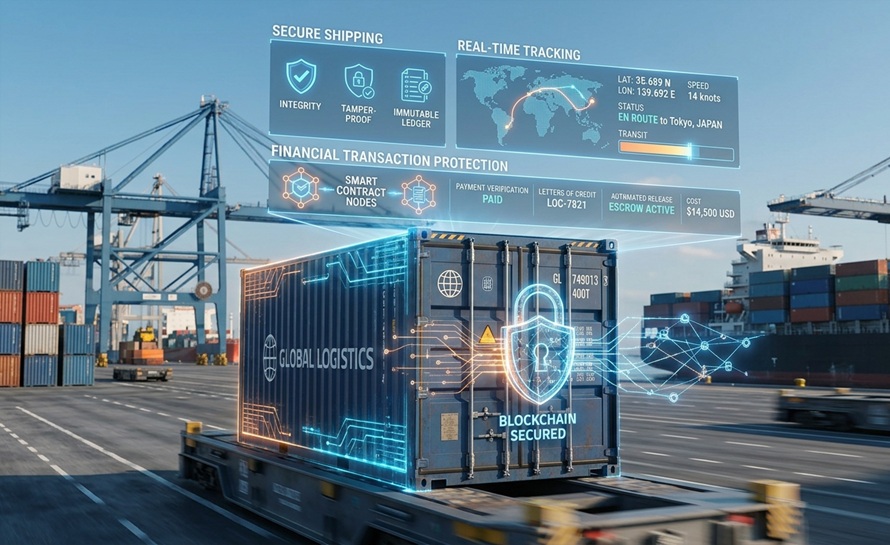
In a blockchain-based logistics system, every event—such as cargo pickup, customs clearance, warehouse entry, or final delivery—is recorded on the ledger. This creates a complete audit trail that authorized stakeholders can access in real time. As a result, logistics companies can easily track shipments, verify transactions, and reduce disputes between supply chain partners.
Industry research also highlights the growing benefits of blockchain adoption in supply chains. A recent industry report found that 52% of organisations identify transparency as one of the key benefits of blockchain adoption in supply chain operations, showing how distributed ledger technology improves visibility and trust between trading partners.
In addition, blockchain platforms enable several advanced capabilities that improve operational efficiency in logistics:
- Secure freight payments through smart contracts that automatically execute when delivery conditions are met
- Automated documentation processes, reducing manual paperwork and errors
- Real-time tracking of shipments and financial transactions across the supply chain
These capabilities significantly reduce fraud risks, improve operational transparency, and create a trusted environment where multiple logistics partners can collaborate securely. As global supply chains become more complex and digital, blockchain is increasingly emerging as a critical technology for building secure, transparent, and verifiable logistics ecosystems.
Blockchain as a Transformative Technology for Logistics Security
Blockchain is essentially a decentralised digital ledger that records transactions securely and transparently across a distributed network.
Unlike traditional databases, blockchain provides several unique advantages:
1. Immutable Transaction Records
Once data is recorded on the blockchain, it cannot be altered or deleted. This ensures that logistics transaction records remain tamper-proof and auditable.
2. Decentralised Data Verification
Every participant in the blockchain network holds a copy of the ledger. This removes the need for a central authority and prevents single-point failures.
3. Smart Contracts for Automated Transactions
Blockchain platforms can use smart contracts to automatically execute agreements when predefined conditions are met.
For example:
- Freight payments are released automatically after delivery confirmation
- Customs documentation is verified instantly
- Insurance claims are processed automatically when shipment damage is recorded
4. Real-Time Supply Chain Visibility
Blockchain allows all authorised stakeholders to access the same transaction records, ensuring:
- Better coordination between partners
- Faster dispute resolution
- Improved compliance with regulations
Because of these advantages, blockchain is quickly becoming a core technology for secure logistics transactions and supply chain transparency.
How Cor Advance Solutions Helps Logistics Companies Implement Blockchain
Implementing blockchain in logistics requires specialised technical expertise, integration with existing systems, and strong security architecture. This is where Cor Advance Solutions plays a key role.
Cor Advance Solutions helps logistics organisations transform their operations through blockchain-powered digital platforms designed specifically for supply chain security.
Key Blockchain Services for Logistics Companies
1. Blockchain Supply Chain Platforms
Development of secure distributed ledger systems for shipment tracking and transaction verification.
2. Smart Contract Automation
Automating freight payments, compliance checks, and logistics contracts to reduce delays and human errors.
3. Secure Digital Documentation
Replacing paper-based documents with blockchain-based digital records for customs, freight, and compliance processes.
4. Blockchain + IoT Integration
Combining blockchain with IoT sensors to track shipment conditions, locations, and delivery confirmations in real time.
5. Enterprise Blockchain Integration
Connecting blockchain networks with ERP, warehouse management systems, and logistics platforms.
Through these solutions, Cor Advance Solutions enables logistics companies to achieve:
- Stronger cybersecurity protection
- Faster transaction verification
- Reduced fraud and operational risks
- Improved transparency across the supply chain
2. Understanding Blockchain Technology
Blockchain technology is becoming one of the most important innovations in modern digital systems. It is widely used in industries such as finance, healthcare, and logistics because it creates secure, transparent, and tamper-proof transaction systems. In logistics and supply chain management, blockchain helps companies track shipments, verify transactions, and improve trust between multiple partners.
Recent industry studies show that more than 9,100 companies globally have implemented blockchain-based supply chain solutions, and the number continues to grow as organisations demand better transparency and traceability in logistics operations.
2.1 What is Blockchain?
Blockchain is a digital system that records transactions in a secure and transparent way across multiple computers. Instead of storing information in one central database, blockchain stores data across a distributed network of computers, making it highly secure and difficult to manipulate.
Each transaction added to the blockchain is verified by the network and then stored permanently. Once recorded, the information cannot be changed or deleted, which makes blockchain extremely reliable for sensitive data such as financial payments, logistics records, and supply chain transactions.
Distributed Ledger System Explained Simply
At its core, blockchain works as a distributed ledger. A ledger is simply a record of transactions. Traditional systems store this ledger in one central location controlled by a single organisation.
In contrast, blockchain distributes the ledger across many computers (called nodes) in the network. Every participant in the network has access to the same verified record. This shared system ensures that all parties see the same version of transaction data, eliminating disputes and reducing fraud.
Because the ledger is shared and continuously updated, blockchain provides real-time visibility of transactions and logistics activities across the entire network.
Immutable and Decentralised Architecture
One of the most powerful features of blockchain is its immutability. Once a transaction is recorded and verified, it becomes a permanent part of the blockchain and cannot be altered without network approval.
Blockchain is also decentralised, meaning no single organisation controls the system. Instead, decisions are made collectively by the network through verification processes. This reduces the risks of data manipulation, cyberattacks, or single-point system failures.
2.2 Key Components of Blockchain
To understand how blockchain works, it is important to look at the key components that power the system.
Blocks and Transaction Records
Blockchain stores data in units called blocks. Each block contains:
- A list of verified transactions
- A timestamp of when the transactions occurred
- A unique digital code linking it to the previous block
These blocks are connected sequentially to form a chain of verified records, which is why the system is called blockchain.
Cryptographic Hashing
Every block is protected using cryptographic hashing, which converts transaction data into a unique digital fingerprint.
This fingerprint ensures that if someone tries to change the data, the hash will change immediately, making the manipulation easy to detect. Cryptographic hashing is one of the main reasons blockchain systems are considered highly secure.
Consensus Mechanisms
Blockchain networks rely on consensus mechanisms to verify transactions before they are added to the ledger.
A consensus mechanism is simply a rule that allows network participants to agree that a transaction is valid. Popular mechanisms include Proof of Work (PoW) and Proof of Stake (PoS).
These mechanisms ensure that only legitimate transactions are recorded, preventing fraud and ensuring the accuracy of the blockchain.
Smart Contracts
Another powerful feature of blockchain is smart contracts.
Smart contracts are self-executing digital agreements stored on the blockchain. They automatically carry out actions when predefined conditions are met.
For example, in logistics operations:
- A smart contract can release payment automatically once a shipment is delivered.
- It can verify customs documentation before approving cargo clearance.
- It can trigger notifications when goods arrive at a warehouse.
In 2024 alone, more than 1.6 million smart contracts were executed in supply chain and logistics operations, demonstrating their growing importance in automating business processes.
2.3 Why Blockchain Matters for Logistics
Blockchain is transforming the logistics industry because it solves several long-standing problems related to transparency, trust, and operational efficiency.
Eliminates Centralised Control Risks
Traditional logistics systems rely on central databases managed by individual organisations. These systems are vulnerable to data manipulation, cyberattacks, and operational errors.
Blockchain removes this risk by creating a decentralised system where all participants share the same verified data. This significantly improves security and reduces dependence on a single authority.
Enhances Transaction Transparency and Traceability
Transparency is one of the biggest challenges in global supply chains. Logistics companies often struggle to track goods across multiple suppliers, carriers, and warehouses.
Blockchain solves this issue by providing a shared, tamper-proof record of every transaction and shipment movement across the supply chain.
Research shows that blockchain technology is significantly improving transparency and traceability in supply chains. According to a report by Deloitte, around 53% of organisations implementing blockchain in their supply chain operations reported improved transparency and traceability, which helps companies monitor goods, transactions, and logistics processes more effectively.
Additionally, industry data indicates that 63% of organisations are actively seeking blockchain verification systems to improve supply chain transparency, demonstrating the growing demand for blockchain-based logistics solutions.
Enables Real-Time Verification of Logistics Data
Blockchain platforms allow logistics companies to verify transactions and shipment data in real time. Every update — such as cargo loading, customs clearance, warehouse entry, or final delivery — is recorded instantly on the blockchain ledger.
This real-time verification helps companies:
- Detect fraud and counterfeit products
- Reduce shipment disputes
- Improve coordination between logistics partners
- Ensure accurate delivery tracking
As global supply chains become more complex and digitally connected, blockchain technology is increasingly becoming a critical foundation for secure, transparent, and automated logistics operations.
3. Security Challenges in Traditional Logistics Transactions
Traditional logistics systems rely on multiple intermediaries, manual paperwork, and disconnected IT systems. While these systems have supported global trade for decades, they also create serious security challenges in logistics transactions, especially when dealing with cross-border shipments and multiple vendors.
Because logistics networks involve shippers, carriers, freight forwarders, warehouses, and customs authorities, information is often shared across different systems that are not fully connected. This fragmented structure increases the risk of fraud, data manipulation, payment disputes, and documentation errors.
According to supply chain risk studies, fraud and payment manipulation are becoming a major issue in logistics finance. Reports show that invoice fraud alone accounts for about 45% of fraud cases in logistics transactions, costing the industry billions of dollars each year.
Below are the major security challenges in traditional logistics transactions.
3.1 Fraud and Payment Disputes
Fraud is one of the most serious problems in traditional logistics systems. Because financial transactions often rely on manual verification and emails, criminals can manipulate invoices, payment instructions, or vendor information.
The global logistics sector handles millions of invoices every year, and manual verification makes it difficult to detect fraudulent transactions quickly.
Fake Invoices
Fake invoicing is a common fraud method in supply chain finance. Fraudsters create fake supplier accounts or falsified invoices that appear legitimate and send them to companies for payment.
In many cases, these invoices mimic real vendors, making it difficult for finance teams to detect fraud. Studies show that invoice fraud and payment diversion cost the logistics industry around $2.5 billion annually.
Another common tactic involves phantom vendors, where criminals create fake companies and submit invoices for goods or services that were never delivered.
Unauthorized Payments
Unauthorized payments occur when attackers manipulate banking details or payment instructions. For example, fraudsters may impersonate suppliers and request that future payments be transferred to a different bank account.
Such attacks are often carried out through business email compromise (BEC) or supplier impersonation schemes. Reports show that fraudsters frequently redirect payments by altering bank details in legitimate invoices, causing major financial losses for logistics companies.
Duplicate Transactions
Duplicate invoices are another major cause of payment disputes. When logistics companies process large volumes of invoices manually, the same invoice may be submitted multiple times.
If internal controls are weak, finance teams may accidentally approve duplicate payments. Research shows that manual invoice processing increases the risk of duplicate payments and billing fraud, especially in complex supply chains with many vendors.
3.2 Lack of Supply Chain Transparency
Transparency is essential for modern logistics operations. However, traditional logistics systems often rely on separate databases and paper-based records, making it difficult to track shipments in real time.
When different companies use different systems, information becomes fragmented, leading to limited supply chain visibility.
Difficulty Tracking Shipments Across Multiple Vendors
A typical international shipment may involve several logistics partners, including:
- Freight forwarders
- Shipping lines
- Customs brokers
- Warehousing providers
- Last-mile delivery companies
Because each partner maintains its own records, shipment information is often scattered across different platforms.
This makes it difficult to identify who is responsible for delays, damages, or missing shipments, which frequently leads to disputes between supply chain partners.
Studies show that traditional supply chains often lack real-time monitoring and verification of shipment data, creating delays in decision-making and increasing operational risk.
Limited Visibility Across International Logistics Networks
Global logistics networks are extremely complex. A single product may travel through multiple countries, ports, and customs checkpoints before reaching the final customer.
However, traditional systems often fail to provide a single, unified view of the entire supply chain.
This lack of visibility creates several problems:
- Delayed shipment tracking
- Difficulty verifying cargo authenticity
- Increased risk of cargo theft
- Poor coordination between logistics partners
Without end-to-end visibility, companies struggle to maintain secure and transparent supply chain operations.
3.3 Data Tampering Risks
Another major challenge in traditional logistics transactions is the risk of data manipulation. Since many logistics records are stored in centralised databases or paper documents, they can be easily modified by insiders or external attackers.
When records are altered, it becomes difficult to verify the authenticity of logistics data.
Manipulation of Shipping Records
Shipping records contain critical information such as:
- Shipment origin and destination
- Cargo type and quantity
- Delivery schedules
- Carrier details
If this information is manipulated, it can lead to financial fraud, shipment diversion, or compliance violations.
For example, criminals may modify shipping documents to hide illegal cargo or change delivery destinations.
Research highlights that centralised logistics systems are vulnerable to malicious modifications of product records, which can compromise data integrity across the supply chain.
Altered Delivery Confirmations
Delivery confirmations are often used as proof that goods have been successfully delivered. However, in traditional systems these confirmations may be manually entered or submitted as scanned documents.
This makes it easier for dishonest parties to:
- Submit fake delivery confirmations
- Alter delivery dates
- Manipulate proof-of-delivery documents
Such practices often lead to payment disputes and financial losses for logistics companies.
3.4 Inefficient Documentation Systems
Documentation is the backbone of international logistics. However, traditional logistics operations still rely heavily on manual paperwork and physical documents.
These outdated processes slow down logistics operations and increase the risk of errors.
Manual Paperwork
International shipments require several important documents, including:
- Bills of lading
- Commercial invoices
- Customs declarations
- Shipping manifests
- Delivery receipts
In traditional logistics systems, these documents are often processed manually and exchanged through email or physical copies.
Manual paperwork increases administrative costs and processing time. Studies show that manual invoice processing can cost between $10 and $15 per invoice, making it inefficient for large logistics operations.
Errors in Bills of Lading, Invoices, and Contracts
Human errors are common when documentation is processed manually. Mistakes may occur in:
- Shipment quantities
- Delivery addresses
- Freight charges
- Contract terms
Even small documentation errors can create major delays in customs clearance and payment processing.
Because these documents are critical for international trade, incorrect information can lead to shipment delays, financial disputes, or regulatory penalties.
4. How Blockchain Secures Logistics Transactions
Security is one of the biggest challenges in modern logistics operations. Traditional logistics systems often rely on centralised databases, paper-based documentation, and manual verification processes. These systems can be vulnerable to fraud, data manipulation, payment disputes, and cyber threats.

The use of blockchain in logistics introduces a highly secure and transparent digital infrastructure where every transaction is recorded, verified, and protected through advanced cryptographic mechanisms. By using a distributed ledger, blockchain ensures that all logistics transactions are reliable, traceable, and tamper-proof.
Below are the key ways blockchain technology secures logistics transactions across the supply chain.
4.1 Immutable Transaction Records
One of the most powerful security features of blockchain for logistics transactions is immutability. Once a transaction is recorded on the blockchain network, it cannot be altered, deleted, or manipulated.
Each logistics transaction—such as shipment details, delivery confirmations, invoices, and payment records—is stored in a block. These blocks are then linked together in chronological order to form a secure chain. If someone attempts to change any data in a block, the entire chain would immediately detect the inconsistency.
This immutability provides strong protection against fraud and record tampering.
Key benefits include:
- Permanent transaction history: Every logistics activity is permanently stored on the blockchain ledger.
- Fraud prevention: Fake invoices, shipment manipulation, and payment disputes become extremely difficult.
- Reliable audit trails: Companies can easily verify logistics transactions at any time.
4.2 Decentralized Ledger System
Traditional logistics databases are usually stored in a single central server. If that server fails or is compromised, the entire system can be disrupted.
Blockchain solves this issue through a decentralized ledger system. Instead of storing data in one location, blockchain distributes the same transaction records across multiple network nodes. Every authorised participant in the supply chain—manufacturers, transport companies, warehouses, and retailers—can access the shared ledger.
Because all nodes hold identical copies of the data, the system remains secure even if one node fails or is attacked.
Security advantages of decentralisation include:
- No single point of failure: The system continues to operate even if one node becomes inactive.
- Enhanced data integrity: Any suspicious change is automatically rejected by the network.
- Secure collaboration: Supply chain partners can safely share verified logistics data.
4.3 Smart Contracts for Automated Transactions
Another powerful feature that improves logistics transaction security is the use of smart contracts. Smart contracts are self-executing digital agreements stored on the blockchain network.
These contracts automatically perform actions when specific conditions are met. This removes the need for manual approvals and reduces the risk of manipulation or payment delays.
For example, a smart contract can automatically release payment once a shipment is delivered and verified on the blockchain system.
Examples of smart contract use in logistics include:
- Automatic payment release: Payment is triggered immediately after delivery confirmation.
- Shipment tracking validation: Contracts verify delivery milestones before executing transactions.
- Reduced disputes: All contract rules are pre-programmed and transparent.
4.4 Cryptographic Security
Blockchain networks use advanced cryptographic security mechanisms to protect transaction data. Every transaction is encrypted and verified using digital signatures, ensuring that only authorised participants can access and validate the data.
When a logistics transaction is created, it is secured using cryptographic hashing. This process converts transaction data into a unique digital fingerprint. Even the smallest change in the data would create a completely different hash, making manipulation immediately detectable.
Key cryptographic security features include:
- Data encryption: Sensitive logistics data remains protected from unauthorised access.
- Digital signatures: Transactions are verified using secure identity authentication.
- Tamper detection: Any attempt to modify stored records is instantly identified.
5. Key Use Cases of Blockchain in Logistics
The logistics industry handles millions of shipments, payments, and documents every day. Managing these processes securely and efficiently is often difficult because many different parties are involved, such as suppliers, manufacturers, transport companies, warehouses, and retailers.
Blockchain in logistics is helping companies solve many of these problems. It provides a secure, transparent, and tamper-proof system where every transaction is recorded and verified. Because data on a blockchain cannot be easily changed, it builds trust between all supply chain partners.
Below are some of the most important use cases of blockchain in logistics and supply chain management.
5.1 Secure Freight Payments
One of the biggest challenges in logistics is managing freight payments safely and efficiently. Traditional payment systems often rely on manual verification and multiple intermediaries, which can lead to delays, fraud, and disputes.
Blockchain technology in logistics improves the freight payment process by verifying shipment delivery before a payment is released. Every shipment update is recorded on the blockchain ledger, creating a secure and permanent record of the transaction.
When a delivery is confirmed, the system automatically validates the information and allows the payment to be processed. This ensures that payments are made only after the agreed delivery conditions are met.
Key benefits include:
- Verified delivery before payment processing
Blockchain ensures that payment is triggered only after delivery confirmation is recorded on the network. - Reduced payment fraud and disputes
Because every transaction is recorded and visible to authorised participants, it becomes very difficult to manipulate payment records.
For logistics companies, this creates a more secure and reliable freight payment system, improving trust between shippers, carriers, and suppliers.
5.2 Shipment Tracking and Transparency
Shipment visibility is another major challenge in traditional logistics systems. Many companies rely on separate tracking systems, emails, and manual updates to monitor shipments. This often results in limited transparency and delayed information.
With blockchain-based logistics tracking, all shipment updates are recorded in a shared digital ledger that can be accessed by authorised participants in the supply chain. Each stage of the shipment journey—from warehouse dispatch to final delivery—is recorded as a verified transaction.
This creates a single source of truth for all supply chain partners.
Key advantages include:
- Real-time shipment tracking
Logistics companies can track goods in real time as they move through different transportation stages. - Verified transaction history across the supply chain
Every shipment event is permanently recorded, creating a reliable audit trail.
This improved transparency helps businesses reduce delays, improve planning, and build stronger trust with customers.
5.3 Smart Contracts for Logistics Agreements
Logistics operations involve many agreements, such as freight contracts, service agreements, and delivery terms. Managing these contracts manually often requires significant paperwork and administrative effort.
Smart contracts in blockchain logistics solve this problem by automating agreements through self-executing digital contracts. These contracts automatically perform actions when predefined conditions are met.
For example, a smart contract can automatically release payment once a shipment reaches the destination and delivery is confirmed.
Important benefits include:
- Automated freight contracts
Smart contracts execute transactions automatically based on agreed rules. - Reduced manual contract management
Companies no longer need to manually verify contract conditions, which reduces paperwork and administrative work.
Using blockchain smart contracts in logistics improves efficiency, reduces operational costs, and minimises human errors in contract execution.
5.4 Cross-Border Trade and Customs Documentation
International shipping involves complex documentation processes, including customs forms, bills of lading, certificates of origin, and regulatory approvals. Managing these documents across multiple countries can cause delays and increase administrative costs.
Blockchain technology in global logistics allows companies to create secure digital records of shipping documents that can be shared with authorised authorities and supply chain partners.
Instead of relying on paper-based documentation, all required records can be stored securely on the blockchain.
Key advantages include:
- Blockchain-based digital documentation
Important logistics documents are stored in a secure and verifiable digital format. - Faster customs clearance
Customs authorities can access verified information instantly, reducing the time required for shipment approvals.
This makes cross-border logistics operations faster, more transparent, and less prone to documentation errors.
5.5 Fraud Prevention in Supply Chains
Fraud and counterfeit goods are major issues in global supply chains. Fake products, false shipment records, and supplier fraud can lead to financial losses and damage to brand reputation.
Blockchain in supply chain security helps prevent these issues by creating a transparent and verifiable record of every transaction and shipment movement.
Each product or shipment can be assigned a unique digital identity that is recorded on the blockchain. As the product moves through the supply chain, every step is recorded and verified by the network.
This provides strong protection against fraud.
Key benefits include:
- Verification of suppliers and shipments
Companies can verify the authenticity of suppliers, products, and logistics transactions. - Prevention of counterfeit goods
Blockchain tracking helps ensure that only genuine products move through the supply chain.
With improved transparency and traceability, blockchain technology significantly strengthens fraud prevention in logistics and supply chain operations.
6. Benefits of Blockchain for Logistics Companies
The logistics industry is becoming more digital and data-driven. Companies are constantly looking for technologies that can improve security, efficiency, and transparency across the supply chain. One technology that is bringing major improvements is blockchain in logistics.
Blockchain provides a decentralised and secure system where transactions are recorded permanently and shared across authorised supply chain participants. Because the data cannot be easily changed or manipulated, it creates a reliable environment for logistics operations.
Below are the key benefits of blockchain technology for logistics companies.
6.1 Improved Transaction Security
Security is one of the most important concerns in logistics and supply chain management. Logistics companies handle large amounts of sensitive information, including payment records, shipment data, supplier details, and delivery confirmations.
Traditional systems often rely on centralised databases, which can be vulnerable to cyber attacks, data manipulation, or unauthorised access.
Blockchain technology in logistics solves this problem by creating a distributed ledger where every transaction is verified by the network and permanently recorded. Once a transaction is added to the blockchain, it cannot be altered or deleted without consensus from the network.
Key advantages include:
- Tamper-proof records
Blockchain stores transactions in secure blocks that are linked together. This makes the data extremely difficult to modify or manipulate. - Fraud reduction
Since all participants can verify transaction records, fraudulent activities such as fake invoices or altered shipment data become much harder to perform.
As a result, blockchain-based logistics systems provide stronger transaction security and improved data protection.
6.2 Real-Time Supply Chain Visibility
One of the biggest challenges in traditional logistics systems is the lack of complete visibility across the supply chain. Shipment information is often stored in separate systems used by different organisations, which makes tracking difficult and sometimes unreliable.
Blockchain in supply chain management provides a shared digital ledger where shipment updates are recorded and verified in real time. This means that authorised stakeholders can access the same verified information at any time.
Benefits include:
- Transparent transaction tracking
Every shipment update, transaction, and delivery record is stored in the blockchain ledger and can be tracked throughout the entire logistics process.
This level of visibility allows logistics companies to monitor shipments more accurately, detect delays earlier, and improve overall operational planning.
6.3 Faster Payment Processing
Payment delays are common in logistics because traditional systems often require manual verification of delivery documents before payments can be processed. This process can take days or even weeks.
Blockchain-powered logistics platforms improve payment efficiency by using smart contracts, which are automated digital agreements stored on the blockchain. These contracts automatically execute transactions when predefined conditions are met.
For example, a smart contract can automatically release payment once delivery confirmation is recorded on the blockchain.
Key benefits include:
- Automated settlements through smart contracts
Payments can be processed instantly once delivery conditions are verified, reducing the need for manual approval.
This helps logistics companies improve cash flow, reduce administrative delays, and create a more efficient payment process.
6.4 Reduced Operational Costs
Logistics companies often deal with large volumes of paperwork, including shipping documents, invoices, customs forms, and delivery confirmations. Managing these documents manually requires time, labour, and administrative resources.
Blockchain technology in logistics operations reduces this burden by digitising and automating many of these processes. Because all transaction records are stored securely in a shared digital ledger, companies no longer need to maintain multiple copies of documents across different systems.
Key advantages include:
- Less paperwork and administrative overhead
Digital records stored on the blockchain reduce the need for paper documents and manual record management.
By simplifying documentation and reducing manual processes, blockchain helps logistics companies lower operational costs and improve efficiency.
6.5 Increased Trust Between Supply Chain Partners
The logistics industry involves collaboration between many different organisations, including manufacturers, suppliers, carriers, warehouse operators, distributors, and retailers.
In traditional systems, trust issues can arise because each party maintains its own records, which may not always match with others. This can lead to disputes, delays, and operational inefficiencies.
Blockchain-based supply chain systems solve this problem by providing a shared and verified source of information. All authorised participants have access to the same transaction records, which are validated and securely stored on the blockchain.
Key benefits include:
- Verified data shared across stakeholders
Every participant can view the same verified information, reducing misunderstandings and improving collaboration.
By increasing transparency and data accuracy, blockchain technology helps build stronger trust between supply chain partners, leading to smoother logistics operations and better long-term business relationships.
7. Real-World Applications of Blockchain in Logistics
Blockchain is no longer just a theoretical technology. Many logistics and transportation companies are already using blockchain in logistics and supply chain management to improve transparency, security, and operational efficiency.
By creating a secure and decentralised system for recording transactions, blockchain allows logistics companies to track shipments, manage contracts, and share data across multiple partners without relying on a single central authority.
Below are some important real-world applications of blockchain technology in logistics.
7.1 Global Logistics Companies Using Blockchain
Many global logistics organisations are exploring and implementing blockchain-based logistics systems to improve freight management and shipment tracking. Large logistics networks involve multiple stakeholders, including suppliers, shipping companies, freight carriers, ports, and warehouses. Managing data across all these participants can be complex.
Blockchain helps solve this challenge by providing a shared digital ledger where shipment updates are recorded and verified. This allows all authorised participants to access accurate and real-time logistics information.
One major use case is blockchain-based freight tracking systems. These systems record every shipment event, such as loading, transportation, customs clearance, and delivery confirmation, directly on the blockchain.
Benefits of blockchain freight tracking include:
- Improved accuracy in shipment tracking
- Reduced risk of data manipulation
- Better coordination between logistics partners
By using blockchain technology in freight logistics, companies can monitor shipments more efficiently and reduce delays caused by missing or inaccurate information.
7.2 Blockchain Platforms Transforming Supply Chains
Another major real-world application is the development of blockchain logistics platforms that connect different participants in the supply chain through a decentralised network.
Traditional supply chain systems often operate in isolated environments where each company stores its own data. This makes information sharing slow and sometimes unreliable. Blockchain platforms solve this problem by creating a shared ecosystem where all supply chain partners can securely access verified information.
These decentralised logistics ecosystems allow companies to exchange data about shipments, inventory, contracts, and payments in a transparent and secure way.
Key advantages include:
- Better coordination between supply chain partners
- Reduced communication delays
- Improved transparency across logistics networks
With blockchain-powered supply chain platforms, businesses can build more efficient and trustworthy logistics operations.
7.3 Enterprise Blockchain Adoption in Transportation
Many transportation and logistics companies are also adopting enterprise blockchain solutions to improve their internal logistics management systems. Instead of replacing existing systems completely, blockchain technology is often integrated with current logistics software such as transportation management systems (TMS), warehouse management systems (WMS), and supply chain management platforms.
This integration allows companies to combine the security and transparency of blockchain with their existing operational tools.
For example, blockchain can be used to securely store shipment records, delivery confirmations, and freight contracts, while the logistics management system handles daily operational tasks.
Key benefits of enterprise blockchain adoption in transportation include:
- Improved data security across logistics systems
- Better coordination between digital platforms
- More reliable record management for shipments and payments
Through integration with existing logistics management systems, blockchain helps companies modernise their supply chain operations without disrupting their current workflows.
8. Blockchain Implementation Challenges in Logistics
While blockchain in logistics offers many benefits like enhanced security, transparency, and efficiency, implementing it in real-world supply chains is not without challenges. Logistics operations are complex, involving multiple stakeholders, large volumes of shipments, and existing technology systems. Companies must carefully plan blockchain adoption to overcome these hurdles.
Below are the key implementation challenges of blockchain in logistics.
8.1 Integration with Legacy Systems
Most logistics companies rely on traditional software systems, such as transportation management systems (TMS), warehouse management systems (WMS), and enterprise resource planning (ERP) platforms. Integrating blockchain with these existing systems can be difficult.
Challenges include:
- Compatibility issues with traditional logistics software
Legacy systems may not support blockchain’s decentralised architecture, making it challenging to connect old and new systems. - Data migration complexities
Transferring historical logistics data to a blockchain network requires careful planning to avoid errors or data loss.
Successful integration often requires customised solutions or middleware to bridge blockchain networks with legacy software, ensuring smooth communication between systems.
8.2 Regulatory and Compliance Concerns
Blockchain is a relatively new technology, and its legal and regulatory frameworks are still evolving. Logistics companies must comply with local, national, and international regulations when implementing blockchain.
Key regulatory challenges include:
- Legal frameworks for blockchain transactions
Questions arise around the legal recognition of blockchain records, smart contracts, and digital signatures. - Cross-border compliance
International shipments may be subject to different laws in each country, making standardised blockchain adoption difficult.
Companies need to ensure that blockchain implementations meet all regulatory requirements to avoid legal disputes or operational interruptions.
8.3 Scalability Issues
Blockchain networks rely on decentralised verification processes, which can slow down transaction processing when handling large volumes of data. For logistics companies that process thousands of shipments daily, this can become a bottleneck.
Challenges include:
- Handling large transaction volumes
Some blockchain platforms may experience slower processing times or higher costs as transaction numbers increase. - Network congestion
During peak logistics periods, such as festive seasons or major global trade events, transaction delays can impact real-time tracking and payments.
To overcome these issues, companies may need to use advanced blockchain solutions designed for high scalability or implement hybrid systems that combine blockchain with traditional databases.
8.4 Initial Implementation Costs
Implementing blockchain in logistics requires significant upfront investment. Companies need to budget for technology infrastructure, training, and change management.
Challenges include:
- Infrastructure and training investments
Setting up blockchain networks, nodes, and secure cloud storage requires capital expenditure.
Staff must be trained to operate and maintain blockchain systems effectively. - Long ROI period
While blockchain improves efficiency and reduces fraud over time, the initial costs can be a barrier, especially for small or medium-sized logistics companies.
Careful planning and phased implementation can help companies manage these costs while gradually realising the benefits of blockchain in logistics.
9. Best Practices for Implementing Blockchain in Logistics
Adopting blockchain technology in logistics can transform supply chain operations, but success depends on careful planning and execution. Companies that follow best practices for blockchain implementation can maximise benefits like improved security, transparency, and operational efficiency while avoiding common pitfalls.
Here are the most effective strategies for implementing blockchain in logistics.
9.1 Identify High-Risk Transaction Areas
The first step in implementing blockchain is to identify areas of logistics operations that are most vulnerable to errors, fraud, or inefficiencies. Focusing on these high-risk areas ensures that blockchain provides the maximum value.
Common high-risk areas include:
- Payment processing
Blockchain can secure freight payments and reduce disputes by verifying deliveries before releasing funds. - Supplier verification
Blockchain helps confirm supplier identities and track shipments, preventing fraud and counterfeit goods.
By targeting these areas first, companies can quickly see tangible benefits and justify further blockchain adoption across the supply chain.
9.2 Integrate Blockchain with Existing Logistics Platforms
Most logistics companies already use systems like ERP (Enterprise Resource Planning) and transportation management systems (TMS). Blockchain works best when it is integrated seamlessly with these existing platforms rather than replacing them entirely.
Best practices for integration include:
- Ensuring compatibility between blockchain networks and current software.
- Using middleware solutions to bridge data between legacy systems and blockchain.
- Gradually migrating critical data to the blockchain to minimise operational disruption.
This approach ensures smooth adoption without halting daily logistics operations.
9.3 Use Smart Contracts for Automation
Smart contracts are self-executing digital contracts that automatically perform actions when predefined conditions are met. They are a key feature of blockchain technology that can greatly improve efficiency in logistics operations.
Practical applications include:
- Automated billing and settlements
Smart contracts can release payments instantly once delivery conditions are confirmed, reducing manual verification and delays. - Contract enforcement
Automatically executing contractual obligations reduces errors and ensures transparency across all parties.
By using smart contracts, companies can streamline complex processes, reduce administrative work, and accelerate supply chain operations.
9.4 Partner with Experienced Blockchain Development Companies
Implementing blockchain in logistics requires specialised expertise in blockchain architecture, cybersecurity, and supply chain processes. Partnering with experienced blockchain development companies can ensure a secure, scalable, and effective implementation.
Best practices include:
- Selecting development partners with proven experience in logistics and supply chain blockchain solutions.
- Planning for scalable systems that can handle growing transaction volumes as the company expands.
- Ensuring robust security measures to protect sensitive supply chain and financial data.
Collaborating with the right experts reduces risks, ensures compliance, and accelerates successful adoption of blockchain technology.
10. The Future of Blockchain in Logistics
The logistics industry is changing fast. With rising global trade, complex supply chains, and higher customer expectations, businesses need smarter, safer, and more transparent systems. Blockchain technology in logistics is at the heart of this change. Recent research shows that the market for blockchain in logistics is growing rapidly, with some forecasts estimating it will grow from billions today to tens or even hundreds of billions in value by the end of this decade.
Below is a detailed, expert‑style look at where blockchain in logistics is heading, written in very simple UK English and built for strong search engine performance using primary and secondary keywords naturally.
AI + Blockchain Integration for Predictive Logistics
One of the most exciting trends shaping the future of logistics is the integration of artificial intelligence (AI) with blockchain technology. Both technologies complement each other — blockchain provides secure and tamper‑proof data records, while AI can analyse that data to make predictions and automate decisions.
For example:
- AI models can use verified shipment data stored on a blockchain to predict delivery delays, forecast demand, and optimise transport routes.
- Logistics planners can use real‑time insights to reduce delays and minimise costs.
This AI + blockchain integration for predictive logistics means logistics operators can act before issues occur, improving reliability and efficiency. Recent industry roads ahead show continued investment in combining AI and blockchain to create smarter supply chains.
This shift is important because companies no longer rely solely on past performance; they can use real, validated data to anticipate future trends and plan accordingly — something that was not possible with traditional systems.
Decentralised Supply Chain Ecosystems
Another major future trend is the rise of decentralised supply chain ecosystems. In traditional logistics, data is held in separate databases controlled by different companies. This often causes delays, errors, and limited visibility.
With a decentralised blockchain network:
- Every authorised partner — from manufacturers to shippers to customs officials — can access the same verified data.
- Information about shipments, contracts, invoices, and regulatory paperwork can be shared instantly and securely without relying on a central authority.
This approach improves real‑time supply chain visibility, reduces disputes, and builds stronger collaboration across the entire logistics network. According to market research, decentralised logistics systems are one of the top trends expected to drive adoption of blockchain in logistics in the years ahead.
In a decentralised supply chain, no single company controls all the data. Instead, every participant sees the same factual version of events, making operations smoother and more trustworthy.
Tokenised Logistics Payments
The future of logistics payments is also evolving with blockchain. Tokenised logistics payments refer to using blockchain‑based digital tokens to represent value — such as freight fees, customs charges, or supplier payments.
Instead of traditional banking systems, tokenised systems:
- Enable faster cross‑border payments
- Reduce transaction fees
- Improve transparency and settlement times
Tokenisation paired with smart contracts can automate payments once delivery conditions are met. For example, once a shipment is verified as delivered on a blockchain, a smart contract can automatically release payment to the carrier.
This automation reduces manual work, lowers the chance of payment disputes, and makes financial settlements much faster for logistics companies operating across regions.
Tokenised payment systems are expected to become mainstream as more organisations adopt blockchain for logistics and trade finance solutions.
Increased Adoption in Global Trade and Shipping
The adoption of blockchain technology in global trade and shipping is growing at a dramatic pace. Industry reports project that the blockchain in logistics market could expand tremendously over the next decade, driven by demand for transparency, efficiency, and fraud prevention. Some forecasts estimate exponential growth in market size as blockchain becomes central to traceability, automation, and digital documentation in logistics.
For global shipping and cross‑border trade, blockchain helps address longstanding challenges:
- Complex customs procedures
- Paper‑heavy documentation
- Limited visibility across trading partners
By using immutable blockchain records, all parties can authenticate shipment status, customs paperwork, and trade data more efficiently. This reduces delays at borders, lowers compliance risks, and strengthens trust between international partners.
As global trade continues to expand and supply chains become more interconnected, the adoption of blockchain solutions — especially combined with AI and automation — will continue to rise. This makes blockchain not just a technological choice but a strategic necessity for future‑ready logistics operations.
11. How Cor Advance Solutions Helps Logistics Companies Implement Blockchain
Implementing blockchain technology in logistics can be complex, especially with large supply chains, multiple stakeholders, and legacy systems. Cor Advance Solutions specialises in helping logistics companies adopt blockchain efficiently, securely, and in a way that adds real business value. Their approach ensures that companies not only implement blockchain but also achieve better transparency, faster operations, and stronger trust across their supply chains.
Here is a detailed look at how Cor Advance Solutions supports logistics companies in blockchain adoption.
11.1 Custom Blockchain Development
Every logistics company has unique operations, processes, and challenges. Cor Advance Solutions offers custom blockchain development tailored to the specific needs of each client.
Key features include:
- Tailored solutions for logistics companies
Blockchain networks, nodes, and smart contracts are designed to match the company’s shipment volumes, payment processes, and supply chain complexity. - End-to-end consultation
Experts analyse current logistics workflows to identify the areas where blockchain can create the most impact.
This customised approach ensures that companies do not implement a one-size-fits-all solution but instead get a system that optimises their operations and maximises ROI.
11.2 Smart Contract Development
Smart contracts are a core part of blockchain in logistics, automating agreements and ensuring accurate execution of operations. Cor Advance Solutions develops smart contracts that make logistics workflows faster and more reliable.
Key benefits include:
- Automated logistics workflows
Freight payments, supplier agreements, delivery confirmations, and compliance checks can all be executed automatically through smart contracts. - Reduced manual intervention
This reduces paperwork, human error, and delays in operational processes.
By implementing smart contracts, logistics companies can save time, reduce costs, and improve trust across supply chain partners.
11.3 Blockchain Integration with Logistics Platforms
Most logistics companies already rely on platforms like ERP (Enterprise Resource Planning), WMS (Warehouse Management Systems), and TMS (Transportation Management Systems). Integrating blockchain with these platforms ensures seamless adoption without disrupting existing operations.
Cor Advance Solutions provides:
- ERP, WMS, and TMS integration
Blockchain nodes and ledgers are connected to existing platforms, enabling real-time tracking and secure data sharing. - Hybrid solutions
They create systems that combine blockchain security with the familiarity and functionality of traditional logistics software.
This integration helps companies maintain operational continuity while gaining all the benefits of blockchain technology, including security, traceability, and automation.
11.4 Secure Digital Supply Chain Infrastructure
Security is paramount in logistics, especially when dealing with payments, shipment data, and sensitive supplier information. Cor Advance Solutions builds a secure, end-to-end blockchain-enabled supply chain infrastructure.
Key features include:
- End-to-end blockchain-enabled logistics systems
Every shipment, payment, and transaction is securely recorded on a tamper-proof ledger. - Enhanced data protection
Advanced cryptography ensures that sensitive information is only accessible to authorised parties. - Real-time transparency
Supply chain participants can track shipments and payments securely and in real time.
By creating a secure digital logistics infrastructure, Cor Advance Solutions helps companies reduce fraud, improve trust, and optimise supply chain performance.
12. Why Choose Cor Advance Solutions
When it comes to implementing blockchain technology in logistics, choosing the right partner can make all the difference. Cor Advance Solutions stands out as a leader in this field, offering expertise, experience, and a proven track record in transforming supply chains through secure and efficient blockchain solutions.
Here’s why logistics companies trust Cor Advance Solutions to lead their digital transformation.
Expertise in Blockchain Development and Logistics Technology
Cor Advance Solutions has deep knowledge of both blockchain technology and the logistics industry. Their experts understand the unique challenges faced by logistics companies, including payment processing, shipment tracking, supplier verification, and cross-border trade.
Key advantages:
- Customised blockchain solutions designed specifically for logistics operations
- In-depth understanding of supply chain workflows, enabling targeted improvements
- Ability to integrate emerging technologies like AI and IoT with blockchain for predictive logistics
With this expertise, companies can adopt blockchain confidently, knowing that every solution is built with real-world logistics challenges in mind.
Proven Experience in Digital Transformation for Supply Chains
Digital transformation is more than just technology; it’s about reshaping processes for efficiency, transparency, and growth. Cor Advance Solutions has a strong track record of helping supply chains modernise using blockchain, ensuring smooth adoption and measurable results.
Benefits include:
- Streamlined shipment tracking and supply chain visibility
- Automation of routine processes through smart contracts
- Reduced operational costs and improved decision-making with secure data insights
This proven experience gives clients confidence that blockchain implementation will deliver tangible benefits.
Scalable and Secure Blockchain Architecture
Every logistics company has different needs, from regional operations to global supply chains. Cor Advance Solutions builds blockchain systems that are both scalable and secure, ensuring they grow with your business.
Key features include:
- End-to-end encryption and tamper-proof ledgers to protect sensitive data
- Scalable networks that can handle increasing shipment volumes and transactions
- Flexible architecture that integrates seamlessly with existing logistics platforms like ERP, WMS, and TMS
By combining scalability with strong security, companies can expand operations without worrying about system limitations or data breaches.
Dedicated Support and Implementation Services
Implementing blockchain technology requires more than just development—it requires guidance, training, and ongoing support. Cor Advance Solutions provides end-to-end assistance throughout the implementation journey.
Support includes:
- Planning and consulting to identify high-value use cases
- Integration with existing logistics systems for minimal disruption
- Training for staff and ongoing technical support to maintain performance
This dedicated approach ensures that logistics companies get the maximum value from blockchain while avoiding common adoption pitfalls.
13. Conclusion
Blockchain technology is rapidly changing the way logistics companies operate. From securing payments to tracking shipments, it has become a key tool for modern supply chains.
Recap of Blockchain’s Role in Securing Logistics Transactions
One of the most significant benefits of blockchain is its ability to secure logistics transactions. Every payment, delivery update, and contract is recorded on a tamper-proof ledger, making it almost impossible to alter or manipulate. This ensures that freight payments, supplier agreements, and shipment records are accurate, verified, and reliable.
Importance of Transparency and Fraud Prevention in Supply Chains
Transparency is crucial in logistics. Traditional supply chains often suffer from delays, miscommunication, and fraud, which can lead to financial losses and damaged business relationships. Blockchain addresses these challenges by creating a shared, immutable record that all authorised stakeholders can access.
With blockchain:
- Shipment tracking becomes real-time and verifiable
- Supplier authenticity and goods are easily verified
- Fraud and counterfeit goods are significantly reduced
This level of transparency helps businesses maintain trust and strengthen their reputation in the market.
How Blockchain Improves Trust, Efficiency, and Operational Performance
By integrating blockchain into logistics, companies can achieve:
- Enhanced trust between supply chain partners
Verified data is shared across suppliers, carriers, and clients, reducing disputes. - Improved operational efficiency
Smart contracts automate payments and approvals, reducing manual work and delays. - Optimised performance
Real-time data and predictive insights allow better planning and resource management.
These improvements make supply chains faster, safer, and more reliable, helping companies stay competitive in a global market.
Adopt Blockchain-Powered Logistics Solutions with Cor Advance Solutions
For logistics companies looking to future-proof their operations, blockchain is no longer optional—it’s essential. Cor Advance Solutions offers expert guidance, customised blockchain development, smart contract automation, and seamless integration with your existing systems.
By partnering with Cor Advance Solutions, businesses can enhance transparency, prevent fraud, and improve operational efficiency across the entire supply chain.
Take the step towards smarter, safer, and more efficient logistics today with Cor Advance Solutions and harness the full potential of blockchain technology.
FAQs
1. How is blockchain being used in logistics?
Blockchain is revolutionising logistics by providing a secure, transparent, and tamper-proof record of every transaction. Companies use it to track shipments in real-time, verify deliveries, and streamline supply chain operations. Its decentralised ledger ensures all parties have the same trusted information, reducing disputes and enhancing accountability.
2. Can blockchain really make logistics payments 100% secure?
While no system can claim absolute security, blockchain significantly reduces fraud and errors in logistics payments. By using encrypted, immutable ledgers and smart contracts, payments are automatically verified and released only when delivery conditions are met, ensuring safer, faster, and more reliable transactions.
3. How does blockchain stop fraud in logistics transactions?
Blockchain prevents fraud by creating immutable records that cannot be altered or deleted. Every shipment and payment is recorded transparently across a decentralised network, so attempts to manipulate data or falsify deliveries are instantly visible. Smart contracts further automate validation, ensuring only genuine transactions are executed.
4. Which blockchain type is most secure?
Private and permissioned blockchains are considered the most secure for logistics. They limit access to trusted participants, maintain a high level of control, and use advanced cryptographic security, reducing the risk of hacking and unauthorised changes compared to public blockchains.
5. Why are startups disrupting logistics with blockchain solutions?
Startups are leveraging blockchain to simplify complex supply chains, reduce costs, and eliminate inefficiencies. By offering real-time tracking, automated payments, and fraud-proof systems, they challenge traditional logistics firms and bring innovation, speed, and transparency to the industry like never before.