
1. Introduction: The AI Disruption Every Business Must Understand
Artificial Intelligence (AI) is no longer a future technology. It is already changing how businesses operate, compete, and grow. Over the last few years, AI tools have become part of everyday work for millions of companies and professionals around the world. From customer service automation to data analysis and marketing optimisation, AI for business is quickly becoming a core technology for modern organisations.

The turning point for global AI adoption came in November 2022, when OpenAI launched ChatGPT. What started as an experimental AI chatbot quickly became one of the fastest-growing technologies in history. Today, AI tools are used by individuals, students, professionals, and organisations across nearly every industry.
The Rapid Growth of AI Around the World
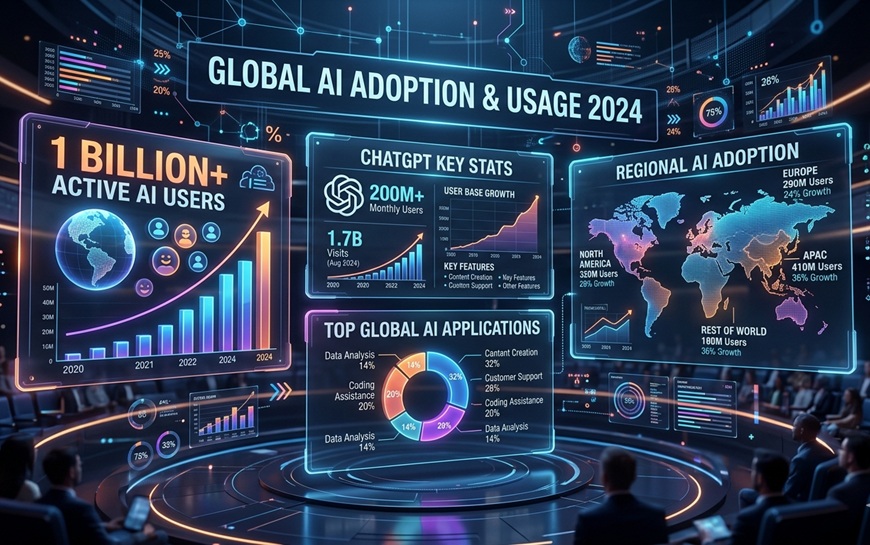
The speed of AI adoption has been extraordinary. According to the DataReportal Digital 2026 Report and global industry studies, more than 1 billion people worldwide now use AI tools every month. ChatGPT alone has reached 800 million weekly active users, doubling from 400 million earlier in 2025.
This makes AI one of the fastest adopted technologies in human history, even faster than social media platforms such as Facebook or Instagram in their early years.
AI platforms now process enormous amounts of activity every day. For example:
- Over 2.5 billion prompts are processed daily on ChatGPT alone
- AI platforms are used by 66% of people globally
- In the United States, 56% of the population (about 179 million people) actively use AI tools
- India already has over 70 million AI users, making it one of the fastest-growing AI markets
These numbers clearly show that AI is no longer optional. It is becoming a standard technology for both individuals and organisations.
AI Adoption in Companies Is Growing Rapidly
Businesses around the world are adopting AI faster than ever before. According to research from McKinsey, KPMG, and global business surveys, about 78% of companies worldwide now use AI in at least one business function.
Even more interesting is how deeply companies are integrating AI into their operations:
- 63% of companies use AI in two or more departments
- 45% of companies use AI across three or more business functions
- 92% of Fortune 100 companies already use ChatGPT in their operations
This trend shows that AI adoption in companies is moving beyond experimentation. Many organisations now use AI for daily operations such as marketing, customer service, analytics, cybersecurity, and automation.
Small businesses are also embracing AI. In the United States, about 89% of small businesses now use AI tools for everyday tasks, including content creation, customer communication, and workflow automation.
How Businesses Are Using AI Today
Companies are using AI to improve efficiency, reduce operational costs, and scale their operations faster. Some of the most common applications include:
1. Customer Support Automation
AI chatbots and virtual assistants help companies respond to customers instantly, 24 hours a day. This reduces support costs and improves customer satisfaction.
2. Data Analysis and Decision-Making
AI can analyse huge amounts of data in seconds. Businesses use this to predict trends, understand customer behaviour, and make better strategic decisions.
3. Marketing and Personalisation
AI helps companies personalise advertisements, product recommendations, and marketing campaigns based on user behaviour.
4. Workflow Automation
AI can automate repetitive tasks such as report generation, scheduling, document processing, and email management.
5. Fraud Detection and Security
Banks and financial institutions use AI to monitor transactions and detect suspicious activity in real time.
These applications clearly show the growing benefits of artificial intelligence in business, particularly in improving productivity and reducing operational costs.
The Economic Impact of AI
Artificial Intelligence (AI) is rapidly changing the global economy. Businesses, governments, and organisations are using AI to increase productivity, reduce costs, and create new opportunities. Many experts believe that AI could become one of the most powerful economic technologies since the Industrial Revolution.
1. AI Is Adding Trillions to the Global Economy
One of the biggest economic benefits of AI is its ability to generate enormous financial value. According to a report by McKinsey & Company, generative AI alone could add between $2.6 trillion and $4.4 trillion to the global economy every year once widely adopted.
This economic value will come from many different industries, including:
- Banking and finance
- Retail and e-commerce
- Healthcare and pharmaceuticals
- Technology and software development
For example, AI could generate $200 billion to $340 billion in additional value in the banking sector alone, while retail may gain $240 billion to $390 billion annually through automation, improved customer experience, and smarter supply chains.
2. AI Improves Productivity and Business Efficiency
Productivity growth is one of the main drivers of economic development, and AI has the potential to significantly increase productivity across many industries.
AI tools can:
- Automate repetitive tasks
- Analyse large amounts of data quickly
- Improve decision-making
- Reduce operational costs
Research shows that AI could automate 60–70% of tasks that currently consume employees’ time, allowing workers to focus on more complex and creative activities.
As a result, companies can operate faster and more efficiently. Businesses using AI for customer support, software development, and marketing are already seeing significant productivity improvements.
3. AI Could Increase Global GDP Growth
AI is also expected to increase overall economic growth. According to economic modelling by McKinsey Global Institute, AI could add around $13 trillion to global economic activity by 2030, increasing global GDP by about 16% compared with today’s levels.
This growth would come from three main factors:
- Automation of work tasks
- Innovation and new products
- Improved business efficiency
Just like electricity and the internet transformed economies in the past, AI is expected to become a general-purpose technology that supports growth across almost every sector.
4. New Industries and Job Opportunities
Although there are concerns about automation replacing some jobs, AI is also creating entirely new industries and career opportunities.
Examples include:
- AI engineering and development
- Data science and machine learning
- AI ethics and governance
- Robotics and automation systems
Many companies are investing heavily in AI research and development, which is increasing demand for skilled professionals in technology, data analysis, and digital innovation.
At the same time, AI is helping industries such as manufacturing, agriculture, transport, and logistics improve efficiency and address labour shortages by supporting workers rather than fully replacing them.
5. Economic Challenges and Risks
Despite its benefits, AI also brings economic challenges. Some experts warn that AI may disrupt certain job markets, especially roles that involve repetitive or routine tasks.
For example, economic forecasts suggest that AI could eventually displace around 6% of workers in the United States, as companies automate some functions to improve productivity.
Other economic concerns include:
- The need for workforce retraining
- High investment costs in AI infrastructure
- Unequal access to AI technology between countries
Governments and businesses will need to invest in education, digital skills training, and responsible AI policies to ensure the economic benefits are widely shared.
6. The Future Economic Role of AI
In the coming decades, AI is expected to become a core part of the global economy. Countries that invest in AI technology, research, and digital infrastructure are likely to gain significant economic advantages.
Experts believe AI will transform how businesses operate, how products are developed, and how services are delivered. If managed responsibly, AI has the potential to boost economic growth, increase productivity, and create new industries across the world.
Why Businesses Cannot Ignore AI
As AI technology becomes more advanced and widely available, companies that adopt it early gain a major competitive advantage. They can automate processes, reduce costs, improve customer experience, and make faster decisions.
On the other hand, businesses that ignore AI may struggle to compete with more innovative and efficient competitors.
In the next five years, organisations that fail to invest in AI for business may face serious challenges, including:
- Higher operational costs
- Slower decision-making
- Lower productivity
- Poor customer experiences
- Reduced market competitiveness
Simply put, AI is becoming a fundamental part of modern business infrastructure.
The Role of Technology Partners
For many companies, implementing AI successfully requires technical expertise, strategy, and the right tools. This is where technology partners become essential.
Companies such as Cor Advance Solutions help organisations adopt AI technologies, automate processes, and build intelligent systems that improve business performance. With the right technology partner, businesses can safely integrate AI into their operations and unlock its full potential.
2. The Rapid Rise of Artificial Intelligence in Business
Artificial intelligence (AI) is no longer a future concept – it is a powerful technology transforming businesses today. Around the world, companies are adopting AI faster than any previous technology, such as computers, the internet or mobile. This rapid rise of AI in business is reshaping how work is done, how decisions are made, and how customers are served.
2.1 AI Adoption Is Growing Faster Than Any Previous Technology
Global AI Market Growth Statistics
The global AI market is expanding at an extraordinary pace. According to trusted research data:
- The global AI market was estimated to be worth about $391 billion in 2025, and continues growing rapidly.
- Around 78% of organisations worldwide now use AI in at least one business function, up sharply from previous years.
- Many companies are not just using AI for experiments, but are integrating it into core business systems and digital transformation plans.
This growth shows that AI adoption is moving from isolated tools to being central in business infrastructure. As more companies invest in AI technologies, the use of AI in everyday operations will only increase.
Companies Investing Billions into AI Transformation
Leading global firms are spending billions of dollars on AI transformation each year. Tech giants, banks, retailers and manufacturers are investing heavily to stay competitive. For example, some of the world’s largest companies have publicly committed to increasing AI investment by large margins over the coming years to enhance productivity and service innovation.
AI is now seen as a core business infrastructure, much like electricity or the internet in the past. It supports essential functions such as analytics, automation, customer service, and decision‑making in daily business life.
Data Point Section – Quick Facts
| Statistic | Data Point |
| Global AI Market Size (2025) | Approx $391 billion |
| Organisations Using AI | Approx 78% globally |
| Fortune 100 Companies Using AI | Around 92% |
| Companies Using AI in Multiple Functions | Approx 63% |
These data points paint a clear picture: AI adoption is becoming widespread across business functions, not just in niche areas.
2.2 Industries Already Dominated by AI
AI is not only growing in tech companies. It is transforming entire industries. Below are the main sectors where AI is already making a major impact:
Healthcare
AI in healthcare is used for tasks like diagnosis support, patient outcome prediction, and automated administrative work. For example, many hospitals now use AI tools to analyse medical scans and help doctors make faster decisions. Around 36.8% annual growth has been recorded in AI implementation in healthcare.
Finance
The finance industry is one of the biggest adopters of AI. Banks and financial firms use AI for:
- Fraud detection
- Risk analysis
- Algorithmic trading
- Customer insights
More than 77% of financial institutions use AI for risk and fraud control systems, with many seeing improved revenue and efficiency.
Retail
AI is reshaping retail and e‑commerce by enabling:
- Predictive analytics for stock and pricing
- Personalised recommendations
- AI chatbots for customer help
Many retail companies report that AI helps improve customer engagement, increase sales and drive better inventory management.
Manufacturing
Manufacturers are using AI for predictive maintenance and quality control:
- AI predicts equipment problems before they occur.
- It reduces breakdowns and cuts downtime in factories.
This leads to more efficient production and cost savings.
Logistics
In logistics and transport, AI helps with:
- Route optimisation
- Fleet management
- Supply chain automation
AI tools ensure goods move faster and at lower cost. Many logistics firms already use AI for real‑time decision‑making and planning.
Marketing
Marketing teams use AI to:
- Analyse customer data
- Deliver tailored ads
- Automate content generation
AI marketing tools can predict customer preferences and deliver personalised experiences far more efficiently than traditional methods.
Customer Support
AI chatbots and virtual assistants are becoming everyday tools:
- They respond instantly to common queries
- They reduce workload for human staff
- They operate 24/7
Experts predict that AI chatbots will handle a large share of all customer interactions in the near future, helping companies save time and money.
Examples of AI in Action
Here are common AI technologies already used across industries:
AI Chatbots
Chatbots are AI programs that chat with users in natural language, solving problems and answering questions instantly. Many companies use chatbots to support customers 24 hours a day.
Predictive Analytics
This AI tool looks at large amounts of historical data to forecast future trends, such as demand for products or risks in finance. It helps companies make more informed decisions.
Automation
AI automation means tasks that used to take hours manually can now be completed automatically. This speeds up work and allows staff to focus on higher‑value tasks.
3. What Happens When Companies Ignore AI
Businesses that avoid integrating artificial intelligence risk falling behind in multiple critical areas, from competitiveness to customer satisfaction. Here’s a breakdown of the key consequences:
3.1 Loss of Competitive Advantage
AI empowers companies to:
- Analyze data faster: AI can process massive datasets instantly, revealing patterns humans might miss.
- Make better decisions: Predictive analytics and AI-driven insights help managers choose strategies with higher success rates.
- Automate operations: Repetitive tasks are handled efficiently, freeing up employees for strategic work.
Risk: Companies ignoring AI will fall behind competitors who are leveraging these advantages, losing market share and relevance over time.
3.2 Higher Operational Costs
AI can significantly reduce operational costs by:
- Automating routine tasks like data entry, customer support, and supply chain management.
- Enabling smart forecasting to optimize inventory, production, and staffing.
- Supporting predictive maintenance to prevent equipment downtime and costly repairs.
Without AI:
- Labor costs remain high due to manual processes.
- Inefficiencies persist, increasing overhead and reducing profitability.
3.3 Poor Customer Experience
Modern customers expect:
- Instant responses through chatbots and AI-powered support.
- Personalized experiences in recommendations, offers, and communication.
- Intelligent support that anticipates needs and solves problems proactively.
Risk: Companies that avoid AI struggle to meet these expectations, leading to dissatisfaction, lost loyalty, and negative brand perception.
3.4 Slower Decision Making
AI provides:
- Real-time insights into operations, markets, and customer behavior.
- Predictive analytics to anticipate trends and risks.
Without AI:
- Companies rely on manual analysis, which is slower and prone to errors.
- Decision making becomes delayed, reactive, and less strategic, reducing agility in fast-moving markets.
4. Real Business Benefits of Artificial Intelligence
Artificial intelligence is no longer a futuristic idea – it’s a powerful tool that businesses in the UK and around the world are using right now to improve how they work. Using credible reports and surveys, here’s how AI is helping companies get real results.

4.1 Automation of Repetitive Tasks
One of the biggest reasons companies adopt AI automation. AI technologies can take over everyday, repetitive work that once took up hours of human time. This includes:
- Customer support — AI tools like chatbots answer basic queries instantly.
- Data entry — AI software can enter and check data far faster than people.
- Inventory management — AI can update stocks and track levels in real time.
- Marketing campaigns — AI helps schedule, personalise, and optimise campaigns automatically.
Result:
✅ Businesses see higher productivity because staff can focus on important work rather than routine tasks.
✅ Human errors fall, since AI follows precise rules without fatigue.
4.2 Data‑Driven Decision Making
AI is very strong at analysing large amounts of data quickly — much more than humans alone could manage. This makes business decisions faster and better informed.
With AI, companies can:
- Forecast demand — plan stock and staff based on what AI predicts customers will want.
- Detect risks early — spot trends that could turn into problems before they happen.
- Optimise operations — find ways to cut costs and improve performance across the business.
Why this matters: Studies show that even basic AI analytics can help businesses reduce costs and make smarter choices faster than traditional methods.
4.3 Improved Customer Experience
Modern customers expect fast, personalised service — and AI delivers this better than most traditional systems.
AI technologies that help include:
- AI chatbots — provide answers instantly, 24/7.
- Recommendation engines — suggest products or services based on customer behaviour.
- Voice assistants — make interactions smarter and more natural.
- Predictive customer service — AI can anticipate problems before the customer even reports them.
Real data: Many UK businesses report that AI tools are most helpful in improving customer service and communication.
When customers get faster replies and personalised suggestions, they are more likely to stay loyal and make repeat purchases.
4.4 Faster Innovation and Product Development
AI isn’t just about doing old tasks better — it also helps companies grow and innovate:
- Analyse market trends — AI can spot patterns across huge datasets that humans would miss.
- Accelerate research and development (R&D) — fast analysis speeds up design cycles and testing.
- Design smarter products — by using AI to understand customer needs, products can be tailored more closely to what people want.
Impact: According to business research, companies using AI are expanding revenue growth faster than those that don’t — showing that AI helps move beyond efficiency into real innovation and competitive edge.
Summary (Simple and Clear)
In plain terms, artificial intelligence is helping businesses:
✔ Do boring jobs quickly and without mistakes
✔ Make smarter choices based on real data
✔ Treat customers better and faster
✔ Create new products and ideas more quickly
No wonder more than half of businesses in the UK are adopting AI, and most report increases in revenue and efficiency after doing so.
5. Key AI Technologies Transforming Businesses
Artificial intelligence (AI) is reshaping how modern companies operate. From smarter decisions to improved customer experiences, AI technologies are at the heart of digital transformation. In this section, we explain the most important AI technologies in clear and simple words so anyone can understand them.
5.1 Machine Learning
Machine learning is one of the most powerful forms of AI technology used in business today.
In simple terms:
👉 Machine learning uses algorithms that learn from data.
That means machines improve their answers the more information they get.
For example:
- Machine learning tools can analyse customer behaviour to predict what people are likely to buy next (this is known as predictive analytics).
- Retailers use machine learning to stock the right products at the right time.
- Banks use it to spot unusual transactions and reduce fraud.
Why it matters:
Machine learning helps businesses make smarter, faster and more accurate decisions than ever before.
5.2 Natural Language Processing (NLP)
Natural Language Processing (NLP) is an AI technology that helps computers understand human language — the way we speak and write.
This powerful technology is used in:
- Chatbots that answer customer questions instantly.
- Virtual assistants such as voice‑enabled help on phones or websites.
- Automated support systems that can read and respond to customer emails and messages.
Because of NLP, businesses can deliver fast, personalised service without extra staff. It’s an essential tool for improving customer communication and AI customer support.
5.3 Computer Vision
Computer vision is the AI technology that enables machines to “see” and interpret the world — just like human eyes do.
Businesses use computer vision in many areas:
- Manufacturing: to check products for faults on the production line.
- Security: to recognise faces or detect unusual behaviour.
- Healthcare diagnostics: to scan medical images and help doctors spot issues more quickly.
Computer vision combines cameras and AI algorithms so machines can detect patterns and make decisions without human input.
This technology is rapidly transforming industries that rely on accurate visual inspection and fast image recognition.
5.4 Generative AI
Generative AI is one of the most discussed AI technologies today. It can create new content from existing data.
Examples of generative AI use in business include:
- Content creation such as writing blogs, marketing copy or social media posts.
- Product design where AI suggests shapes, features, or improvements.
- Automated coding — AI tools that help developers write software faster.
Generative AI tools boost creativity and save time by automating routine creative tasks. They are especially valuable in marketing, design, and software development.
Summary: How These AI Technologies Help Business Growth
| AI Technology | Key Benefit |
| Machine Learning | Better predictions and smarter decisions |
| Natural Language Processing (NLP) | Improved customer interaction and support |
| Computer Vision | Visual analysis for quality, security, and health |
| Generative AI | Faster content and product creation |
Together, these AI technologies are transforming businesses by automating work, improving decision making, and speeding up innovation. Companies that embrace these AI tools are better placed to compete, grow and delight their customers in today’s fast‑moving digital world.
6. Real Examples of Companies Winning with AI
Artificial intelligence isn’t just a buzzword — many of the world’s biggest companies are already using AI in business to create a huge competitive advantage, grow faster, and deliver better products and services. Below are clear AI success stories with facts and trusted links to show how AI drives real business success.
Amazon – AI in Logistics and Recommendations
Amazon is one of the best examples of AI driving business transformation. It uses advanced AI systems in its supply chain, logistics and product recommendations across its e‑commerce platform.
AI in logistics and supply chain
Amazon uses machine learning and predictive analytics to forecast customer demand, plan inventory, and optimise warehouse operations. These AI systems allow Amazon to manage millions of stock units worldwide with greater speed and fewer errors than traditional methods. AI‑powered robotics and route optimisation help the company deliver faster and reduce costs across its logistics network.
AI in recommendations
Amazon’s recommendation engine – powered by machine learning – analyses customer browsing and buying behaviour to suggest products a shopper is likely to buy. Studies show that personalised recommendations like this can contribute to over 35% of total sales on an e‑commerce platform.
Business impact: AI helps Amazon reduce logistic costs, improve delivery times and increase sales — all contributing to its leadership in global retail.
Netflix – AI Recommendation Systems
Netflix is famous for using AI for personalised content recommendations.
How it works:
Netflix’s AI watches what each viewer chooses, how long they watch, what they skip, and what they come back to. Based on this, the AI predicts which films or series each person will enjoy and shows those first.
Why it matters:
More than 80% of total viewing time on Netflix comes from recommended titles made by its AI system. This means AI helps keep users watching longer, which boosts subscriber loyalty and growth.
Business impact: With AI suggestions, Netflix keeps viewers engaged and reduces churn (people leaving the service), which drives strong revenue and subscriber growth year after year.
Tesla – AI in Autonomous Vehicles and Manufacturing
Tesla uses AI in both vehicle automation and production.
AI for self‑driving:
Tesla’s autopilot and Full‑Self Driving (FSD) systems rely on neural networks and real‑time processing of data from cameras and sensors. AI learns from billions of miles of driving data to improve safety and driver assistance features.
AI in manufacturing:
AI systems also optimise Tesla’s production planning, quality checks and battery performance by analysing patterns across huge datasets.
Business impact: Tesla’s use of AI makes its cars smarter and safer, positioning the company as a leader in electric and autonomous vehicles — attracting customers and supporting premium pricing.
Banks Using AI for Fraud Detection
Banks and financial institutions are using AI in business operations to protect customers and reduce losses.
AI fraud detection adoption:
Studies show around 87% of financial institutions now use AI‑powered fraud detection systems to spot suspicious transactions and prevent fraud faster than human teams could. These systems can work with 90–98% accuracy, compared with much lower figures using old manual methods.
Real bank use cases:
- HSBC implemented real‑time AI monitoring that significantly reduced fraudulent transactions by spotting patterns more quickly than traditional systems.
- American Express uses advanced machine learning models to analyse over billions of transactions each year, improving fraud detection and reducing losses.
Business impact: Banks using AI save billions by stopping fraud before it happens, protect customer trust, and reduce losses from fraud‑related costs.
How AI Creates Competitive Advantage
Across all these examples — Amazon, Netflix, Tesla, and major banks — AI delivers three big business benefits:
1. Better Customer Experiences
AI tailors services to each user, increasing satisfaction and loyalty.
➡ Personalised recommendations at Netflix and Amazon keep customers engaged longer.
2. Greater Efficiency and Lower Costs
AI automates complex tasks such as logistics, transaction monitoring, and fraud detection.
➡ Amazon makes faster deliveries with fewer errors using AI logistics.
➡ Banks stop fraud in real time with AI alerts.
3. Faster Innovation and Growth
AI helps companies create new products and improve existing ones.
➡ Tesla improves autonomous driving features through continuous machine learning.
These companies aren’t using AI because it’s trendy — they are using it because AI delivers real‑world business results like higher profits, stronger customer engagement, faster operations and safer services. When AI becomes part of a company’s core strategy, it often leads to massive growth and long‑lasting competitive advantage in the market.
7. Challenges Businesses Face When Adopting AI
Artificial intelligence (AI) can transform a business, but adopting it isn’t always easy. Companies often face real hurdles when implementing AI. Understanding these challenges and knowing how to overcome them is key to making AI adoption in business successful.
7.1 Data Quality and Data Management
AI is only as good as the data it uses. For AI systems to work effectively, businesses need:
- Structured data — data that is organised, clean, and consistent.
- Reliable data pipelines — systems that ensure data flows correctly from collection to analysis.
The challenge: Many businesses have data stored in multiple formats across different departments. AI can’t make accurate predictions if the data is messy or incomplete.
Solution: Invest in data cleaning tools, implement proper data governance, and ensure continuous monitoring of data quality. Reliable data management is the backbone of successful AI projects.
Example: A survey found that 60% of AI projects fail due to poor data quality.
7.2 AI Skills Shortage
One of the biggest barriers to AI adoption in business is the lack of skilled professionals.
- Companies often do not have enough AI engineers or data scientists to build, train, and maintain AI systems.
- Existing staff may need training to understand AI tools and workflows.
Solution:
- Partner with AI service providers or hire consultants for initial projects.
- Invest in upskilling employees through online courses and workshops.
- Encourage cross-functional teams combining business knowledge with technical AI expertise.
Fact: According to a report, over 50% of companies report AI skills gaps as a major challenge to adoption.
7.3 Integration with Existing Systems
AI does not work in isolation — it must connect with a company’s current technology. This includes:
- ERP systems for resource planning
- CRM systems for customer management
- Legacy systems that may not be designed for AI
The challenge: Older systems often don’t support AI integration, making deployment slow or expensive.
Solution:
- Start with small pilot projects to test integration.
- Use AI middleware platforms that connect AI tools with legacy systems.
- Gradually upgrade systems to be AI-compatible without disrupting operations.
Example: Many enterprises struggle initially, but successful AI integration can improve operational efficiency by up to 30%.
7.4 Security and Ethical Concerns
AI adoption in business raises important security and ethical issues.
- Data privacy: AI systems often handle sensitive customer and company data. Mismanagement can lead to breaches and legal consequences.
- Responsible AI usage: Businesses must ensure AI does not make biased decisions or act in ways that harm customers or employees.
Solution:
- Implement strong data protection policies and comply with regulations like GDPR.
- Conduct AI ethics audits and regularly monitor algorithms for bias or unfair outcomes.
- Educate staff about responsible AI usage and the importance of ethical decision-making.
Fact: A study shows that 79% of executives see ethical and security concerns as a top barrier to AI adoption.
Summary
Adopting AI in business can be challenging, but understanding these hurdles is the first step to success. The main challenges are:
- Data quality and management — clean, structured data is essential.
- AI skills shortage — hire, train, or partner to get the right talent.
- Integration with existing systems — plan carefully to connect AI to legacy tech.
- Security and ethical concerns — protect data and use AI responsibly.
By addressing these challenges proactively, businesses can implement AI effectively, gain a competitive advantage, and unlock its full potential for growth.
8. How Companies Can Start Their AI Transformation
Adopting artificial intelligence (AI) can feel overwhelming, but any business — big or small — can start an AI transformation with the right plan. Below is a clear, step-by-step guide showing practical, actionable steps to begin using AI in business and achieve real results.
Step 1: Identify High-Impact AI Use Cases
The first step in any AI transformation in business is finding the areas where AI can make the biggest difference. Look for tasks that are repetitive, data-driven, or customer-facing.
Examples of high-impact use cases:
- Customer support automation: Use AI chatbots to answer routine queries quickly.
- Predictive analytics: Forecast sales, demand, or inventory to make smarter decisions.
- Marketing personalisation: Tailor campaigns for each customer using AI insights.
Tip: Start with use cases that will deliver clear, measurable results. This ensures early success and builds confidence in AI initiatives.
Step 2: Build a Data Strategy
AI relies on data. Without high-quality data, even the smartest AI tools cannot deliver value. Businesses need to focus on:
- Data collection: Gather relevant data from all sources — sales, customer interactions, operations.
- Data cleaning: Ensure the data is accurate, complete, and formatted correctly.
- Data governance: Establish rules for data security, access, and compliance.
A solid data strategy is the foundation of successful AI implementation. Companies with organised and clean data can train AI systems faster and get reliable results.
Step 3: Partner with AI Experts
Many businesses don’t have all the skills needed to implement AI in-house. This is where technology partners become essential.
A trusted AI implementation partner can help businesses:
- Implement AI solutions effectively.
- Integrate AI tools with existing systems like ERP and CRM.
- Scale AI capabilities across departments without disruption.
Example: Cor Advance Solutions is a leading AI partner that helps companies plan, deploy, and scale AI projects for maximum business impact. Partnering with experts like this ensures smoother adoption and faster results.
Step 4: Start Small and Scale
AI transformation works best when businesses start with pilot projects and gradually expand.
Practical steps:
- Launch small AI initiatives in high-impact areas.
- Measure results carefully — track metrics like time saved, cost reduction, or revenue growth.
- Expand the AI solution to other areas once the pilot proves successful.
Tip: Starting small reduces risk, allows teams to learn, and builds momentum for larger AI projects.
Summary
Starting an AI transformation in business doesn’t have to be complicated. By following these four steps, companies can make AI adoption practical, effective, and scalable:
- Identify high-impact AI use cases — focus on areas that deliver the most value.
- Build a data strategy — collect, clean, and govern your data properly.
- Partner with AI experts — work with trusted partners like Cor Advance Solutions to implement and scale AI.
- Start small and scale — test, measure, and expand AI initiatives gradually.
When done correctly, AI transformation helps businesses improve efficiency, delight customers, and gain a competitive edge in the market.
9. The Future of AI in Business (Next 5 Years)
In the next five years, artificial intelligence (AI) will no longer be a “nice‑to‑have” tool for companies. It will become essential for survival and success. Businesses that adopt AI smartly will grow faster, cut costs, and compete better, while those that delay may struggle to keep up. In fact, enterprise AI strategy and implementation are now boardroom priorities, not optional experiments. If firms ignore this shift, they risk losing market share and falling behind competitors that embrace AI sooner.
Let’s explore the major upcoming AI trends in business and how they are shaping the future:
1. Autonomous Decision Systems
Autonomous decision systems are AI tools that can make routine choices without human input. These systems analyse data, recognise patterns, and decide the best course of action in real time. For example, AI can automatically adjust production schedules, optimise pricing or allocate resources more quickly than humans.
By 2026, more businesses will use agentic AI—networked autonomous agents that act like digital workers—handling whole workflows and not just giving suggestions.
This shift means companies will rely on AI for everyday decision‑making rather than making every decision themselves.
2. AI‑Powered Automation Across Operations
AI‑powered automation goes far beyond simple task automation. Instead of automating only one job at a time, future AI will automate end‑to‑end processes, linking multiple steps together seamlessly. This approach is often called hyperautomation.
For example, if a customer places an order online, AI can:
- check inventory,
- process payment,
- arrange shipping,
- notify the warehouse,
- and update financial records all without manual work.
This type of automation boosts efficiency, reduces errors, and saves both time and money — freeing up workers to focus on strategic tasks.
3. AI‑Driven Supply Chains
Supply chains are becoming smarter thanks to AI. AI‑driven supply chains use real‑time data to predict demand, optimise delivery routes, manage inventory and prevent delays.
According to industry analysis, AI can lower logistics costs by up to 15–20% and reduce excess inventory by 10–35%. These systems also alert teams to issues like equipment failures before they happen and can suggest alternative actions automatically.
This means companies will be more resilient, faster and better at satisfying customers — and supply chain intelligence will become a major competitive advantage.
4. Intelligent Business Platforms
The next generation of business platforms will be intelligent and adaptive. These intelligent business platforms combine AI with machine learning and analytics to create systems that:
- understand data across the whole company,
- suggest insights,
- improve resource planning,
- and support strategic decisions.
Such platforms move beyond dashboards and alerts — they create ongoing improvements as they learn from data and outcomes over time.
By 2030, experts predict that AI will be deeply embedded across sectors like healthcare, logistics, finance and retail, powering smarter operations everywhere.
5. AI Copilots for Employees
One of the most exciting trends is the rise of AI copilots — digital assistants embedded in tools most employees use every day. These AI copilots help with writing reports, analysing data, preparing presentations, answering questions, drafting emails and much more.
By 2026, these copilots are expected to be standard parts of enterprise software, making knowledge work easier and faster. They help employees be more productive by taking on routine tasks and offering smart suggestions instantly.
Why AI Will Become Essential, Not Optional
In the near future, AI will be like electricity — a foundational part of business, not an add‑on. Here’s why:
- Competition relies on AI: Companies using AI grow faster and make better decisions. Firms that wait risk falling behind.
- Speed and efficiency are expected: Customers now want faster service and personalised experiences. AI makes this possible.
- Cost pressures demand smarter tools: Automating routine work with AI means businesses can do more with less.
- Data is everywhere: AI helps firms turn large volumes of data into useful decisions — something humans cannot do alone.
In the next five years, AI will stop being a special project. Instead, it will be a core part of every successful business strategy.
10. Why Businesses Should Act Now on AI Adoption
In today’s fast‑changing business world, adopting Artificial Intelligence (AI) isn’t just a nice‑to‑have — it’s urgent. Companies that delay AI risk falling behind, while those who act early can gain real advantages quickly.
The Cost of Waiting
When businesses put off AI, a number of serious problems can build up over time:
Declining Productivity
AI helps automate routine tasks and speeds up work. Without AI, companies keep relying on manual processes that are slower and more error‑prone. Over time this hurts productivity and increases costs. Businesses with AI can get much more done with the same team.
Loss of Market Share and Competitive Position
Research shows that organisations using AI can operate with much lower costs and faster innovation than those that do not. Competitors with AI tools can respond to customers quicker, launch new products faster, and attract more business. Companies that delay often find it harder to catch up.
Inability to Compete with AI‑Driven Firms
Top talent increasingly wants to work in AI‑enabled environments. Businesses without AI struggle to attract and keep skilled staff like data scientists, engineers, and digital marketers. This creates a “talent gap” that widens the competitive disadvantage.
What Early Adopters Gain
Companies that embrace AI early do so because the benefits aren’t theoretical — they are being proven across industries:
Innovation Advantage
AI enables faster product development and smarter decisions. By analysing data and spotting patterns, AI can help firms innovate, tailor offerings to customers, and launch improvements much more quickly than rivals who are still using older methods.
Operational Efficiency and Productivity
Businesses that use AI to automate tasks — like scheduling, reporting, customer support and inventory management — save time and reduce errors. Teams can then focus on strategic work that adds real business value.
Better Customer Engagement
AI tools, like chatbots or personalised recommendation systems, help businesses give faster, more personalised service. This boosts customer satisfaction and loyalty, which turns into repeat sales and stronger brand reputation.
In Simple Terms
- If you delay AI: your operations stay slow, costs stay high, your rivals get ahead, and you may lose market share over time.
- If you act now: your business becomes more efficient, smarter in decision‑making, more innovative, and better at engaging customers — all of which strengthen your position in the market.
AI isn’t just a trend — it’s becoming a core part of how successful, future‑ready companies operate.
11. How Cor Advance Solutions Helps Businesses Adopt AI
Cor Advance Solutions is a technology partner that supports businesses in their journey to adopt artificial intelligence (AI) and use it to grow faster and work smarter. Adopting AI can feel complex, but with the right guidance and tools, companies of all sizes can benefit from smarter systems, better insights, and improved efficiency.
AI Services Offered by Cor Advance Solutions
Below are the key AI consulting and development services that help businesses adopt AI effectively:
AI Consulting
Cor Advance Solutions starts by understanding your business goals and challenges. Through AI consulting, experts assess where AI can make the biggest impact, create a practical roadmap, and help you prioritise successful AI projects.
Machine Learning Development
Machine learning is a core part of AI. The team builds custom machine learning models that can learn from your data to make predictions, recognise patterns, and support better decision‑making. These models power smarter tools that improve operations and customer experience.
AI Automation
Repetitive tasks slow teams down. AI automation tools developed by Cor Advance Solutions help reduce manual work, streamline processes, and free up your staff for more valuable activities. This includes automating data entry, report generation, and routine workflows.
AI Chatbot Development
Chatbots are AI‑powered digital assistants that can answer questions, support customers, and handle routine tasks online or in apps. Cor Advance Solutions can create AI chatbot systems that fit your business needs — from simple support bots to advanced conversational tools.
Predictive Analytics Solutions
Predictive analytics uses data and AI to forecast trends and future outcomes. With these solutions, businesses can make smarter plans, forecast demand, reduce risks, and see opportunities before competitors do.
Enterprise AI Integration
AI works best when it’s built into your everyday systems. Cor Advance Solutions helps integrate AI into your existing software — such as sales platforms, customer systems, or operations tools — so AI becomes a seamless part of how your company functions.
Benefits of Working with Cor Advance Solutions
Choosing Cor Advance Solutions for your AI adoption brings several clear advantages:
Faster Implementation
With expert guidance and tested methods, AI projects are launched faster. This means your business starts seeing results sooner rather than later.
Cost‑Effective AI Solutions
Instead of spending a fortune on trial and error, the company focuses on delivering cost‑effective AI solutions that fit your budget and deliver value without unnecessary costs.
Scalable AI Architecture
As your business grows, your AI systems can grow too. Cor Advance Solutions builds scalable AI architecture — meaning your technology evolves as your needs expand, without starting from scratch.
12. Conclusion: AI Is No Longer Optional for Business Survival
Artificial Intelligence (AI) is no longer just a technology trend — it has become a critical part of business survival. Across industries, AI is transforming the way companies operate, innovate, and engage with customers. From manufacturing and healthcare to retail and finance, businesses that embrace AI are seeing faster growth, better efficiency, and stronger customer loyalty.
Why Acting Now Matters
Companies that ignore AI risk falling behind. Experts predict that within the next five years, organisations that delay AI adoption will struggle to compete, lose market share, and face declining productivity. On the other hand, early AI adopters are already gaining a significant advantage, dominating their markets through smarter operations, predictive insights, and enhanced customer experiences.
Start Your AI Transformation Today
There has never been a better time to start your AI transformation journey. Cor Advance Solutions offers the expertise, tools, and guidance to help businesses adopt AI efficiently and effectively. From AI consulting and machine learning development to AI automation, chatbot creation, predictive analytics, and enterprise integration, Cor Advance Solutions makes AI accessible, scalable, and cost‑effective.
By partnering with Cor Advance Solutions, your business can move from manual, slow processes to AI-powered efficiency, stay ahead of competitors, and ensure long-term growth. Remember, in today’s fast-changing world, AI is not optional — it is essential for survival and success.