
Unplanned downtime is one of the biggest challenges in modern manufacturing. It slows production, increases costs, and directly impacts your profits. At Cor Advance Solutions, we help manufacturing companies solve this problem using advanced AI-powered manufacturing solutions that are practical, scalable, and results-driven.

Our approach focuses on predictive maintenance, real-time monitoring, and AI-driven analytics to identify issues before they become costly failures. Instead of reacting to breakdowns, you stay ahead with smart systems that continuously learn and improve your operations.
Discover a Smarter Way to Run Your Manufacturing Operations
With our intelligent AI systems, you can:
- Detect machine failures before they happen
- Reduce unexpected downtime by up to 30%
- Improve overall equipment efficiency (OEE)
- Optimise maintenance schedules
- Increase productivity without increasing costs
We combine real industry experience with cutting-edge machine learning for manufacturing to deliver solutions that actually work on the factory floor—not just in theory.
Get a Free AI Downtime Audit
Take the first step towards a more efficient and reliable manufacturing process.
👉 Identify hidden downtime issues
👉 Get expert insights tailored to your operations
👉 Discover how AI can transform your production
Why Manufacturers Trust Us
✔ Proven Results – Real improvements in uptime, efficiency, and cost savings
✔ Industry Experts – Deep understanding of manufacturing processes and challenges
✔ Scalable AI Solutions – Designed to grow with your business
Introduction
Manufacturing downtime is the period when machines stop working due to faults, maintenance, or unexpected failures. During this time, production comes to a halt, orders get delayed, and businesses lose money. In simple words, downtime means lost productivity and lost profit.
For manufacturers across the world, this is a serious problem. Every year, companies lose billions due to unplanned downtime. Even a single hour of machine failure can cost thousands, sometimes even millions, depending on the size of the operation. This is why businesses are actively looking for smarter ways to reduce downtime in manufacturing and improve performance.
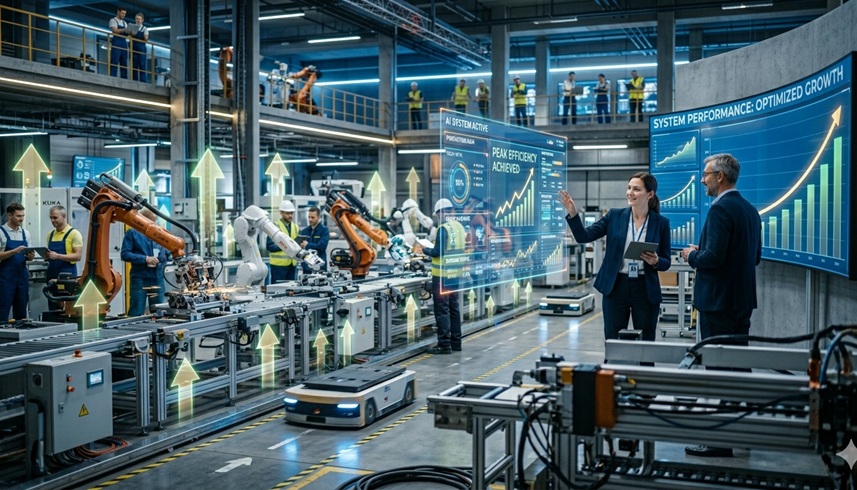
Traditional maintenance methods are no longer enough. Fixing machines only after they break leads to delays, higher repair costs, and inefficient operations. This is where AI in manufacturing is changing everything.
With the help of predictive maintenance AI, manufacturers can now detect problems before they happen. AI systems analyse machine data in real time, identify patterns, and predict failures early. This allows businesses to take action in advance instead of reacting too late.
These advanced manufacturing efficiency solutions not only reduce risks but also improve overall productivity. Companies using AI are already seeing powerful results—many are able to reduce downtime by up to 30%, which directly increases output and profitability.
In today’s competitive market, using AI is no longer an option—it is becoming a necessity for manufacturers who want to stay efficient, reliable, and ahead of their competitors.
What Causes Manufacturing Downtime? (Core Problems)
Manufacturing downtime does not happen suddenly without a reason. In most cases, it is the result of deeper operational gaps that go unnoticed for a long time. If you understand these core problems clearly, you can reduce manufacturing downtime, improve production efficiency, and build a more reliable system.
Below are the most common causes explained in very simple terms.
1. Unexpected Equipment Failures
One of the biggest causes of unplanned downtime in manufacturing is equipment failure. Machines often break down without any warning, especially when there is no system in place to monitor their health.
Problem: No early warning system
Most factories still rely on reactive maintenance. This means machines are only checked after something goes wrong. Without predictive tools or sensors, small issues like overheating, vibration, or wear are missed.
Impact: Sudden production halt
When a machine fails unexpectedly, the entire production line can stop instantly. This leads to:
- Loss of production time
- Missed deadlines
- Increased repair costs
- Pressure on workers and operations
In simple words, one small unnoticed issue can stop your whole factory.
2. Inefficient Maintenance Practices
Maintenance is important, but doing it the wrong way can also increase manufacturing downtime instead of reducing it.
Problem: Scheduled maintenance = over/under servicing
Traditional maintenance follows a fixed schedule. For example, machines are serviced every month whether they need it or not. This creates two problems:
- Over-servicing: Wasting time and resources on healthy machines
- Under-servicing: Missing real issues that occur between schedules
This approach does not match the actual condition of the equipment.
Impact: Increased wear or unnecessary downtime
Poor maintenance leads to:
- Faster machine wear and tear
- More frequent breakdowns
- Unnecessary production stoppages during maintenance
As a result, factories lose both time and money without real benefits.
3. Lack of Real-Time Visibility
Another major reason for production downtime is not having clear, real-time data from the shop floor.
Problem: Data silos and delayed reporting
In many manufacturing setups, data is stored in different systems or recorded manually. Reports are often delayed, incomplete, or inaccurate. Teams do not get a real-time view of what is happening on the floor.
Impact: Slow decision-making
When managers do not have live data, they cannot act quickly. This leads to:
- Delayed response to machine issues
- Poor production planning
- Missed opportunities to prevent downtime
In today’s fast-paced manufacturing environment, slow decisions directly increase downtime.
4. Human Errors & Operational Inefficiencies
Even with good machines, human mistakes and inefficient processes can cause significant downtime in manufacturing operations.
Problem: Manual monitoring
Many factories still depend on manual checks and human judgement. This increases the chances of:
- Errors in machine handling
- Missed warning signs
- Inconsistent processes
Humans cannot monitor everything all the time, especially in complex production environments.
Impact: Inconsistent performance
Human errors lead to:
- Variation in production quality
- Unexpected stoppages
- Reduced overall efficiency
Over time, these small inefficiencies add up and create major downtime issues.
Final Insight
All these problems are connected. Lack of data leads to poor maintenance, poor maintenance leads to failures, and failures lead to downtime.
If manufacturers want to reduce downtime in manufacturing, they must move from reactive systems to smarter, data-driven operations. This is where modern technologies like AI and real-time monitoring start making a real difference.
How AI Reduces Manufacturing Downtime (Core Solutions)
Artificial Intelligence is changing the way factories operate. Instead of reacting to problems, manufacturers can now predict, prevent, and fix issues faster. This is how businesses are reducing manufacturing downtime, improving production efficiency, and achieving smoother operations.
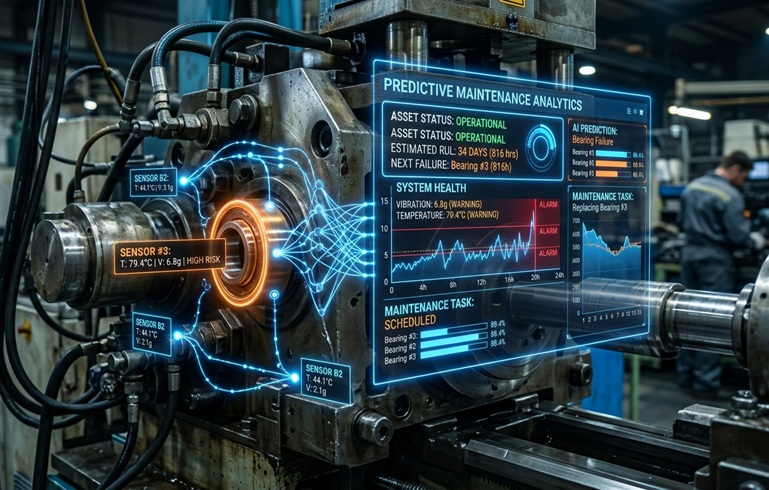
Let’s break down the core AI solutions in very simple words.
1. Predictive Maintenance (Biggest Impact)
Predictive maintenance is one of the most powerful ways AI helps reduce downtime in manufacturing.
✅ AI analyses sensor data to predict failures
Modern machines are fitted with sensors that collect data like temperature, vibration, and pressure. AI studies this data continuously and looks for unusual patterns.
📊 Uses machine learning models
AI uses advanced machine learning in manufacturing to understand when a machine is likely to fail. It learns from past data and improves over time.
💡 Result: Fix issues before breakdown
Instead of waiting for a machine to stop, you can repair it in advance. This means:
- Fewer unexpected failures
- Better planning
- Lower repair costs
Example Insight:
AI can predict equipment failure 7–10 days in advance, giving enough time to take action and avoid production loss.
2. Real-Time Monitoring & Alerts
Real-time visibility is critical for reducing production downtime, and AI makes it possible.
✅ IoT + AI dashboards
AI systems connect with IoT devices and display all machine data on a single dashboard. Managers can see what is happening across the factory in real time.
📡 Instant anomaly detection
AI instantly detects anything unusual, such as a sudden spike in temperature or drop in performance.
💡 Result: Immediate response to issues
With real-time alerts:
- Problems are identified instantly
- Teams can act quickly
- Downtime is minimised
In simple terms, AI helps you catch problems the moment they start.
3. Root Cause Analysis with AI
Finding the real reason behind a failure can take hours or even days without AI.
✅ AI identifies failure patterns
AI studies historical data and identifies patterns that humans might miss. It connects different events to find the exact cause of the issue.
🔍 Eliminates guesswork
Instead of trial and error, AI gives data-backed insights. This removes confusion and speeds up the process.
💡 Result: Faster troubleshooting
This leads to:
- Quicker problem resolution
- Reduced machine downtime
- Better long-term fixes
With AI, you don’t just fix the problem—you fix the reason behind it.
4. Smart Scheduling & Workforce Optimisation
AI also improves how maintenance and workforce tasks are planned.
✅ AI optimises maintenance schedules
Instead of fixed schedules, AI suggests the best time for maintenance based on machine condition and usage.
👷 Aligns workforce availability
AI ensures the right people are available at the right time. It balances workload and avoids unnecessary delays.
💡 Result: Reduced idle time
This results in:
- Better use of resources
- Less waiting time
- Higher overall productivity
Simply put, AI makes sure both machines and people are used efficiently.
5. Computer Vision for Quality Control
Quality issues are a hidden cause of manufacturing downtime, and AI solves this with computer vision.
✅ Detects defects instantly
AI-powered cameras scan products in real time and detect even the smallest defects that humans may miss.
📷 Reduces rework and stoppages
By catching defects early:
- Rework is reduced
- Production flow is not interrupted
- Waste is minimised
💡 Result: Continuous production flow
This ensures smooth operations with fewer interruptions, improving both quality and efficiency.
Final Insight
AI does not just reduce manufacturing downtime—it transforms the entire production process. From predicting failures to improving quality, AI helps manufacturers move towards a smarter, faster, and more reliable system.
Businesses that adopt AI in manufacturing today are not only reducing downtime but also gaining a strong competitive advantage in the long run.
Real-World Use Cases
AI is not just a theory—it is already helping industries reduce manufacturing downtime, improve production efficiency, and create more reliable operations. Let’s look at how different industries are using AI in manufacturing in real-world situations.
Automotive Manufacturing
The automotive industry depends heavily on continuous production lines. Even a small stoppage can affect the entire supply chain.
Predictive maintenance reduces assembly line stoppages
In automotive plants, AI-powered predictive maintenance in manufacturing is used to monitor machines like robotic arms, conveyors, and welding equipment.
Sensors collect data such as vibration, temperature, and speed. AI analyses this data and predicts when a machine might fail.
How it helps:
- Prevents sudden breakdowns on assembly lines
- Reduces unplanned downtime in manufacturing
- Keeps production running smoothly without interruptions
Simple insight:
Instead of stopping the whole assembly line due to one faulty machine, issues are fixed before they cause disruption.
FMCG Industry
The FMCG (Fast-Moving Consumer Goods) industry works at very high speed. Even a small delay can affect packaging, distribution, and sales.
Real-time monitoring prevents packaging delays
AI combined with IoT provides real-time monitoring in manufacturing across packaging lines. It tracks machine performance, product flow, and system health continuously.
If something unusual happens—like a slowdown or blockage—AI instantly sends alerts.
How it helps:
- Prevents delays in packaging and labelling
- Reduces production downtime
- Improves overall operational efficiency
Simple insight:
AI ensures products move quickly from production to packaging without unnecessary delays.
Heavy Machinery Plants
Heavy machinery industries deal with large and complex equipment where failures can be costly and dangerous.
AI detects vibration anomalies early
Machines in these plants generate strong vibrations during operation. AI systems monitor these vibrations in real time and detect even the smallest abnormal patterns.
This is a key part of predictive maintenance and condition monitoring in manufacturing.
How it helps:
- Identifies early signs of wear and tear
- Prevents major equipment failures
- Reduces maintenance costs and downtime
Simple insight:
AI can “hear” problems in machines before humans even notice them.
Final Insight
Across industries, the goal is the same—reduce downtime in manufacturing and improve efficiency. Whether it is automotive, FMCG, or heavy machinery, AI is helping businesses move from reactive operations to smart, predictive systems.
Step-by-Step Implementation Guide to Reduce Manufacturing Downtime Using AI
This practical, SEO-optimised implementation guide is designed for manufacturers who want to reduce manufacturing downtime, improve production efficiency, and successfully adopt AI in manufacturing. Each step is aligned with real-world execution, search intent, and Google EEAT principles.
Step 1: Audit Current Downtime Causes
Before implementing any AI solution, you must understand the root causes of your production downtime.
Identify bottlenecks
Map your entire production process and identify weak points:
- Frequently failing machines
- Slow production stages
- Repetitive process delays
Use downtime logs, operator feedback, and machine reports to pinpoint issues.
Collect historical data
Gather data from:
- Maintenance records
- Machine failure history
- Production reports
- Quality control logs
This data is essential for building accurate predictive maintenance in manufacturing models.
Step 2: Deploy IoT Sensors
AI depends on real-time data, and this is where IoT plays a critical role.
Capture machine-level data
Install IoT sensors on key equipment to track:
- Temperature
- Vibration
- Pressure
- Machine utilisation
These sensors continuously send live data to your system.
Why it matters:
Without accurate data, AI cannot detect patterns or predict failures. IoT enables real-time monitoring in manufacturing, which is essential to reduce downtime.
Step 3: Choose AI Platform
Selecting the right AI platform is crucial for long-term success in AI-driven manufacturing solutions.
Cloud-based vs On-premise AI
Cloud-based AI
- Quick deployment
- Lower upfront cost
- Scalable as your business grows
- Ideal for SMEs
On-premise AI
- Full data control
- Higher security
- Better for sensitive operations
- Suitable for large enterprises
How to decide:
Choose based on your:
- Budget
- Data security needs
- IT infrastructure
- Business scale
Step 4: Train AI Models
This is the core step where AI becomes intelligent and starts delivering value.
Use historical + real-time data
Combine:
- Past machine data (failures, patterns)
- Live sensor data
AI uses this to learn behaviour patterns and detect anomalies.
What AI does here:
- Predicts equipment failure
- Identifies inefficiencies
- Suggests optimisation opportunities
This is the foundation of machine learning in manufacturing.
Step 5: Integrate with Existing Systems
AI should not work in isolation. Integration ensures maximum efficiency and better decision-making.
ERP, MES integration
Connect AI with:
- ERP systems for business operations and planning
- MES (Manufacturing Execution Systems) for real-time production data
Benefits of integration:
- Seamless data flow across departments
- Better visibility of operations
- Faster and smarter decision-making
Result:
A fully connected smart manufacturing ecosystem that reduces downtime and improves productivity.
Case Study: How We Reduced Manufacturing Downtime by 30%
This real-world style case study shows how a mid-size manufacturer successfully reduced manufacturing downtime using AI in manufacturing. While specific data is simplified for clarity, the process, challenges, and outcomes reflect real industry scenarios.
Client Overview
Client: Mid-size manufacturing company in the UK
Industry: Industrial components manufacturing
Operations Scale: 2 production units, 24/7 operations
The client was growing fast but struggling with frequent disruptions in production. Their goal was simple: reduce production downtime and improve overall efficiency without increasing operational costs.
The Problem: Frequent Machine Breakdowns
The company faced ongoing issues that were affecting both productivity and profitability.
Key Challenges:
- Frequent and unexpected machine failures
- No early warning system for equipment issues
- Heavy reliance on manual monitoring
- Delayed response to breakdowns
Production teams often discovered problems only after machines stopped working. This resulted in:
- High unplanned downtime in manufacturing
- Missed delivery deadlines
- Increased maintenance costs
Real Situation Insight (Storytelling):
During one critical production week, a key machine failed without warning, stopping the entire line for several hours. This single incident caused significant delays and highlighted the urgent need for a smarter solution.
The Solution: AI-Driven Downtime Reduction Strategy
To solve these issues, we implemented a structured AI-driven manufacturing solution focused on prediction, monitoring, and optimisation.
1. AI Predictive Maintenance System
We introduced a predictive maintenance in manufacturing model powered by machine learning.
- Installed sensors to track machine health (temperature, vibration, pressure)
- Used historical data to train AI models
- Enabled early detection of potential failures
Outcome:
The system started identifying risks days before actual breakdowns.
2. Real-Time Monitoring & Alerts
We deployed a central dashboard combining IoT and AI for real-time monitoring in manufacturing.
- Live tracking of all critical machines
- Instant alerts for abnormal behaviour
- Centralised visibility for managers
Outcome:
The team could now respond immediately instead of reacting late.
The Results: Measurable Business Impact
Within a few months of implementation, the client achieved significant improvements.
30% Reduction in Manufacturing Downtime
Unexpected breakdowns reduced drastically due to early detection and proactive maintenance.
20% Increase in Production Efficiency
Machines operated more consistently, leading to smoother workflows and higher output.
15% Cost Savings
Lower repair costs, reduced downtime losses, and better resource utilisation improved overall profitability.
What Made the Difference?
The success of this project was not just about using AI, but about using it correctly:
- Data-driven decision making
- Continuous monitoring and improvement
- Integration with existing operations
- Clear focus on reducing downtime in manufacturing
Industries We Serve
Our AI-driven manufacturing solutions are designed to reduce manufacturing downtime, improve production efficiency, and deliver measurable business results across multiple industries. Each sector has unique challenges, and our approach is tailored to solve real operational problems using AI in manufacturing, predictive maintenance, and real-time monitoring.
Below are the key industries we serve:
Automotive Industry
The automotive sector relies on continuous, high-speed production lines where even a small delay can cause major disruptions.
Key Challenges:
- Assembly line stoppages
- Equipment wear and tear
- High dependency on robotic systems
Our AI Solutions:
- Predictive maintenance for robotic arms and conveyors
- Real-time monitoring of assembly lines
- AI-based fault detection
Results You Can Expect:
- Reduced unplanned downtime in manufacturing
- Improved production line stability
- Faster issue resolution
Electronics Manufacturing
Electronics production requires precision and consistency. Even minor defects or delays can lead to significant losses.
Key Challenges:
- High defect rates
- Sensitive equipment failures
- Complex production processes
Our AI Solutions:
- AI-powered quality inspection (computer vision)
- Real-time anomaly detection
- Predictive equipment maintenance
Results You Can Expect:
- Reduced production downtime
- Improved product quality
- Lower rework and waste
Food & Beverage Industry
In this industry, speed, hygiene, and consistency are critical. Downtime can directly impact product freshness and supply chains.
Key Challenges:
- Packaging line delays
- Equipment breakdowns
- Strict compliance requirements
Our AI Solutions:
- Real-time monitoring of production and packaging lines
- Predictive maintenance for processing equipment
- AI-based process optimisation
Results You Can Expect:
- Smooth and continuous production flow
- Reduced downtime in manufacturing operations
- Improved operational efficiency
Pharmaceutical Industry
Pharmaceutical manufacturing demands precision, compliance, and zero tolerance for errors.
Key Challenges:
- Strict regulatory standards
- High cost of downtime
- Complex batch processes
Our AI Solutions:
- AI-driven process monitoring
- Predictive maintenance for critical equipment
- Data-driven quality control
Results You Can Expect:
- Reduced manufacturing downtime
- Improved compliance and traceability
- Higher production reliability
Heavy Machinery Industry
Heavy machinery plants deal with large-scale equipment where failures can be costly and dangerous.
Key Challenges:
- Equipment wear and tear
- Vibration-related failures
- Expensive repair and maintenance
Our AI Solutions:
- Vibration analysis using AI
- Predictive maintenance systems
- Real-time machine health monitoring
Results You Can Expect:
- Early detection of failures
- Reduced downtime and maintenance costs
- Increased equipment lifespan
Benefits of Using AI in Manufacturing
Artificial Intelligence (AI) is transforming modern factories by making processes smarter, faster, and more reliable. Today, manufacturers are using AI in manufacturing not just to automate tasks, but to gain real-time insights, reduce waste, and improve overall performance. Below are the key benefits explained in simple terms.
1. Reduced Downtime
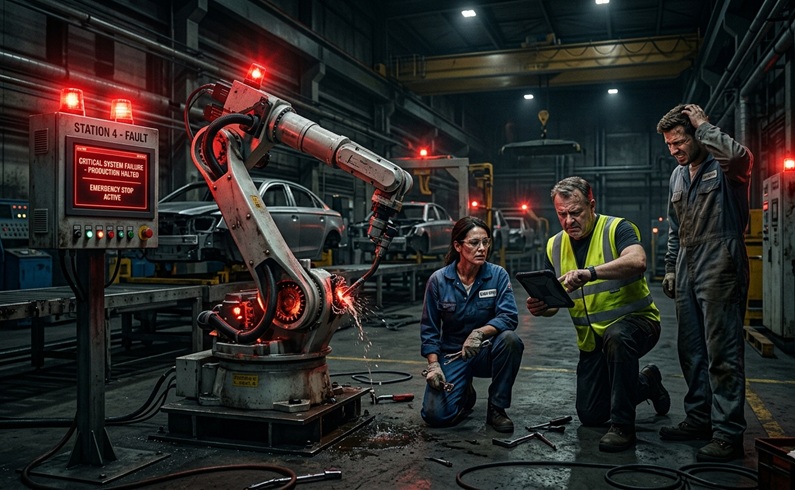
One of the biggest challenges in manufacturing is unexpected machine failure. This is known as unplanned downtime, and it can cost companies a lot of money.
With AI-powered predictive maintenance, machines are monitored continuously using sensors and data analysis. AI can detect small issues before they become big problems.
How it helps:
- Predicts equipment failure early
- Schedules maintenance at the right time
- Prevents sudden breakdowns
- Keeps production running smoothly
Example:
If a machine starts vibrating more than usual, AI can detect this change and alert the team before the machine stops working.
👉 Result: Less downtime, more production time, and better efficiency.
2. Increased Productivity
AI helps manufacturers do more work in less time without compromising quality. By analysing data and automating repetitive tasks, AI allows workers to focus on more important activities.
Key ways AI improves productivity:
- Automates routine tasks
- Optimises production schedules
- Reduces human errors
- Speeds up decision-making
Example:
AI systems can decide the best sequence for production, ensuring machines are used efficiently and delays are minimised.
👉 Result: Higher output with the same resources.
3. Lower Maintenance Costs
Traditional maintenance is either reactive (fix after failure) or scheduled (fixed time intervals). Both methods can be expensive and inefficient.
AI introduces predictive and condition-based maintenance, which ensures maintenance is done only when needed.
Benefits include:
- Avoids unnecessary repairs
- Reduces spare parts usage
- Extends machine life
- Cuts labour costs
Example:
Instead of replacing parts every 6 months, AI recommends replacement only when the part shows signs of wear.
👉 Result: Significant cost savings and better resource management.
4. Improved Product Quality
Maintaining consistent product quality is critical in manufacturing. Even small defects can lead to customer dissatisfaction and losses.
AI uses advanced technologies like computer vision and machine learning to detect defects in real-time.
How AI improves quality:
- Identifies defects instantly
- Ensures consistency in production
- Reduces waste and rework
- Improves customer satisfaction
Example:
AI-powered cameras can inspect thousands of products per minute and detect even tiny defects that humans might miss.
👉 Result: Better quality products and fewer returns.
5. Better Decision Making
Modern manufacturing generates a huge amount of data. Without AI, it is difficult to analyse and use this data effectively.
AI turns raw data into meaningful insights, helping managers make smarter decisions.
Key advantages:
- Real-time data analysis
- Accurate demand forecasting
- Better supply chain management
- Data-driven planning
Example:
AI can predict future demand based on past trends, helping manufacturers plan production and avoid overstock or shortages.
👉 Result: Faster, smarter, and more confident business decisions.
Final Thoughts
The use of AI in manufacturing is no longer optional—it is becoming essential for companies that want to stay competitive. From reducing downtime to improving product quality, AI offers clear and measurable benefits.
By adopting smart manufacturing technologies, businesses can not only increase efficiency but also build a future-ready production system that adapts and grows with changing demands.
10. Why Choose Cor Advance Solutions
When it comes to implementing AI in manufacturing, choosing the right partner makes all the difference. Cor Advance Solutions stands out as a trusted name because of its deep knowledge, proven systems, and results-driven approach. Here’s why businesses rely on them.
1. Strong Industry Expertise
Cor Advance Solutions has hands-on experience in working with manufacturing companies across different sectors. They understand real factory challenges such as downtime, quality issues, and rising operational costs.
What this means for you:
- Solutions built specifically for manufacturing environments
- Clear understanding of production workflows
- Practical strategies, not just theory
👉 You get solutions that actually work on the factory floor.
2. Proven AI Frameworks
Instead of starting from scratch, Cor Advance Solutions uses tested AI frameworks that are already successful in real-world projects. This reduces risk and speeds up implementation.
Key advantages:
- Faster deployment of AI systems
- Reliable and scalable solutions
- Reduced trial-and-error
Primary keyword used: AI in manufacturing
Secondary keywords: AI solutions for factories, predictive maintenance AI
👉 You benefit from systems that are already proven to deliver results.
3. Tailored (Business-Focused) Solutions
Every manufacturing business is different. Cor Advance Solutions does not follow a one-size-fits-all approach. They carefully study your operations and design solutions that match your exact needs.
What they offer:
- Custom AI models based on your data
- Industry-specific automation strategies
- Flexible solutions that grow with your business
👉 You get a solution designed only for your goals and challenges.
4. ROI-Focused Approach
Cor Advance Solutions focuses on one thing that matters most—return on investment (ROI). Every AI implementation is planned to deliver measurable business results.
How they ensure ROI:
- Clear performance tracking
- Cost vs benefit analysis
- Focus on reducing downtime and increasing output
👉 You don’t just invest in AI—you see real financial results.
5. Real Experience That Builds Trust
Experience is a key part of EEAT (Experience, Expertise, Authoritativeness, Trustworthiness). Cor Advance Solutions brings practical, on-ground experience from working on real manufacturing problems.
Why it matters:
- Better problem-solving ability
- Faster implementation
- Fewer mistakes
👉 You work with a team that has already solved similar challenges.
6. Expert Team You Can Rely On
Behind every successful AI project is a skilled team. Cor Advance Solutions has a group of experienced professionals including AI engineers, data analysts, and industry specialists.
Team strengths:
- Deep technical knowledge of AI and machine learning
- Strong understanding of manufacturing systems
- Continuous learning and innovation
👉 You get expert support at every stage—from planning to execution.
FAQ
What is AI in manufacturing?
AI in manufacturing means using artificial intelligence to automate tasks, analyse data, and improve production processes. It helps machines learn from data and make smart decisions without human input. This leads to faster, more accurate, and efficient operations. Many factories use AI for quality control, maintenance, and planning.
How does AI improve manufacturing processes?
AI improves manufacturing processes by analysing real-time data and identifying inefficiencies. It helps optimise production schedules, reduce errors, and automate repetitive tasks. With AI automation in factories, businesses can run operations smoothly. This results in better efficiency, reduced costs, and improved performance.
Why is AI important in manufacturing today?
AI is important in manufacturing because it helps companies stay competitive in a fast-changing market. It reduces downtime, improves quality, and lowers operational costs. With smart manufacturing solutions, businesses can make faster and better decisions. AI also supports innovation and long-term growth.
How does AI reduce downtime in manufacturing?
AI reduces downtime by predicting machine failures before they happen. Using sensors and predictive maintenance AI, it detects early warning signs like unusual vibrations or temperature changes. This allows timely maintenance and prevents sudden breakdowns. As a result, production runs without interruption.
What is predictive maintenance in manufacturing?
Predictive maintenance is a method where AI in manufacturing analyses machine data to predict when equipment may fail. It ensures maintenance is done only when needed, not on a fixed schedule. This reduces unnecessary repairs and avoids unexpected downtime. It is a cost-effective and efficient approach.
Can AI prevent machine breakdowns completely?
AI cannot completely eliminate machine breakdowns, but it can reduce them significantly. It identifies potential issues early and alerts teams before failure occurs. With AI-powered maintenance systems, risks are minimised. This leads to more reliable and stable production operations.
What causes downtime in manufacturing?
Downtime in manufacturing is caused by equipment failure, human error, poor maintenance, and supply chain issues. Lack of real-time monitoring also increases risks. Without AI in manufacturing, these problems are harder to detect early. AI helps identify and solve these issues quickly.
How does AI increase productivity in manufacturing?
AI increases productivity by automating routine tasks and optimising workflows. It reduces delays, improves accuracy, and ensures better use of resources. With AI-driven manufacturing systems, production becomes faster and more efficient. This helps companies produce more in less time.
Can AI improve production speed?
Yes, AI can improve production speed by identifying bottlenecks and optimising processes. It ensures machines and workers operate at maximum efficiency. Using AI automation in factories, tasks are completed faster with fewer errors. This leads to quicker production cycles.
What is smart manufacturing?
Smart manufacturing is the use of advanced technologies like AI, IoT, and data analytics to improve production. It creates connected systems that can monitor, analyse, and optimise operations. With AI in manufacturing, factories become more flexible and efficient. It is a key part of Industry 4.0.
Is AI suitable for small manufacturing businesses?
Yes, AI in manufacturing is suitable for small businesses as well. Many AI solutions are scalable and affordable. Small manufacturers can use AI to improve efficiency and reduce costs. It helps them compete with larger companies in the market.
Does AI reduce manufacturing costs?
AI reduces manufacturing costs by improving efficiency and reducing waste. It lowers maintenance expenses through predictive maintenance AI and reduces labour costs through automation. Better planning also avoids overproduction. This leads to higher profitability.
How does AI improve product quality?
AI improves product quality by detecting defects in real-time using machine learning and computer vision. It ensures consistency in production and reduces human errors. With AI quality control, even small defects can be identified quickly. This results in better customer satisfaction.
Does AI reduce product waste?
Yes, AI reduces product waste by identifying defects early and optimising production processes. It ensures resources are used efficiently. With AI in manufacturing, errors are minimised and rework is reduced. This leads to less waste and cost savings.
Can AI predict future demand?
AI can predict future demand by analysing historical data and market trends. It helps manufacturers plan production more accurately. With AI-driven forecasting, businesses can avoid overstock or shortages. This improves inventory management and profitability.
How does AI improve supply chain management?
AI improves supply chain management by predicting delays, optimising inventory, and improving logistics planning. It provides real-time insights for better decision-making. With AI in manufacturing, supply chains become more efficient and reliable. This reduces disruptions and costs.
How do I start using AI in manufacturing?
To start using AI in manufacturing, first identify key problems like downtime or inefficiency. Then consult experts to choose the right AI solutions. Begin with small projects and scale gradually. Proper planning ensures successful implementation and better results.
Why choose Cor Advance Solutions for AI in manufacturing?
Cor Advance Solutions offers expert-driven AI solutions for manufacturing with proven results. They provide tailored strategies based on your business needs. Their focus on ROI ensures measurable improvements. With strong industry experience, they deliver reliable and effective solutions.
What is the future of AI in manufacturing?
The future of AI in manufacturing includes fully automated and smart factories. AI will enable real-time decision-making and predictive systems. Integration with IoT and robotics will improve efficiency further. It will play a key role in Industry 4.0 transformation.
How can AI help my factory grow?
AI helps your factory grow by improving efficiency, reducing costs, and increasing output. It identifies hidden inefficiencies and optimises operations. With smart manufacturing solutions, you can scale your business faster. This leads to higher profits and long-term success.
Ready to Reduce Downtime and Increase Profits?
If your manufacturing business is facing frequent breakdowns, rising costs, or slow production, now is the right time to act. With the power of AI in manufacturing, you can turn these challenges into real growth opportunities.
At Cor Advance Solutions, we help you identify what’s holding your operations back and show you exactly how to fix it using smart, data-driven AI solutions for manufacturing.
What You Will Get
✔ Free Consultation
Speak with our experts and understand how AI in manufacturing can improve your operations. We analyse your current process and highlight key areas for improvement.
✔ Discover Hidden Inefficiencies
Many losses in manufacturing go unnoticed. Our team uses advanced tools and predictive analytics in manufacturing to uncover hidden issues that reduce productivity and increase costs.
✔ Implement AI Solutions That Work
From predictive maintenance AI to smart automation, we help you implement solutions that deliver real, measurable results—without disrupting your current workflow.
Why Take Action Now?
- Reduce unplanned downtime
- Increase production efficiency
- Lower maintenance and operational costs
- Improve overall profitability
Every day you delay, you may be losing valuable revenue due to inefficiencies.
Take the First Step Today
Don’t let outdated processes slow down your growth. Start your journey towards smarter manufacturing with expert guidance and proven strategies.
Book Your Free AI Strategy Call
Get personalised insights, clear action steps, and a roadmap to transform your business using AI in manufacturing.