
Businesses today are drowning in data—but the real challenge is choosing the right way to store and use it. This is where understanding data lake vs data warehouse vs lakehouse becomes critical.
A data lake gives you flexibility to store any type of data, a data warehouse helps you get fast and reliable reports from structured data, and a data lakehouse combines both into one powerful solution.
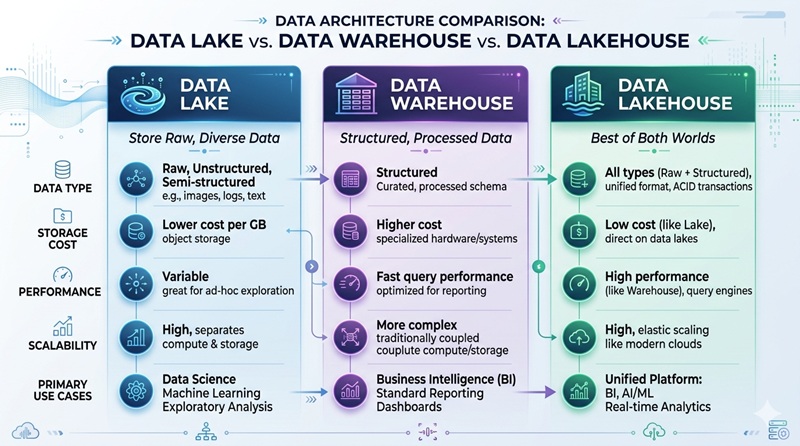
If you’re confused about data lake vs warehouse difference or wondering what is data lakehouse and which one is best for your business, you’re in the right place. In this guide, we’ll break everything down in very simple words so you can choose the right data architecture based on your goals, budget, and future growth.
📊 Quick Comparison Table
| Feature | Data Lake | Data Warehouse | Data Lakehouse |
| Data Type | Stores raw, structured, and unstructured data | Stores only structured data | Stores all types of data |
| Schema | Schema-on-read (structure applied later) | Schema-on-write (structure applied before storing) | Hybrid approach |
| Cost | Low (cheap storage) | High (expensive infrastructure) | Moderate (balanced cost) |
| Performance | Moderate (depends on tools) | High (optimized for fast queries) | High (optimized + flexible) |
| Use Case | Big data, machine learning, real-time data | Business intelligence, dashboards, reporting | Unified analytics (AI + BI together) |
| Flexibility | Very high | Limited | High |
What This Means in Simple Words
- A data lake is best when you have a large amount of raw data and want flexibility.
- A data warehouse is best when you need fast, accurate reports from clean data.
- A data lakehouse is the modern solution that combines both flexibility and performance.
If you’re choosing between data warehouse vs lakehouse performance or looking for the best data storage solution for big data analytics, the answer depends on your business needs, not just technology.
Why This Comparison Matters for Your Business
Choosing the wrong data system can waste money, slow down decisions, and limit growth. But choosing the right one can:
✔ Improve decision-making speed
✔ Reduce data costs
✔ Support AI and analytics together
✔ Future-proof your business
That’s why understanding data architecture comparison is not just technical—it directly impacts your ROI.
What is a Data Lake?
A data lake is a centralized storage system that allows you to store all your data in its original, raw format—without organizing, filtering, or structuring it first. This makes it a key part of modern discussions around data lake vs data warehouse vs lakehouse.
In simple words, a data lake works like a huge digital storage space where businesses can collect data from multiple sources—websites, mobile apps, sensors, social media, logs, and databases—and keep everything as it is. You don’t need to decide how the data will be used before storing it. Instead, you structure and analyze the data only when you need it.
This approach is called schema-on-read, and it is one of the biggest differences in the data lake vs warehouse difference comparison. It gives businesses the flexibility to use data in many different ways, especially for advanced analytics and future use cases.
🔹 Key Features of a Data Lake
✔ Handles all types of data
A data lake can store structured data (tables), semi-structured data (JSON, XML), and unstructured data (images, videos, emails). This makes it ideal for companies dealing with diverse data sources.
✔ Highly scalable storage
Data lakes are built to handle massive amounts of data. Whether you have gigabytes or petabytes of data, a data lake can scale easily without performance issues.
✔ Cost-efficient solution
Compared to traditional systems, data lakes are much cheaper because they use low-cost storage solutions. This is why they are popular for big data analytics.
✔ Supports AI and Machine Learning
Since data is stored in raw form, it can be used for training machine learning models, predictive analytics, and AI applications. This makes data lakes a key part of modern data strategies.
✔ Schema-on-read flexibility
You don’t need to define the structure before storing data. You apply structure only when you read or analyze it, giving you more control and flexibility.
✔ Centralized data storage
All business data is stored in one place, making it easier to access and analyze across teams.
These features make data lakes a strong choice in modern data architecture for businesses that want flexibility and future-ready systems.
🔹 Pros of a Data Lake
• Low storage cost
Data lakes use affordable storage systems, making them ideal for companies that generate large volumes of data daily.
• High scalability
As your business grows, your data lake can easily expand without major infrastructure changes.
• Flexibility in data usage
You can store any type of data and decide later how to use it. This is useful when business needs change over time.
• Supports advanced analytics
Data lakes are perfect for AI, machine learning, and predictive analytics, helping businesses make smarter decisions.
• Future-proof solution
Since all data is stored, you can use it later for new technologies or insights that you may not need today.
👉 If you’re deciding which is better data lake or data warehouse for business, a data lake is the better option when flexibility, scalability, and innovation are your priorities.
🔹 Cons of a Data Lake
• Data quality challenges
Because data is stored in raw format, it can become messy and unorganized over time. Without proper management, it may be hard to find useful insights.
• Requires skilled professionals
Data engineers and data scientists are needed to clean, process, and analyze the data effectively.
• Slower performance for reporting
Data lakes are not optimized for fast queries like data warehouses, so they are not the best choice for business dashboards and reporting.
• Risk of becoming a “data swamp”
If data is not managed properly, the data lake can become cluttered and difficult to use, reducing its value.
👉 This is why governance and proper data management are critical when using a data lake.
🔹 Best Use Cases of a Data Lake
• Machine Learning and AI projects
Data lakes are widely used to store large datasets needed to train AI and machine learning models.
• IoT data processing
Devices and sensors generate continuous data. A data lake can store and process this real-time data efficiently.
• Real-time analytics
Businesses can analyze live data streams, such as user activity or system logs, to make quick decisions.
• Big data storage and processing
Companies dealing with massive data volumes use data lakes for storage and future analysis.
• Data exploration and experimentation
Data scientists can explore raw data to discover patterns, trends, and insights.
🧠 Quick Summary
A data lake is a scalable and cost-effective system that stores raw data in any format. It is best for big data, machine learning, and real-time analytics because it offers flexibility and supports advanced analytics. However, it requires proper management to maintain data quality and performance.
What is a Data Warehouse?
A data warehouse is a system designed to store clean, structured data so businesses can easily analyze it and create reports. In the data lake vs data warehouse vs lakehouse comparison, a data warehouse is built for one main goal—fast and accurate business insights.
In simple words, a data warehouse takes data from different sources (like CRM, sales tools, or apps), cleans it, organizes it into tables, and makes it ready for reporting. This process is called schema-on-write, meaning data is structured before it is stored.
👉 This is why a data warehouse is the best choice when you need reliable reporting and clear decision-making.
🔹 Key Features of a Data Warehouse
✔ Stores cleaned and structured data
All data is organized into rows and columns, making it easy to understand and analyze.
✔ Fast query performance
Data warehouses are optimized for speed, so you can run reports and get results quickly.
✔ Strong data governance
They follow strict rules for data quality, security, and consistency, ensuring trustworthy insights.
✔ Optimized for business intelligence (BI)
Perfect for dashboards, reports, and data visualization tools.
✔ Schema-on-write approach
Data is cleaned and structured before storage, ensuring high accuracy.
👉 These features make data warehouses a key part of modern data architecture for businesses focused on reporting and analytics.
🔹 Pros of a Data Warehouse
• Reliable insights
Since data is cleaned and structured, the results are accurate and trustworthy.
• High performance
Queries run fast, making it ideal for real-time business decisions.
• Easy reporting
Business teams can quickly create dashboards and reports without technical complexity.
• Better decision-making
Clear and organized data helps companies make smarter, data-driven decisions.
👉 When comparing data warehouse vs lakehouse performance, data warehouses are still one of the best options for fast and reliable reporting.
🔹 Cons of a Data Warehouse
• Expensive to maintain
Data warehouses require more resources, infrastructure, and licensing costs.
• Limited flexibility
They mainly support structured data, so handling unstructured data (like videos or images) is difficult.
• Time-consuming setup
Data must be cleaned and structured before storage, which takes time and effort.
👉 This is a key difference in the data lake vs warehouse difference, where data lakes offer more flexibility.
🔹 Best Use Cases of a Data Warehouse
• Financial reporting
Used for accurate financial data analysis and compliance reporting.
• Business dashboards
Helps create dashboards for sales, marketing, and operations teams.
• Historical data analysis
Ideal for analyzing past trends and performance over time.
• Business intelligence (BI)
Supports tools that provide insights for decision-making.
🧠Quick Summary
A data warehouse is a structured system that stores clean and organized data for fast reporting and business intelligence. It offers high performance and reliable insights, making it ideal for dashboards and financial analysis, but it is more expensive and less flexible than a data lake.
What is a Data Lakehouse?
A data lakehouse is a modern data system that combines the best parts of a data lake and a data warehouse into one platform. In the data lake vs data warehouse vs lakehouse comparison, the lakehouse is designed to give you both flexibility and performance in a single solution.
In simple words, a data lakehouse lets you store all types of data like a data lake (raw, structured, and unstructured), while also giving you fast queries and reliable reporting like a data warehouse. It removes the need to manage two separate systems.
👉 This is why many companies are now moving toward lakehouse architecture as part of the modern data stack 2026.
🔹 Key Features of a Data Lakehouse
✔ Supports all data types
You can store structured, semi-structured, and unstructured data in one place—just like a data lake.
✔ Unified architecture
Instead of using separate systems for storage and analytics, a lakehouse brings everything together in one platform.
✔ Improved performance
It offers fast query performance similar to a data warehouse, making it ideal for reporting and analytics.
✔ Data reliability and governance
Unlike traditional data lakes, lakehouses include features like data quality control and governance.
✔ Combines schema flexibility
Uses a hybrid approach (schema-on-read + schema-on-write), giving both flexibility and structure.
👉 These features make lakehouses a strong solution in data architecture comparison for modern businesses.
🔹 Pros of a Data Lakehouse
• Cost-efficient with high performance
You get the low-cost storage of a data lake and the speed of a data warehouse in one system.
• Simplified data stack
No need to manage separate tools for storage and analytics, reducing complexity.
• Supports AI and BI together
You can run machine learning models and business reports on the same data platform.
• Better scalability and flexibility
Handles growing data needs while still delivering fast performance.
👉 If you’re deciding when to use data lakehouse architecture, it’s ideal when you want both advanced analytics and business reporting in one place.
🔹 Cons of a Data Lakehouse
• Still evolving technology
Lakehouse architecture is newer compared to traditional systems, so tools and best practices are still developing.
• Requires proper implementation
To get the best results, you need the right setup, tools, and expertise.
• Initial learning curve
Teams may need time to adapt to this modern approach.
👉 Despite these challenges, lakehouses are quickly becoming a preferred solution in modern data architecture.
🔹 Best Use Cases of a Data Lakehouse
• Modern data platforms
Companies building new data systems prefer lakehouses for flexibility and performance.
• AI + BI integration
Run machine learning models and business dashboards on the same data.
• Real-time analytics and reporting
Analyze live data and generate reports without moving data between systems.
• Unified data management
Manage all data in one place without duplication or complexity.
🧠 Quick Summary
A data lakehouse is a modern data architecture that combines the flexibility of a data lake with the performance of a data warehouse. It supports all data types, enables fast analytics, and allows businesses to run AI and BI together, making it a powerful and cost-effective solution for modern data needs.
Data Lake vs Data Warehouse vs Lakehouse (Deep Comparison)
Choosing between a data lake vs data warehouse vs lakehouse is one of the most important decisions in modern data architecture. The right choice can improve your business performance, reduce costs, and help you scale faster. The wrong choice can slow down insights and increase complexity.
In this detailed comparison, we will break down the key differences in data processing, performance, cost, and scalability in very simple words so you can make a confident decision.
🔹 1. Data Processing Approach (How Data is Stored & Used)
This is the biggest difference in the data lake vs warehouse difference.
✅ Data Lake → Raw Ingestion (Schema-on-Read)
A data lake stores data in its original format without cleaning or organizing it first. You apply structure only when you use the data.
What this means for your business:
- You can store any type of data quickly
- No need to decide structure in advance
- More flexibility for future use
👉 Best for: AI, machine learning, and big data analytics
✅ Data Warehouse → Processed Data (Schema-on-Write)
A data warehouse cleans, transforms, and structures data before storing it.
What this means for your business:
- Data is ready for reporting immediately
- High accuracy and consistency
- Easier for business users to understand
👉 Best for: dashboards, reporting, and business intelligence (BI)
✅ Data Lakehouse → Hybrid Approach
A data lakehouse combines both approaches. You can store raw data and also structure it for fast analytics.
What this means for your business:
- Flexibility + performance together
- Supports both raw and processed data
- One system instead of multiple tools
👉 Best for: modern data platforms and unified analytics
🔹 2. Performance Comparison (Speed & Query Efficiency)
Performance is critical when you need fast insights for decision-making.
⚡ Data Warehouse → Best for BI Performance
- Optimized for fast queries
- Ideal for dashboards and reports
- Handles structured data efficiently
👉 If your business depends on real-time reporting, data warehouse is a strong choice.
⚡ Data Lakehouse → Balanced Performance
- Delivers fast performance like a warehouse
- Handles large and mixed data types
- Supports both analytics and AI workloads
👉 Best option when you need both speed and flexibility.
⚡ Data Lake → Performance Depends on Tools
- Not optimized by default for fast queries
- Requires additional tools for performance improvement
👉 Suitable when performance is not the top priority but flexibility is.
🔹 3. Cost Comparison (Budget & ROI Impact)
Understanding cost is key when choosing the best data storage solution for big data analytics.
💰 Data Lake → Cheapest Option
- Uses low-cost storage systems
- Ideal for storing massive data volumes
- Minimal upfront investment
👉 Best for startups or companies handling large raw data
💰 Data Warehouse → Expensive Option
- Higher storage and processing costs
- Requires structured infrastructure
- Maintenance and scaling increase cost
👉 Best for enterprises that prioritize accuracy and reporting
💰 Data Lakehouse → Cost-Effective Balance
- Combines low-cost storage with high performance
- Reduces need for multiple systems
- Better long-term ROI
👉 Best for businesses looking for value + performance
🔹 4. Scalability (Handling Growth & Big Data)
Scalability determines how well your system can grow with your business.
📈 Data Lake → Highly Scalable
- Can store unlimited data
- Easily handles big data growth
- Ideal for long-term storage
👉 Best for data-heavy businesses
📈 Data Warehouse → Limited Scaling
- Scaling can be complex and costly
- Performance may drop with large datasets
👉 Better for controlled, structured data environments
📈 Data Lakehouse → Scalable & Efficient
- Combines scalability of data lakes with performance of warehouses
- Supports growing data without sacrificing speed
👉 Best for modern, growing businesses
🔹 5. Side-by-Side Comparison Table (Featured Snippet Optimized)
| Factor | Data Lake | Data Warehouse | Data Lakehouse |
| Data Processing | Raw ingestion | Processed before storage | Hybrid approach |
| Schema | Schema-on-read | Schema-on-write | Hybrid |
| Performance | Depends on tools | Very high | High & balanced |
| Cost | Low | High | Moderate |
| Scalability | Very high | Limited | High |
| Best For | AI, ML, big data | BI, reporting | Unified analytics |
🧠 Quick Summary
- A data lake is best for storing large amounts of raw data at low cost with high flexibility.
- A data warehouse is best for fast, reliable reporting using structured data.
- A data lakehouse is the modern solution that combines both, offering flexibility, performance, and scalability in one platform.
💡 Final Insight
If your business only needs reporting, choose a data warehouse.
If you need flexibility and big data storage, go with a data lake.
But if you want a future-ready system that supports both AI and business intelligence, a data lakehouse is the best choice in modern data architecture.
When Should You Choose Each?
Choosing between a data lake vs data warehouse vs lakehouse is not about picking the “best” technology—it’s about choosing what fits your business goals, data type, and future plans. The right decision can improve speed, reduce costs, and help you scale faster.
Below is a clear, detailed, and easy-to-follow decision framework to help you choose the right data architecture.
Understand Your Primary Goal
Before choosing any system, ask yourself:
- Do I need flexibility to store all types of data?
- Do I need fast and accurate reports?
- Do I need both AI + business analytics together?
👉 Your answer will directly guide your decision in the data lake vs data warehouse vs lakehouse comparison.
✅ Choose a Data Lake If (Flexibility & Big Data Focus)
A data lake is the best choice when your business deals with large, complex, and unstructured data.
✔ 1. You handle large unstructured data
If your data includes videos, images, logs, sensor data, or social media content, a data lake can store everything without needing structure.
👉 Example:
- IoT devices generating real-time data
- Applications collecting user activity logs
✔ 2. You need ML/AI capabilities
Data lakes are ideal for machine learning and AI because they store raw data that can be used for training models and predictive analytics.
👉 Example:
- Recommendation systems
- Fraud detection models
✔ 3. Your budget is limited
If you want to store large volumes of data at a low cost, a data lake is the most affordable option.
✔ 4. You want long-term data storage
You may not need the data now, but you want to store it for future analysis.
🎯 Best Fit For:
- Startups and tech companies
- AI and data science teams
- Businesses handling big data
✅ Choose a Data Warehouse If (Reporting & Accuracy Focus)
A data warehouse is the right choice when your main goal is fast, reliable, and structured reporting.
✔ 1. You need fast BI reports
If your business depends on dashboards and reports, a data warehouse provides fast query performance.
👉 Example:
- Sales dashboards
- Marketing performance reports
✔ 2. Your data is structured
If your data is already organized (like CRM, ERP, or financial data), a data warehouse works best.
✔ 3. Accuracy is critical
Data warehouses ensure clean, consistent, and validated data, which is important for decision-making.
👉 Example:
- Financial reporting
- Compliance and auditing
✔ 4. Business users need easy access
Non-technical teams can easily use data warehouses for reporting and analysis.
🎯 Best Fit For:
- Enterprises and corporate teams
- Finance and operations departments
- Businesses focused on BI and reporting
✅ Choose a Data Lakehouse If (Modern Hybrid Solution)
A data lakehouse is the best choice when you need both flexibility and performance in one system.
✔ 1. You want both flexibility + performance
A lakehouse allows you to store raw data and also run fast queries like a warehouse.
✔ 2. You run AI + BI together
If your business uses both machine learning and reporting, a lakehouse lets you do both on the same platform.
👉 Example:
- Predictive analytics + dashboards
- Real-time recommendations + reporting
✔ 3. You want a future-proof architecture
Lakehouses are designed for modern data needs, making them ideal for long-term growth.
✔ 4. You want to simplify your data stack
Instead of managing separate systems (lake + warehouse), a lakehouse combines everything into one.
🎯 Best Fit For:
- Growing businesses and startups
- Data-driven companies
- Organizations building modern data platforms
🔍 Side-by-Side Decision Summary
| Requirement | Best Choice |
| Handle raw and unstructured data | Data Lake |
| Fast reporting and dashboards | Data Warehouse |
| AI + BI in one platform | Data Lakehouse |
| Low-cost storage | Data Lake |
| High accuracy and governance | Data Warehouse |
| Future-ready and scalable system | Data Lakehouse |
🧠 Quick Decision Guide
- Choose a data lake if you need flexibility, low cost, and support for big data or AI.
- Choose a data warehouse if you need fast, accurate reporting with structured data.
- Choose a data lakehouse if you want a modern solution that combines both flexibility and performance.
Real-World Examples
Understanding data lake vs data warehouse vs lakehouse becomes much easier when you see how top companies actually use these systems in real life. These examples show how different data architectures solve different business problems and why choosing the right one matters.
🎬 Netflix → Uses Data Lake for Massive Streaming Data
Why Netflix uses a data lake:
Netflix handles huge amounts of data every second—user activity, watch history, search behavior, and streaming logs. This data is not always structured, so a data lake is the perfect solution.
How it helps:
- Stores massive amounts of raw and unstructured data
- Analyzes user behavior for personalized recommendations
- Supports machine learning models for content suggestions
👉 Key takeaway:
If your business deals with large, fast-moving, and unstructured data, a data lake is the best choice. This is a strong example in the data lake vs warehouse difference, where flexibility is more important than structure.
🛒 Amazon → Uses Data Warehouse for Analytics
Why Amazon uses a data warehouse:
Amazon processes millions of transactions daily, including sales data, customer orders, and financial records. This data needs to be clean, structured, and highly accurate for reporting.
How it helps:
- Generates fast and reliable business reports
- Tracks sales, inventory, and customer behavior
- Supports decision-making with accurate insights
👉 Key takeaway:
If your business depends on fast reporting and structured data, a data warehouse is the right solution. This shows why data warehouses are essential for business intelligence (BI).
⚡ Databricks → Popular Data Lakehouse Platform
Why Databricks represents the lakehouse model:
Databricks is one of the leading platforms that introduced the data lakehouse concept, combining the benefits of data lakes and data warehouses.
How it helps businesses:
- Stores all data types in one place
- Runs both AI/ML and BI workloads together
- Delivers high performance with lower cost
👉 Key takeaway:
If you want a modern, all-in-one data solution, a data lakehouse is the best option. It solves the limitations of both data lakes and data warehouses.
🧠 Quick Summary
- Netflix uses a data lake to handle large-scale unstructured streaming data.
- Amazon uses a data warehouse for fast and accurate business analytics.
- Databricks provides a data lakehouse platform that combines flexibility and performance.
Tools & Technologies Comparison (Data Lake vs Data Warehouse vs Lakehouse)
Choosing the right tools is just as important as choosing the right architecture. In the data lake vs data warehouse vs lakehouse comparison, each system has its own set of popular tools that help you store, process, and analyze data efficiently.
Below is a simple and clear breakdown of the most widely used technologies so you can understand which tools fit your business needs.
🔹 Data Lake Tools & Technologies
Data lakes are designed for storing large volumes of raw data at a low cost. These tools focus on scalability and flexibility.
✅ Popular Data Lake Tools:
- Amazon S3 – Cloud storage service for storing massive amounts of raw data
- Apache Hadoop – Framework for distributed data storage and processing
- Azure Data Lake Storage – Microsoft’s scalable data lake solution
- Google Cloud Storage – Secure and scalable object storage
🔧 What These Tools Do:
- Store structured, semi-structured, and unstructured data
- Handle big data workloads
- Support AI and machine learning pipelines
👉 Best for: Big data analytics, AI/ML projects, and flexible data storage
🔹 Data Warehouse Tools & Technologies
Data warehouses are optimized for structured data and fast reporting. These tools focus on performance and accuracy.
✅ Popular Data Warehouse Tools:
- Snowflake – Cloud-based data warehouse with high performance
- Google BigQuery – Serverless data warehouse for fast analytics
- Amazon Redshift – Scalable data warehouse for large datasets
- Microsoft Azure Synapse Analytics – Integrated analytics service
🔧 What These Tools Do:
- Store clean and structured data
- Run fast queries for dashboards and reports
- Support business intelligence (BI) tools
👉 Best for: Reporting, dashboards, and business intelligence
🔹 Data Lakehouse Tools & Technologies
Data lakehouse tools combine the features of both data lakes and data warehouses. These are modern platforms built for unified analytics.
✅ Popular Lakehouse Tools:
- Databricks – Leading lakehouse platform for AI + BI
- Delta Lake – Storage layer that adds reliability to data lakes
- Apache Iceberg – High-performance table format for large datasets
- Apache Hudi – Real-time data processing and management
🔧 What These Tools Do:
- Store all types of data in one system
- Enable fast queries and analytics
- Support both machine learning and reporting
👉 Best for: Modern data platforms, real-time analytics, and unified data architecture
🔍 Side-by-Side Tools Comparison (Featured Snippet Ready)
| Category | Data Lake Tools | Data Warehouse Tools | Data Lakehouse Tools |
| Purpose | Raw data storage | Structured analytics | Unified analytics |
| Examples | S3, Hadoop | Snowflake, BigQuery | Databricks, Delta Lake |
| Data Type | All types | Structured only | All types |
| Performance | Moderate | High | High |
| Use Case | AI, big data | BI, reporting | AI + BI together |
🧠 Quick Summary
- Data lake tools focus on storing large volumes of raw data at low cost.
- Data warehouse tools focus on fast, structured reporting and analytics.
- Data lakehouse tools combine both to support AI and business intelligence in one platform.
💡 Final Insight
In the data lake vs data warehouse vs lakehouse comparison, tools play a major role in performance and scalability.
- Choose data lake tools if your focus is flexibility and big data storage
- Choose data warehouse tools if your focus is reporting and accuracy
- Choose lakehouse tools if you want a future-ready, all-in-one solution
👉 For most modern businesses, data lakehouse technologies are becoming the top choice because they reduce complexity while delivering both performance and scalability.
Future of Data Architecture (2026 & Beyond)
The future of data is changing very fast. In the data lake vs data warehouse vs lakehouse comparison, businesses are no longer choosing just one system—they are moving toward smarter, faster, and more unified solutions.
In simple words, companies now want less complexity, more speed, and better insights. Let’s understand the key trends shaping the future of data architecture in 2026 and beyond.
🔹 1. Rise of Lakehouse Architecture
One of the biggest trends is the rapid growth of the data lakehouse model. Businesses are moving away from using separate data lakes and data warehouses.
🚀 Why lakehouse is becoming popular:
- Combines flexibility of data lakes with performance of data warehouses
- Reduces cost by using one system instead of two
- Supports both analytics and machine learning
👉 In the data lake vs warehouse difference, lakehouse solves the limitations of both systems.
Simple takeaway:
If you want a modern, scalable, and future-ready solution, lakehouse is becoming the top choice.
🔹 2. AI-Driven Data Processing
Artificial intelligence is now deeply connected with data systems. Businesses are not just storing data—they are using AI to process it faster and smarter.
🤖 What AI is doing in data architecture:
- Automatically cleaning and organizing data
- Finding patterns and insights instantly
- Powering predictive analytics and automation
👉 This is why companies are choosing systems that support AI, especially in modern data architecture like lakehouse and data lakes.
Simple takeaway:
The future is not just data storage—it’s smart data powered by AI.
🔹 3. Real-Time Analytics Demand
Today’s businesses cannot wait for reports. They need data instantly.
⚡ What is changing:
- Real-time dashboards
- Instant alerts and decision-making
- Live data streaming and processing
👉 In the data warehouse vs lakehouse performance comparison, lakehouse is gaining attention because it supports both real-time and batch analytics.
Simple takeaway:
Speed is everything—real-time analytics is now a business necessity, not a luxury.
🔹 4. Unified Data Platforms (All-in-One Systems)
Managing multiple systems (data lake + warehouse + tools) is complex and expensive. The future is about unified data platforms.
🔗 What unified platforms offer:
- One system for storage, analytics, and AI
- No need to move data between tools
- Simpler and more efficient data management
👉 This is why the data lakehouse architecture is growing fast—it brings everything together in one place.
Simple takeaway:
Businesses want one platform that does everything, not multiple disconnected tools.
🧠 Quick Summary
The future of data architecture in 2026 is focused on data lakehouse adoption, AI-driven processing, real-time analytics, and unified data platforms. Businesses are moving toward systems that are faster, scalable, and capable of handling both analytics and machine learning in one place.
FAQs
1. What is the difference between data lake and data warehouse?
A data lake stores raw data in any format, including structured and unstructured data, while a data warehouse stores only clean, structured data. Data lakes offer flexibility, while data warehouses focus on fast reporting and accuracy. In simple terms, a lake is for storage and exploration, and a warehouse is for analysis and business insights.
2. What is a data lakehouse in simple terms?
A data lakehouse is a modern system that combines a data lake and a data warehouse into one platform. It lets you store all types of data while also providing fast analytics and reporting. In simple words, it gives you the flexibility of a lake and the performance of a warehouse in one place.
3. Which is better: data lake or data warehouse?
It depends on your needs. A data lake is better for big data, AI, and flexibility, while a data warehouse is better for fast reporting and structured data. If your focus is analytics and dashboards, choose a warehouse. If you need scalability and raw data storage, choose a lake.
4. Why are companies moving to data lakehouse architecture?
Companies are moving to data lakehouse architecture because it combines flexibility, performance, and cost-efficiency in one system. It allows businesses to run both AI and business intelligence (BI) on the same data. This reduces complexity and makes data management faster and easier.
5. What is the main purpose of a data warehouse?
The main purpose of a data warehouse is to store clean, structured data for fast reporting and business intelligence. It helps companies analyze data quickly, create dashboards, and make accurate decisions. It is designed for performance, reliability, and easy access to insights.
6. What is the main purpose of a data lake?
The main purpose of a data lake is to store large volumes of raw data in any format. It allows businesses to keep all their data for future use, especially for big data analytics, machine learning, and AI projects. It focuses on flexibility and scalability.
7. Can a data lake replace a data warehouse?
A data lake cannot fully replace a data warehouse because they serve different purposes. A data lake is great for storing raw data, while a data warehouse is better for structured reporting. However, a data lakehouse can combine both functions in one system.
8. Data lake vs data warehouse vs lakehouse: which is best?
The best option depends on your business needs. A data lake is best for flexibility and big data, a data warehouse is best for reporting and accuracy, and a data lakehouse is best for combining both. For most modern businesses, lakehouse is the preferred choice.
9. What is the biggest difference between data lake and lakehouse?
The biggest difference is that a data lake stores raw data without structure, while a data lakehouse adds structure, performance, and governance on top of that data. A lakehouse makes data easier to analyze while keeping the flexibility of a data lake.
10. Which is better for big data: lake or warehouse?
A data lake is better for big data because it can store massive volumes of raw and unstructured data at a low cost. Data warehouses are better for structured data but are not as flexible for large-scale big data storage.
11. Can a lakehouse replace both lake and warehouse?
Yes, a data lakehouse can replace both a data lake and a data warehouse in many cases. It combines storage, analytics, and performance in one platform. This reduces complexity and makes it easier to manage data systems.
12. Which data architecture is best for startups?
For startups, the best choice depends on budget and goals. A data lake is good for low-cost storage, while a data lakehouse is ideal for scalability and future growth. Most startups prefer lakehouse for its flexibility and all-in-one benefits.
13. When should you use a data lake?
Use a data lake when you have large amounts of raw or unstructured data and need flexibility. It is ideal for machine learning, AI projects, and big data analytics where data structure is not fixed.
14. When should you use a data warehouse?
Use a data warehouse when you need fast, reliable reporting and structured data analysis. It is best for dashboards, financial reports, and business intelligence where accuracy is critical.
15. When should you use a data lakehouse?
Use a data lakehouse when you want both flexibility and performance in one system. It is ideal for businesses that need AI, machine learning, and reporting together on the same platform.
16. Which is best for business intelligence (BI)?
A data warehouse is best for business intelligence because it provides clean, structured data and fast query performance. However, modern lakehouses are also becoming strong options for BI with added flexibility.
17. Which is best for real-time analytics?
A data lakehouse is best for real-time analytics because it supports both streaming data and fast processing. It allows businesses to analyze live data and make instant decisions.
18. Which data system is best for AI projects?
A data lake or data lakehouse is best for AI projects because they store raw data needed for machine learning models. Lakehouse is often preferred as it also supports analytics and performance.
19. Which architecture is best for large enterprises?
Large enterprises often use a data lakehouse because it combines scalability, performance, and flexibility. It helps manage large data volumes while supporting both analytics and AI workloads.
20. Which is best for startups with limited budget?
For startups with limited budget, a data lake is the cheapest option. However, a data lakehouse provides better long-term value by combining multiple systems into one.
21. How to choose the right data architecture for your business?
To choose the right architecture, consider your data type, budget, and use case. Use a data lake for flexibility, a data warehouse for reporting, and a data lakehouse for a modern, all-in-one solution. Always align your choice with your business goals.
Final Verdict
After comparing data lake vs data warehouse vs lakehouse, the decision becomes clear when you align the technology with your business goals. There is no one-size-fits-all solution—but there is always a right solution for your specific needs.
🎯 Here’s the Final Decision in Simple Words:
- Choose a Data Warehouse
If your business relies on structured data, fast reporting, and accurate insights, a data warehouse is the best option. It is perfect for dashboards, financial reporting, and business intelligence (BI). - Choose a Data Lake
If you need to manage large volumes of raw and unstructured data at a low cost, a data lake is the right choice. It works best for big data, AI, and machine learning use cases. - Choose a Data Lakehouse (Best Overall Choice)
If you want flexibility + performance in one platform, a data lakehouse is the clear winner. It supports all data types, enables fast analytics, and allows you to run AI and BI together.
👉 In today’s modern data architecture, most forward-thinking companies are moving toward lakehouse because it offers the best balance of scalability, performance, and cost-efficiency.
🧠 Quick Summary
- Data Warehouse: Best for structured data and fast reporting
- Data Lake: Best for flexibility, big data, and low-cost storage
- Data Lakehouse: Best all-in-one solution for analytics, AI, and scalability
👉 For 2026 and beyond, the data lakehouse is the most future-ready option.
💡 Expert Recommendation by Cor Advance Solutions
At Cor Advance Solutions, we help businesses choose the right data architecture based on their goals, budget, and growth plans.
- If you need clear reporting → Data Warehouse
- If you need data flexibility → Data Lake
- If you need innovation and scalability → Data Lakehouse
👉 Our expert team ensures you build a high-performance, scalable, and cost-efficient data system that drives real business results.
Need help deciding between data lake vs data warehouse vs lakehouse?
👉 Cor Advance Solutions offers a free consultation to analyze your business needs and recommend the best data architecture.
🚀 Start building your future-ready, scalable, and AI-powered data strategy today with Cor Advance Solutions.