Introduction
The logistics industry moves fast. Every day, logistics companies manage customers, transport vendors, shipments, invoices, payments, and delivery updates. When all these tasks are handled manually, operations become slow, confusing, and difficult to manage.
As a logistics business grows, managing everything through spreadsheets, phone calls, emails, and WhatsApp messages starts creating serious problems. Teams struggle to track shipment updates, vendors miss important communication, invoices get delayed, and customers become frustrated because they cannot get real-time information.
Many logistics and transportation companies face common operational challenges such as:
- Delayed communication between customers and vendors
- Manual shipment tracking and dispatch management
- Lost invoices, documents, and payment records
- Difficulty managing multiple transport vendors
- Poor visibility into daily logistics operations
- Slow customer support response times
- Data scattered across Excel sheets, emails, and WhatsApp chats
- No centralized logistics management system
- Lack of workflow automation and reporting
The client was facing the same issues. Their logistics operations were expanding quickly, but their internal systems were not built to handle large-scale customer and vendor management efficiently. The company needed a powerful yet easy-to-use logistics CRM software that could automate operations, improve communication, and give complete visibility into the business.
That is when Cor Advance Solutions stepped in.
Our team designed and developed a fully customized Logistics CRM platform built specifically for the logistics and transportation industry. The goal was simple: create a centralized system that could manage customers, vendors, shipments, invoicing, communication, and operations from one dashboard.
The custom logistics CRM solution was designed to help the client:
- Manage customer and vendor information in one place
- Track shipments and dispatch activities in real time
- Automate logistics workflows and daily operations
- Improve communication between teams, customers, and vendors
- Reduce manual work and operational errors
- Generate invoices and manage payments faster
- Improve reporting, analytics, and business visibility
- Scale logistics operations more efficiently
Unlike traditional CRM systems, this logistics CRM software was developed specifically around the client’s workflow and operational needs. Every module was customized to improve speed, accuracy, and overall business efficiency.
This case study explains how Cor Advance Solutions successfully developed a custom logistics CRM platform for customer and vendor management and how the solution helped streamline operations, improve communication, and support long-term business growth.
In this case study, you will learn about:
- The major business and operational challenges
- Our logistics CRM development strategy
- The customer and vendor management features implemented
- Technologies used during development
- Workflow automation and process optimization
- Real business results and operational improvements
- How the CRM system improved scalability and efficiency
If you are searching for a custom logistics CRM development company or planning to build logistics management software for your transportation business, this case study will give you valuable insights into how the right CRM solution can transform logistics operations.
About the Client
Company Background
The client is a fast-growing logistics and freight management company specializing in transportation, shipment coordination, warehouse support, and vendor-based delivery operations. Over the years, the company expanded its logistics network across multiple cities and started handling a large number of daily shipments for businesses from different industries.
As the business continued to grow, managing operations manually became increasingly difficult. The company needed a centralized logistics CRM system that could simplify customer management, vendor coordination, shipment tracking, invoicing, and communication workflows.
The client was operating in the logistics and transportation industry, where speed, accuracy, and real-time communication play a critical role in daily operations. Their business depended heavily on managing multiple vendors, drivers, customers, warehouses, and delivery schedules at the same time.
Industry Type
The company operates in the logistics and supply chain management industry, offering transportation and freight management services for businesses that require reliable shipment handling and delivery coordination.
Their services were designed to support businesses looking for:
- Freight transportation services
- Shipment delivery management
- Warehouse coordination
- Vendor-based logistics operations
- Regional and multi-city transportation support
- Supply chain and dispatch management
Because of the fast-moving nature of the logistics industry, the company needed a custom logistics CRM software that could automate operations and improve efficiency.
Operational Scale
The client was managing a high volume of logistics operations daily. Their team handled:
- Hundreds of shipment requests every week
- Multiple delivery schedules and dispatch operations
- Large customer databases
- Vendor assignment and coordination tasks
- Invoice and payment management processes
- Ongoing communication between customers, drivers, and vendors
As operations expanded, the company started facing challenges related to manual workflow management, delayed communication, and limited operational visibility.
The business needed scalable logistics management software capable of supporting future growth while reducing manual workload.
Locations Served
The logistics company provided transportation and freight management services across multiple cities and regional delivery zones. Their operations covered:
- Urban delivery networks
- Regional transportation routes
- Warehouse-to-customer shipments
- Business-to-business logistics services
- Multi-location shipment coordination
Managing deliveries across several locations created operational complexity. The company required real-time shipment tracking and centralized communication tools to keep operations running smoothly.
Fleet and Vendor Network
One of the biggest operational areas for the client was vendor and fleet coordination. Instead of managing a small in-house fleet, the company worked with a large network of:
- Transport vendors
- Drivers and dispatch teams
- Fleet operators
- Third-party logistics providers
- Warehouse partners
The vendor network continued growing as the business expanded. However, the company lacked a centralized vendor management system to track vendor performance, availability, payments, and shipment assignments efficiently.
This created several operational issues, including:
- Delayed shipment assignments
- Communication gaps with vendors
- Manual vendor tracking
- Missed delivery updates
- Payment management difficulties
To solve these problems, the company needed a custom CRM for logistics companies that could automate vendor management and streamline dispatch operations.
Logistics Services Offered
The client offered a wide range of logistics and transportation services, including:
- Freight transportation
- Shipment coordination
- Dispatch and delivery management
- Warehouse logistics support
- Vendor-based transportation services
- Multi-city delivery operations
- Supply chain coordination
- Customer shipment support services
Because the company handled multiple logistics workflows simultaneously, they required a powerful logistics CRM platform capable of centralizing all operations into one system.
Why the Client Needed a Custom Logistics CRM
The client had already tried using spreadsheets, emails, and basic software tools to manage operations, but these systems were not designed specifically for logistics workflow automation.
The business needed a custom logistics CRM solution that could:
- Centralize customer and vendor data
- Automate shipment tracking
- Improve operational visibility
- Simplify invoice management
- Reduce manual work
- Improve communication between teams
- Provide real-time logistics updates
- Support future business scaling
Cor Advance Solutions developed a fully customized logistics CRM software tailored to the client’s operational workflow, helping them improve efficiency, streamline logistics management, and support long-term growth.
The Challenges
Problems the Logistics Company Was Facing
As the logistics company continued expanding its operations, managing daily workflows became increasingly difficult. The business was handling multiple customers, transport vendors, shipments, invoices, and delivery operations every day, but most processes were still being managed manually.
The lack of a centralized logistics CRM system created operational delays, communication gaps, and workflow inefficiencies across different departments.
The company needed a custom logistics CRM software solution that could streamline operations, automate workflows, and improve visibility across the entire logistics process.
Below are the major challenges the company was facing before implementing the logistics CRM platform.
Manual Customer Management
One of the biggest operational problems was customer management. The company was storing customer information across Excel sheets, emails, and manual records instead of using a centralized customer management CRM.
Because there was no organized logistics CRM software in place, the team struggled to manage customer communication and shipment updates efficiently.
Customer Records Stored in Excel
Customer details, shipment history, invoices, and delivery information were stored manually in spreadsheets. As the number of customers increased, it became difficult for employees to:
- Find customer records quickly
- Track shipment history
- Update customer information
- Manage ongoing communication
- Monitor pending requests
The manual process increased the chances of:
- Data duplication
- Human errors
- Missing customer information
- Delayed service handling
The company needed a centralized logistics customer management system to organize all customer data in one place.
No Centralized Communication
Communication was spread across multiple channels such as:
- Phone calls
- Emails
- WhatsApp chats
- Manual notes
Because there was no centralized communication system, employees often missed important updates from customers and vendors.
This created several problems:
- Communication gaps between teams
- Delayed responses to customer queries
- Difficulty tracking previous conversations
- Poor customer experience
The company needed a custom CRM for logistics companies that could centralize all communication and improve customer support operations.
Delayed Response Handling
Since customer requests were managed manually, support teams were unable to respond quickly to shipment inquiries, delivery updates, and operational issues.
Customers frequently had to wait for:
- Shipment confirmations
- Delivery updates
- Invoice information
- Vendor coordination responses
Slow response times negatively impacted customer satisfaction and operational efficiency.
Vendor Coordination Issues
Managing transport vendors and fleet operations was another major challenge for the logistics company.
The business worked with multiple transport vendors, drivers, and third-party logistics providers across different locations. However, without a vendor management system, coordinating daily operations became complicated.
Difficulty Assigning Shipments
Shipment assignment was handled manually by operations teams. Employees had to contact vendors individually to check:
- Vehicle availability
- Delivery schedules
- Driver assignments
- Shipment status
This manual process slowed down dispatch operations and created delays in shipment handling.
The company needed logistics workflow automation software that could simplify vendor assignment and dispatch management.
Vendor Availability Tracking Problems
The company had no real-time visibility into vendor availability. Teams struggled to identify:
- Which vendors were available
- Active delivery status
- Vehicle utilization
- Vendor performance
As the vendor network expanded, managing transportation operations manually became almost impossible.
The lack of a centralized vendor management CRM created:
- Shipment delays
- Miscommunication
- Operational confusion
- Inefficient fleet coordination
Poor Payment Tracking
Vendor payments were also managed manually using spreadsheets and accounting records.
This created several financial management problems:
- Delayed vendor payouts
- Missing payment records
- Confusion over completed deliveries
- Difficulty tracking pending payments
The company required invoice and payment management software integrated into the logistics CRM platform.
Shipment Visibility Problems
Shipment tracking was one of the most critical operational challenges.
Customers wanted real-time updates about deliveries, but the company lacked a shipment tracking CRM system capable of providing live visibility into logistics operations.
No Real-Time Shipment Status Updates
Shipment updates were shared manually through calls and messages.
Operations teams had to contact vendors and drivers repeatedly to get delivery updates, which created delays and communication gaps.
Without a real-time logistics tracking system:
- Customers could not monitor shipments
- Teams lacked operational visibility
- Delivery updates were delayed
- Support workload increased significantly
The company needed real-time shipment tracking software that could provide live delivery updates through a centralized dashboard.
Customers Repeatedly Calling Support Teams
Because customers had no direct access to shipment information, they frequently contacted support teams asking:
- Where is my shipment?
- Has the shipment been dispatched?
- What is the delivery status?
- When will the shipment arrive?
Support teams spent a large amount of time manually checking shipment details instead of focusing on operations management.
This reduced productivity and affected the customer experience.
Invoice & Payment Tracking Challenges
The company was also facing serious issues related to invoice generation, payment management, and financial tracking.
Most invoicing processes were handled manually, increasing the risk of delays and accounting errors.
Delayed Invoice Generation
Invoices were created manually after shipment completion.
This process consumed significant time and often caused:
- Billing delays
- Invoice errors
- Missing invoices
- Slow payment collection
The company needed automated invoice generation software integrated into the logistics CRM system.
Missed Payment Follow-Ups
Without an automated payment tracking system, employees struggled to monitor:
- Pending invoices
- Payment due dates
- Vendor payments
- Customer billing cycles
As a result:
- Payment follow-ups were delayed
- Revenue collection slowed down
- Financial management became difficult
Vendor Payout Confusion
Managing vendor payouts manually created confusion between completed deliveries and pending payments.
The accounting team often faced:
- Duplicate payment records
- Missing payout details
- Delayed payment approvals
- Vendor disputes
The business required a centralized logistics payment management system to improve financial accuracy and workflow automation.
Lack of Operational Insights
One of the biggest long-term challenges was the lack of business visibility and reporting.
The company had no centralized analytics dashboard to monitor logistics performance, shipment operations, customer activity, or vendor efficiency.
No Analytics Dashboard
Because operational data was scattered across multiple systems, management teams could not access real-time business insights.
There was no way to monitor:
- Shipment performance
- Delivery timelines
- Vendor efficiency
- Customer activity
- Revenue reports
- Operational bottlenecks
The company needed a logistics analytics dashboard capable of providing real-time reporting and performance tracking.
Difficult Performance Tracking
Tracking operational efficiency manually was extremely difficult.
Managers struggled to evaluate:
- Vendor performance
- Delivery success rates
- Dispatch efficiency
- Customer service response times
- Operational productivity
Without clear reporting, improving business operations became challenging.
Inefficient Reporting System
Generating reports required employees to collect data manually from multiple spreadsheets and systems.
This process was:
- Time-consuming
- Error-prone
- Inefficient
- Difficult to scale
The lack of workflow automation and centralized reporting limited the company’s ability to grow efficiently.
Why the Company Needed a Custom Logistics CRM Solution
After identifying these operational challenges, the company realized that manual processes were slowing down growth and affecting customer satisfaction.
They needed a custom logistics CRM software solution that could:
- Centralize customer and vendor management
- Automate shipment tracking
- Improve communication workflows
- Streamline dispatch operations
- Automate invoicing and payment tracking
- Provide real-time operational visibility
- Improve reporting and analytics
- Support scalable logistics operations
To solve these challenges, Cor Advance Solutions developed a fully customized logistics CRM platform tailored specifically for the company’s operational workflow and long-term business goals.
Project Goals
Objectives of the Logistics CRM Development
Main Goals
- Centralize customer and vendor management
- Automate logistics workflows
- Improve shipment visibility
- Streamline communication
- Reduce manual operations
- Improve operational efficiency
- Build scalable logistics infrastructure
Our Solution
Custom Logistics CRM Development Solution
After analyzing the client’s operational workflow, Cor Advance Solutions designed and developed a fully customized logistics CRM software tailored specifically for the transportation and logistics industry.
The main goal of the project was to create a centralized logistics CRM platform that could simplify customer management, vendor coordination, shipment tracking, dispatch operations, invoicing, and communication management from a single dashboard.
Instead of using multiple spreadsheets, emails, phone calls, and disconnected systems, the client needed a scalable logistics management software solution that could automate operations and improve overall business efficiency.
Our team carefully studied the client’s daily workflow, operational bottlenecks, vendor coordination process, and shipment management challenges before creating the solution.
The final logistics CRM platform was designed to:
- Centralize customer and vendor data
- Automate shipment and dispatch workflows
- Improve communication between teams and vendors
- Simplify invoice and payment tracking
- Provide real-time shipment visibility
- Improve operational reporting and analytics
- Reduce manual work and operational delays
- Support future business scalability
The custom logistics CRM development solution was built with flexibility, scalability, and automation in mind, allowing the client to manage large-scale logistics operations more efficiently.
Core Features Developed
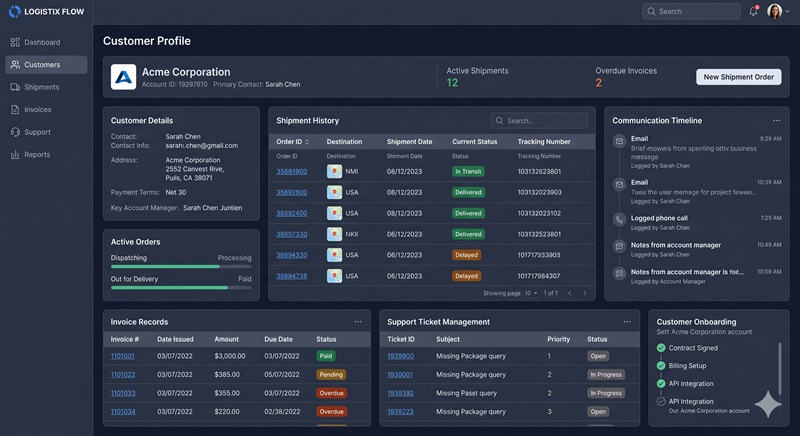
Customer Management Module
One of the most important parts of the logistics CRM software was the customer management module.
Before implementing the system, the client was managing customer data manually through spreadsheets and emails, which created communication gaps and delayed responses.
To solve this issue, Cor Advance Solutions developed a centralized customer management CRM that allowed the company to manage all customer-related activities from one platform.
The logistics customer portal simplified communication, improved customer support, and gave teams quick access to customer records and shipment information.
Customer Onboarding System
We developed a simple customer onboarding system that allowed the logistics company to:
- Add new customers quickly
- Store customer business information
- Manage shipping preferences
- Maintain customer records centrally
- Reduce manual data entry
The onboarding workflow improved operational efficiency and helped the company manage customer information more accurately.
Customer Profile Management
The CRM included a complete customer profile management system where teams could access:
- Customer contact details
- Shipment history
- Invoice records
- Payment information
- Communication history
- Active orders and requests
This helped employees respond faster to customer inquiries and improved customer relationship management.
Communication History Tracking
The logistics CRM dashboard stored all communication records in one place.
Teams could track:
- Customer calls
- Emails
- Shipment discussions
- Support conversations
- Delivery updates
This centralized communication system reduced confusion and improved customer support operations.
Complaint Management
We implemented a complaint management system to help the client handle customer issues more efficiently.
The system allowed teams to:
- Create support tickets
- Track complaint status
- Assign issues to departments
- Monitor resolution timelines
- Improve customer satisfaction
This feature helped streamline customer support workflows and improved service quality.
Quotation Generation
The custom logistics CRM software also included an automated quotation generation module.
The logistics company could now:
- Generate shipping quotations quickly
- Send pricing estimates to customers
- Manage quotation history
- Reduce manual calculation errors
This improved response speed and simplified pricing management.
Automated Notifications
We integrated automated notification features for:
- Shipment updates
- Delivery confirmations
- Invoice reminders
- Customer alerts
- Vendor communication
Automated notifications improved communication and reduced manual follow-ups.
Benefits of the Customer Management CRM
The customer management CRM helped the client:
- Improve customer communication
- Reduce manual workload
- Increase response speed
- Organize customer records centrally
- Improve customer satisfaction
- Streamline logistics support operations
The logistics customer portal became one of the most valuable parts of the CRM system.
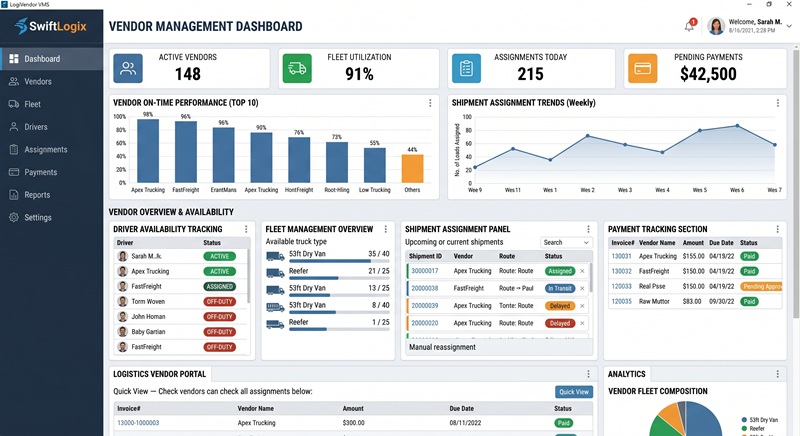
Vendor Management System
Managing transport vendors manually was one of the company’s biggest operational challenges.
To solve this problem, Cor Advance Solutions developed a powerful vendor management software module within the logistics CRM platform.
The system helped the company manage vendors, drivers, fleet availability, payments, and shipment assignments more efficiently.
The transport vendor management system centralized all vendor operations into one easy-to-use dashboard.
Vendor Onboarding
The CRM included a vendor onboarding system that simplified vendor registration and profile management.
The logistics company could:
- Add vendor information
- Store contract details
- Track vendor documents
- Maintain fleet records
- Manage driver information centrally
This reduced manual paperwork and improved vendor organization.
Vendor Performance Tracking
We developed a vendor performance tracking system that allowed management teams to monitor:
- Delivery performance
- Shipment completion rates
- Vendor response times
- Operational reliability
- Driver efficiency
This helped the company identify high-performing vendors and improve logistics operations.
Availability Management
The logistics vendor portal provided real-time vendor availability tracking.
Operations teams could quickly identify:
- Available vehicles
- Active vendors
- Driver schedules
- Delivery capacity
This improved dispatch planning and reduced shipment assignment delays.
Payment Tracking
The CRM system also automated vendor payment tracking.
The company could now:
- Track completed payments
- Monitor pending payouts
- Manage payment history
- Reduce accounting confusion
- Improve financial transparency
This feature simplified financial management and reduced operational errors.
Contract Management
We implemented a digital contract management system that allowed the client to:
- Store vendor agreements
- Manage renewal dates
- Track compliance records
- Access vendor documents instantly
This improved operational organization and reduced paperwork.
Automated Assignment Workflows
One of the most valuable features was workflow automation for shipment assignment.
The logistics CRM software automatically helped assign shipments based on:
- Vendor availability
- Delivery location
- Fleet capacity
- Operational requirements
This reduced manual coordination work and improved dispatch efficiency.
Benefits of the Vendor Management Software
The vendor management software helped the company:
- Simplify vendor coordination
- Improve shipment assignment speed
- Reduce communication delays
- Improve payment tracking
- Increase operational visibility
- Streamline dispatch operations
The logistics vendor portal became a central system for managing transportation operations efficiently.
Shipment & Dispatch Management
Shipment management was one of the core functionalities of the custom logistics CRM platform.
The company needed a centralized shipment management software solution capable of handling dispatch operations, delivery tracking, and driver coordination in real time.
We developed a complete logistics dispatch system that automated shipment workflows and improved operational visibility.
Shipment Creation
The CRM allowed employees to create shipments quickly with complete details such as:
- Pickup location
- Delivery address
- Shipment type
- Vendor assignment
- Delivery timelines
- Customer information
This simplified shipment handling and reduced manual errors.
Dispatch Scheduling
The dispatch management system automated scheduling workflows and helped teams:
- Plan deliveries efficiently
- Reduce scheduling conflicts
- Improve delivery coordination
- Optimize operational workflows
This improved dispatch speed and logistics planning.
Route Assignment
The freight tracking CRM included route assignment features for drivers and vendors.
Operations teams could:
- Assign delivery routes
- Optimize transportation planning
- Reduce delays
- Improve shipment coordination
Driver Coordination
The logistics CRM platform improved communication between dispatch teams and drivers.
Managers could:
- Share shipment updates
- Assign delivery instructions
- Monitor active deliveries
- Track operational progress
This improved logistics communication and reduced delays.
Real-Time Status Updates
The shipment management software provided real-time delivery updates through the CRM dashboard.
Teams and customers could monitor:
- Shipment status
- Delivery progress
- Dispatch updates
- Delivery completion timelines
This improved transparency and customer experience.
Delivery Confirmation Tracking
We also implemented delivery confirmation workflows that allowed the company to:
- Verify completed deliveries
- Maintain proof of delivery records
- Improve shipment accountability
- Reduce operational disputes
Benefits of the Logistics Dispatch System
The logistics dispatch system helped the company:
- Improve shipment visibility
- Streamline delivery operations
- Reduce dispatch delays
- Improve driver coordination
- Increase operational efficiency
- Enhance customer communication
Real-Time Tracking Dashboard
To improve operational visibility, Cor Advance Solutions developed a centralized real-time logistics CRM dashboard.
The dashboard provided complete visibility into shipments, vendors, deliveries, customer activity, and operational performance.
Live Shipment Tracking
The CRM dashboard displayed real-time shipment tracking information for active deliveries.
Teams could monitor:
- Shipment movement
- Delivery timelines
- Dispatch progress
- Route status
This improved logistics management and customer communication.
Delivery Status Monitoring
The system provided live delivery status updates, helping teams identify:
- Delayed shipments
- Completed deliveries
- Pending dispatches
- Active transportation tasks
This improved operational decision-making.
Vendor Activity Dashboard
Managers could monitor vendor performance through a centralized vendor activity dashboard.
The system tracked:
- Vendor assignments
- Delivery performance
- Availability status
- Operational efficiency
Customer Order Visibility
Customers and internal teams could access shipment and order details through the logistics CRM dashboard.
This reduced support calls and improved customer satisfaction.
Operational Performance Analytics
The CRM platform also included analytics and reporting tools that provided insights into:
- Shipment performance
- Delivery timelines
- Vendor efficiency
- Customer activity
- Revenue operations
This helped management teams make better business decisions.
What Does a Logistics CRM Do?
A logistics CRM helps logistics companies manage customers, vendors, shipments, invoices, communication, dispatch operations, and workflow automation from one centralized platform.
Invoice & Payment Automation
To simplify financial operations, Cor Advance Solutions integrated invoice and payment automation features into the logistics CRM software.
The goal was to reduce manual accounting work, improve payment tracking, and increase financial accuracy.
Automated Invoice Generation
The system automatically generated invoices based on completed shipments and delivery records.
This helped:
- Reduce billing delays
- Improve invoice accuracy
- Simplify accounting workflows
- Speed up payment processing
Vendor Payment Tracking
The CRM platform tracked vendor payouts and payment history in real time.
Finance teams could monitor:
- Completed payments
- Pending payouts
- Vendor billing records
- Payment timelines
This improved transparency and reduced accounting confusion.
Customer Billing Management
The logistics CRM software also simplified customer billing workflows by:
- Managing invoices centrally
- Tracking payment status
- Sending billing reminders
- Reducing missed payments
GST and Tax Calculations
We integrated automated GST and tax calculations into the invoicing system to improve compliance and financial accuracy.
Payment Reminders
The CRM automatically sent reminders for:
- Pending invoices
- Overdue payments
- Vendor payouts
- Customer billing cycles
This improved cash flow management.
Financial Reporting
The system generated detailed financial reports for:
- Revenue tracking
- Invoice summaries
- Vendor payments
- Outstanding balances
- Operational financial analysis
Benefits of Invoice & Payment Automation
The invoice and payment automation system helped the company:
- Reduce manual accounting work
- Improve financial accuracy
- Speed up invoice processing
- Improve payment tracking
- Simplify billing management
- Increase operational efficiency
Results Achieved After CRM Implementation
After implementing the custom logistics CRM software, the client experienced major improvements across customer management, vendor coordination, shipment tracking, invoicing, and overall logistics operations.
The new logistics CRM platform completely transformed the company’s daily workflow by replacing manual processes with centralized automation and real-time operational visibility.
The system helped the company improve efficiency, reduce operational delays, and scale logistics operations more effectively.
Within a short period after deployment, the client started seeing measurable improvements in productivity, communication, shipment processing, and customer satisfaction.
Below are the key business results achieved after implementing the custom logistics CRM solution developed by Cor Advance Solutions.
Performance Improvements
Reduced Manual Operations by 70%
Before implementing the logistics CRM software, most daily tasks were handled manually through spreadsheets, phone calls, emails, and WhatsApp communication.
Employees spent a large amount of time managing:
- Shipment updates
- Vendor coordination
- Customer communication
- Invoice generation
- Payment tracking
- Dispatch scheduling
The custom logistics CRM automated these repetitive processes and centralized all operational data into one platform.
As a result, the company reduced manual operational work by nearly 70%.
The workflow automation system helped:
- Reduce human errors
- Improve operational speed
- Eliminate duplicate tasks
- Simplify logistics management
- Improve employee productivity
By automating routine tasks, the operations team could focus more on business growth and customer service instead of manual coordination work.
Faster Shipment Processing
One of the biggest improvements came in shipment and dispatch management.
Before the CRM implementation, shipment creation, vendor assignment, and dispatch scheduling were handled manually, causing delays in delivery operations.
The new shipment management software streamlined the entire process.
The logistics dispatch system allowed teams to:
- Create shipments instantly
- Assign vendors quickly
- Track delivery progress in real time
- Monitor dispatch operations centrally
- Reduce operational bottlenecks
As a result:
- Shipment processing became significantly faster
- Dispatch delays were reduced
- Delivery coordination improved
- Operational efficiency increased
The company was able to handle a larger shipment volume without increasing operational complexity.
Improved Vendor Coordination
Managing transport vendors became much easier after implementing the vendor management system.
The logistics CRM software centralized all vendor-related operations, including:
- Vendor onboarding
- Availability tracking
- Shipment assignments
- Driver coordination
- Payment management
- Vendor performance monitoring
The vendor management software improved communication between dispatch teams and transport vendors, reducing delays and operational confusion.
With the logistics vendor portal, the company could:
- Track active vendors in real time
- Assign shipments faster
- Improve delivery planning
- Monitor vendor performance
- Reduce communication gaps
This improved overall transportation management and helped streamline logistics operations across multiple locations.
Increased Customer Response Speed
Before the CRM system, customer support teams struggled to provide quick shipment updates because information was scattered across different systems.
The logistics customer management CRM centralized customer records, communication history, and shipment details into one dashboard.
This allowed support teams to:
- Respond to inquiries faster
- Access shipment information instantly
- Provide real-time delivery updates
- Improve customer communication
The centralized logistics CRM dashboard significantly improved customer support efficiency.
As response times improved:
- Customer satisfaction increased
- Support delays decreased
- Communication became more organized
- Customer trust improved
The company was able to deliver a much better customer experience through faster and more transparent communication.
Better Invoice Accuracy
Manual invoice generation was creating billing errors and payment delays before the CRM implementation.
The invoice automation system solved these problems by automatically generating invoices based on shipment and delivery data.
The logistics CRM software improved:
- Billing accuracy
- Payment tracking
- Tax calculations
- Financial reporting
- Invoice management workflows
By reducing manual calculations and accounting errors, the company improved financial accuracy and streamlined billing operations.
The automated invoicing system also reduced disputes related to:
- Vendor payments
- Customer invoices
- Shipment billing
- Outstanding balances
Improved Operational Transparency
One of the most valuable outcomes of the logistics CRM implementation was improved operational visibility.
Before the system was introduced, management teams had limited visibility into:
- Shipment progress
- Vendor activity
- Delivery timelines
- Financial operations
- Customer support performance
The real-time logistics CRM dashboard provided complete transparency across all business operations.
Management teams could now monitor:
- Live shipment status
- Vendor performance
- Dispatch operations
- Pending deliveries
- Financial reports
- Customer activity
This helped leadership teams make faster and more informed business decisions.
Operational transparency also improved accountability across departments and reduced communication gaps between teams.
Conversion & Operational Benefits
Increased Customer Retention
The improved customer experience had a direct impact on customer retention.
Because the logistics CRM software improved:
- Shipment visibility
- Communication speed
- Delivery coordination
- Billing accuracy
- Customer support efficiency
Customers became more satisfied with the company’s logistics services.
The client reported:
- Better long-term customer relationships
- Increased repeat business
- Improved client trust
- Higher customer engagement
The centralized customer management CRM played a major role in improving overall customer satisfaction.
Reduced Support Workload
Before the CRM implementation, support teams spent a large amount of time manually answering shipment-related questions.
Customers frequently contacted the support team asking:
- Shipment status updates
- Delivery timelines
- Payment information
- Invoice details
The real-time shipment tracking CRM reduced this workload significantly.
Customers and internal teams could now access shipment information directly through the logistics CRM dashboard.
As a result:
- Support call volume decreased
- Manual follow-ups reduced
- Customer queries were resolved faster
- Support teams became more productive
This helped the company improve operational efficiency while reducing unnecessary workload.
Faster Payment Cycles
The invoice and payment automation system improved cash flow management and reduced payment delays.
The logistics CRM software automated:
- Invoice generation
- Payment reminders
- Vendor payout tracking
- Billing workflows
- Financial reporting
This helped the company:
- Collect payments faster
- Reduce pending invoices
- Improve vendor payout management
- Increase financial transparency
Faster payment processing improved overall business operations and financial stability.
Better Business Scalability
One of the biggest long-term benefits of the custom logistics CRM platform was scalability.
The old manual workflow was limiting business growth because operations became harder to manage as shipment volume increased.
The new logistics management software created a scalable operational structure capable of handling:
- More customers
- More vendors
- Higher shipment volumes
- Multiple operational locations
- Complex logistics workflows
The cloud-based logistics CRM system allowed the company to expand operations without creating operational chaos.
With centralized workflow automation, the client could now scale logistics operations more efficiently while maintaining high service quality.
Overall Business Impact
The custom logistics CRM development solution helped the client modernize its logistics operations and create a more organized, efficient, and scalable business model.
The system successfully transformed:
- Customer management
- Vendor coordination
- Shipment tracking
- Dispatch operations
- Invoice management
- Payment tracking
- Operational reporting
By implementing a centralized logistics CRM platform, the company improved operational efficiency, reduced manual work, increased customer satisfaction, and built a strong foundation for future growth.
The project demonstrated how custom logistics CRM software can help logistics and transportation companies streamline operations, improve workflow automation, and scale more efficiently in a highly competitive market.
Industries That Can Use Logistics CRM Software
Industries
- Freight companies
- Trucking businesses
- Supply chain companies
- Warehouse providers
- Courier services
- Third-party logistics providers (3PL)
- Ecommerce logistics companies
Client Testimonial
What the Client Said About the Logistics CRM Solution
“Before working with Cor Advance Solutions, most of our logistics operations were managed manually through spreadsheets, calls, emails, and WhatsApp messages. As our business continued growing, it became very difficult to manage customers, transport vendors, shipments, invoicing, and communication efficiently.
We were facing constant operational delays, shipment tracking issues, payment management problems, and communication gaps between our internal teams and vendors. Our support team was overloaded because customers repeatedly contacted us for shipment updates and delivery information.
The team at Cor Advance Solutions understood our business challenges deeply and developed a custom logistics CRM software solution tailored specifically to our workflow and operational needs.
The new logistics CRM platform completely transformed the way we manage our business.
Today, we can manage:
- Customer communication
- Vendor coordination
- Shipment tracking
- Dispatch operations
- Invoice management
- Payment tracking
- Operational reporting
from one centralized dashboard.
The customer management CRM and vendor management software have significantly improved our operational efficiency and reduced manual work across departments.
One of the biggest improvements has been real-time shipment tracking and dispatch visibility. Our team can now monitor deliveries, assign vendors faster, and provide customers with instant shipment updates.
The automated invoice and payment tracking system has also improved financial accuracy and reduced delays in billing and vendor payouts.
After implementing the logistics CRM system, we achieved:
- Faster shipment processing
- Better customer response times
- Improved vendor coordination
- Reduced operational workload
- Better reporting and visibility
- Increased customer satisfaction
The system is easy to use, highly scalable, and perfectly designed for logistics and transportation operations.
Cor Advance Solutions delivered exactly what we needed — a powerful, scalable, and user-friendly logistics CRM platform that helped streamline our entire business operation. We highly recommend Cor Advance Solutions to any logistics company looking for custom logistics CRM development, workflow automation, and logistics management software solutions.”
Why Choose Cor Advance Solutions
Logistics CRM Development Expertise
Highlight
- Custom CRM development expertise
- Logistics industry understanding
- Scalable architecture
- Automation-first approach
- Cloud-based CRM systems
- End-to-end development support
FAQ
What is a logistics CRM system?
A logistics CRM system is software designed to help logistics and transportation companies manage customers, vendors, shipments, invoices, communication, and daily operations from one centralized platform. It improves workflow automation, shipment tracking, and customer management. Logistics CRM software also helps businesses reduce manual work, improve operational visibility, and increase efficiency across dispatch and delivery operations.
Why do logistics companies need CRM software?
Logistics companies need CRM software to streamline customer management, vendor coordination, shipment tracking, invoicing, and communication workflows. A custom logistics CRM helps businesses reduce operational delays, improve customer support, automate manual tasks, and manage large-scale logistics operations more efficiently. It also improves real-time visibility into deliveries, payments, and vendor activities.
How does logistics CRM software work?
Logistics CRM software works by centralizing customer data, vendor management, shipment tracking, dispatch operations, invoicing, and communication into one system. It automates daily logistics workflows such as shipment assignments, delivery tracking, payment reminders, and customer notifications. The software helps logistics companies improve operational efficiency, reduce errors, and monitor business performance in real time.
What are the benefits of a custom logistics CRM?
A custom logistics CRM helps logistics companies automate operations, improve shipment visibility, simplify customer communication, and streamline vendor management. It reduces manual work, improves invoice accuracy, speeds up dispatch operations, and provides real-time operational insights. Custom CRM software is designed specifically around a company’s workflow, making logistics operations faster, more scalable, and more efficient.
How can CRM improve logistics operations?
CRM improves logistics operations by automating shipment management, customer communication, dispatch scheduling, vendor coordination, and invoicing workflows. It helps logistics companies manage operations from a centralized dashboard, reducing delays and improving efficiency. A logistics CRM also improves shipment visibility, customer support response times, and operational reporting for better business decision-making.
How does logistics CRM improve workflow automation?
Logistics CRM improves workflow automation by reducing manual tasks involved in shipment tracking, dispatch management, vendor assignments, invoicing, and customer communication. The system automates repetitive operational processes, helping teams work faster and more efficiently. Workflow automation also improves accuracy, reduces operational errors, and helps logistics companies scale operations more effectively.
How does a customer management CRM help logistics companies?
A customer management CRM helps logistics companies organize customer information, shipment history, invoices, and communication records in one centralized platform. It improves customer support, speeds up response times, and provides real-time shipment updates. The CRM also helps logistics businesses improve customer satisfaction, manage inquiries efficiently, and build long-term client relationships.
How does logistics CRM improve operational transparency?
Logistics CRM improves operational transparency by providing real-time visibility into shipments, vendor activities, dispatch operations, invoices, and customer interactions. Managers can monitor business performance through centralized dashboards and analytics reports. This helps logistics companies make faster decisions, reduce communication gaps, improve accountability, and manage operations more efficiently.