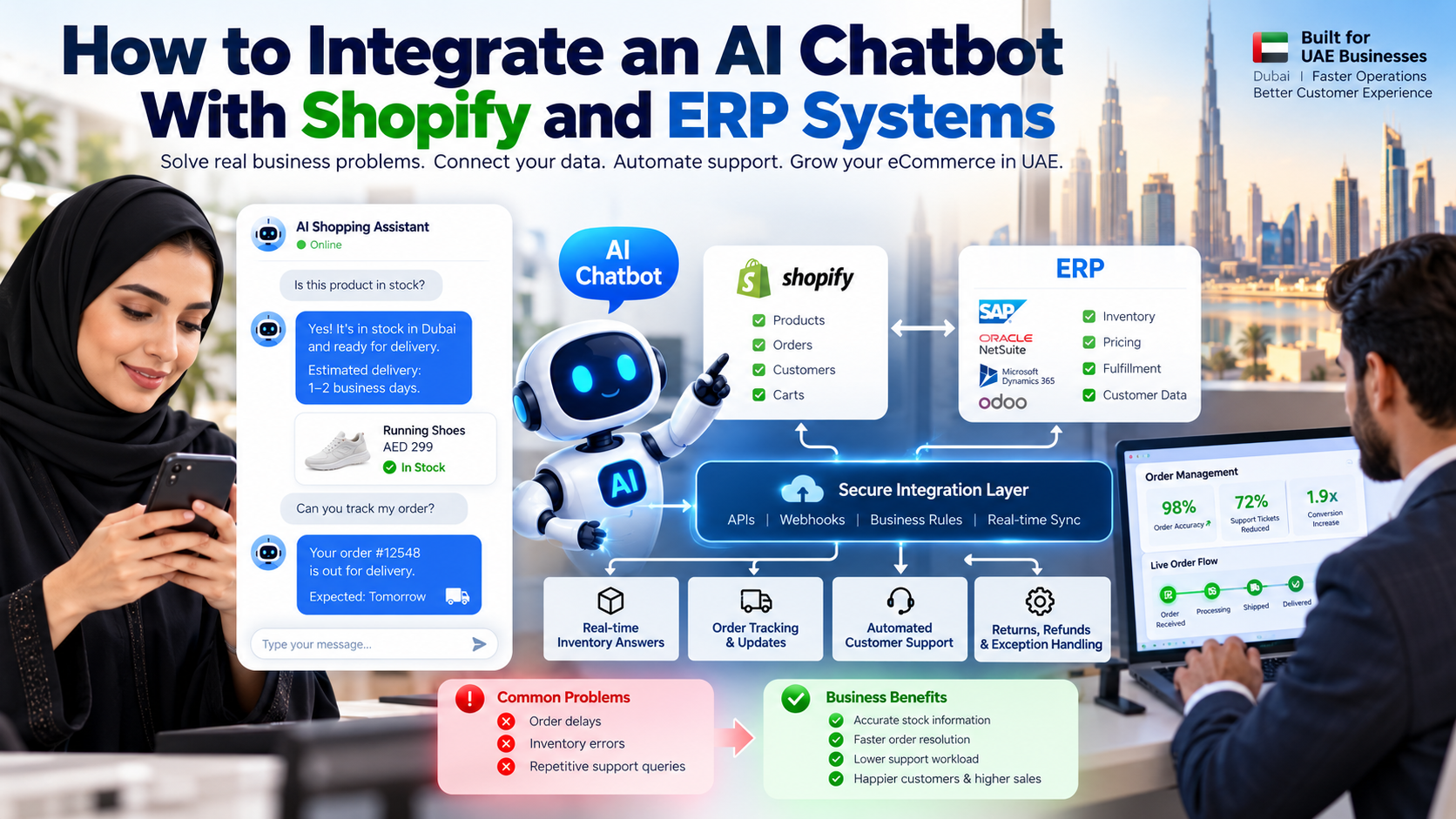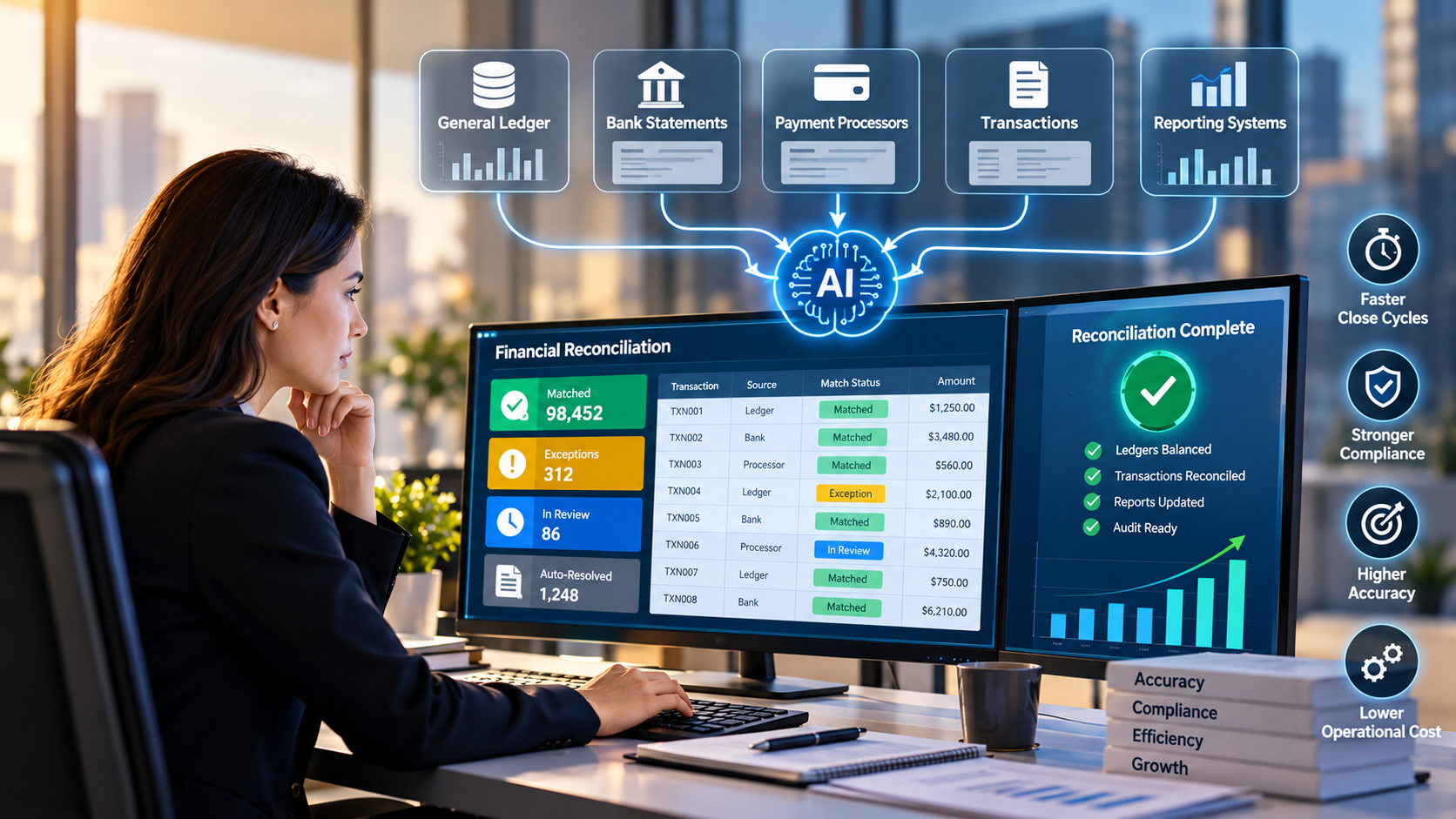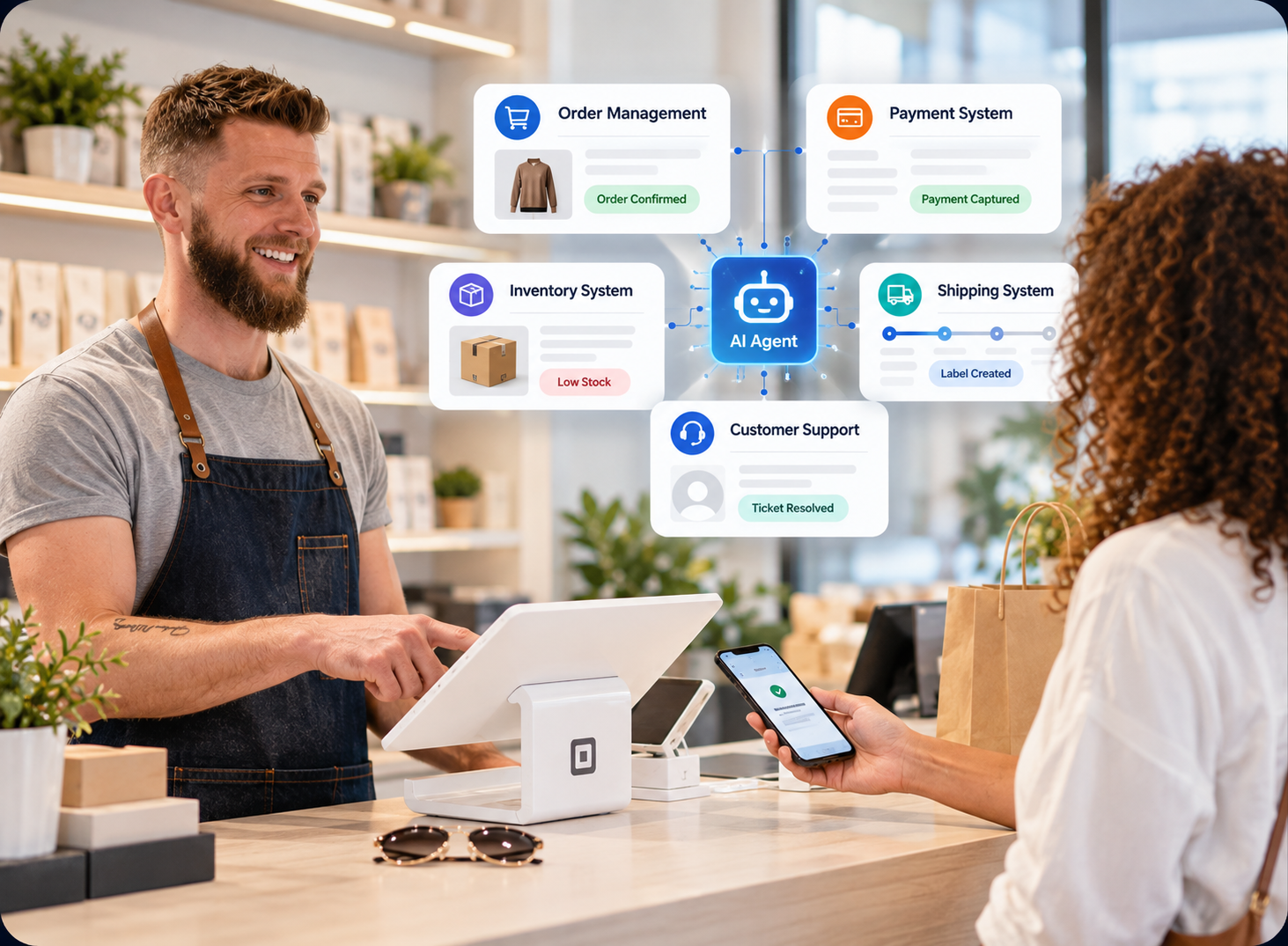
AI agents for e-commerce order management can check authorized order, inventory, payment, and shipping data, spot exceptions early, take approved actions, and send unclear cases to a person. They work best when they connect to the systems that already hold the facts, such as Shopify, the ERP, the warehouse system, and the shipping platform. The goal is not to remove human control. It is to stop stuck orders from waiting unnoticed and to give your team clear, verified information when it steps in.
Imagine an online retailer receiving hundreds of orders a day across its website and marketplaces. Good e-commerce workflow automation starts from this picture, because the order journey crosses every system at once. An order arrives in Shopify. Inventory sits in the ERP. The warehouse runs fulfillment in a separate system, a shipping platform tracks parcels, and customer support uses a CRM. Each system does its job, but the order journey depends on all of them working together.
When something goes wrong, someone has to find it. A payment is confirmed, but the order never reaches the warehouse. The website shows an item as available, but the stock was already reserved. A parcel stops moving, but nobody tells the customer. These problems are rarely caused by missing software. They happen because systems, rules, and exception handling are not connected.
This guide explains how AI agents can support e-commerce order management, which business problems they address, how they connect to existing systems, what controls they need, and how to measure whether they are working. It is written for e-commerce directors, heads of operations, and enterprise retail technology leaders who want AI order management automation that works with Shopify Plus, ERP, OMS, and WMS systems. Our AI agent development services cover this work end to end.
Why e-commerce order management gets harder at scale
Order management is simple at a small scale. As volume grows, you need intelligent order processing automation and AI-powered order fulfillment that can keep pace. One store, one warehouse, and one shipping provider can be run from a spreadsheet and a few emails. As volume grows, the number of handoffs grows with it. Each handoff can fail quietly.
Consumer behavior is also moving toward automated help. Visa's 2026 study of AI shopping in the UAE, based on research by Wakefield Research with 5,800 adults across 17 markets, found that 85% of UAE respondents had used AI tools to help with shopping. The same study found that only 32% would trust AI agents to complete checkout. The lesson for order management is clear: shoppers accept AI for answers and information, but they expect people to stay in charge of consequential decisions.
Demand for automation is rising as well. Process Excellence Network, reporting Gartner's forecast expects 40% of enterprise applications to include task-specific AI agents by the end of 2026, up from less than 5% in 2025. Returns add pressure too. The National Retail Federation and Happy Returns project that 19.3% of online sales will be returned in 2025. Every return touches the order, the inventory, the warehouse, and the refund. Manual coordination across those steps is slow and error-prone.
What are AI agents for e-commerce order management?
An AI agent is a software system that can interpret a task, retrieve information from authorized systems, check the situation against defined rules, and take permitted actions toward a goal. Autonomous AI agents for retail follow the same logic, but only within the boundaries you approve. Unlike a chatbot that mainly answers questions, an agent can take part in a multi-step workflow.
Consider a delayed order. An appropriately configured agent might:
- Identify the affected order.
- Retrieve its fulfillment status.
- Check the latest shipping information.
- Compare the expected delivery date with the current status.
- Decide whether the delay meets your exception criteria.
- Create an internal task or draft a customer message.
- Escalate the case if the next step needs human judgment.
- Record the outcome for monitoring.
The exact workflow depends on available APIs, permissions, business rules, and how the systems are integrated.
AI chatbots, AI agents, and traditional automation
These three approaches overlap, but they are not interchangeable. For a retailer, the practical choice is which of these fits each order task, not which tool is most advanced.
| Capability | Traditional rule-based automation | AI chatbot | AI agent |
|---|---|---|---|
| Main purpose | Run predefined triggers and actions | Answer questions in conversation | Complete defined tasks across connected systems |
| Order-status questions | Possible with configured integrations | Can explain status if connected | Can retrieve status and start permitted follow-up steps |
| Exception investigation | Usually needs predefined rules | May explain an exception | Can gather information from several authorized systems |
| Multi-step workflows | Possible, but each sequence must be set up | Limited unless connected to workflows | Can coordinate steps within set boundaries |
| Unstructured information | Limited without extra components | Interprets natural-language questions | Interprets requests and uses approved tools |
| Human approval | Depends on workflow design | Depends on implementation | Can request approval for sensitive actions |
AI agents do not automatically beat traditional automation. A predictable task, such as sending an order confirmation after payment, is better handled by a simple rule. Agents are most useful when a task requires reading variable information, gathering context, or coordinating several steps.
Actions that need controls
Some actions carry financial or customer impact. An agent should not perform these without explicit permissions, validation rules, and approval:
- Issuing refunds
- Cancelling orders
- Changing delivery addresses
- Applying discounts
- Selecting more expensive shipping options
- Releasing suspicious orders
- Changing inventory records
- Making commitments to customers
Orders get stuck between payment and fulfillment
A customer completes checkout, but the order does not move forward. This is where E-commerce order processing automation earns its keep, because the fix needs data from several systems at once. The causes vary. Payment confirmation may be delayed, an ERP sync may fail, a required field may be missing, a duplicate record may exist, or a fraud check may hold the order.
Employees then check several dashboards to find the cause. An AI agent can do the first pass.
How the agent investigates
- Detect an order that has stayed in one status beyond an approved threshold.
- Retrieve the order from the relevant system.
- Verify payment status with the authorized payment or order system.
- Check whether the order exists in the ERP or order management system.
- Review integration logs or error details.
- Classify the issue using predefined categories.
- Retry a safe, approved operation where appropriate.
- Create an exception task if the issue remains unresolved.
- Record the action and the final status.
Example: paid in Shopify, missing in the ERP
An order shows as paid in Shopify, but the ERP has no matching sales order. The agent checks the integration status and finds that the sync operation failed. Before it retries, it confirms that the ERP order does not already exist, because a blind retry could create a duplicate. If the retry succeeds, the agent verifies the record and logs the result. If the problem continues, it opens an exception for the integration team.
This is an illustrative workflow. Actual capabilities depend on your integrations, permissions, and business rules.
KPIs to track
- Time from payment confirmation to fulfillment release
- Number of orders stuck in processing
- Manual investigation time per exception
- Duplicate order creation rate
- Time to resolve integration failures
Set a baseline before you start. Results depend on your own data, and we do not promise a fixed improvement percentage.
Inventory mismatches cause overselling and cancellations
A product looks available online, but the warehouse does not have enough sellable stock to fill the order. Solving this is a core part of AI agents for inventory and order management, and it depends on AI order management system integration that agrees one stock source. This happens when several channels sell the same inventory, updates arrive late, stock is reserved in one system but not another, SKU mappings differ, or damaged stock is counted as available.
Overselling leads to cancellations, complaints, refund requests, and extra work for operations teams. Better inventory and order management starts with agreeing on a single source of truth for each stock figure.
How an agent helps
The agent retrieves inventory by warehouse or location and checks reservations and stock restrictions. It reviews your allocation rules and identifies whether the order can be filled as requested. If another eligible location has stock, it can recommend that option. If the alternative adds cost or breaks a delivery commitment, it sends the decision to an authorized employee.
Requirements for reliable inventory data
- A defined inventory source of truth
- Consistent product identifiers across systems
- Accurate stock and reservation data
- Warehouse-level visibility where it matters
- Reliable synchronization
- Rules for resolving conflicting records
The agent should not treat a cached inventory figure as current when the system cannot confirm how fresh it is.
KPIs to track
- Inventory answer accuracy
- Overselling incidents
- Cancellations caused by stock issues
- Manual inventory investigation time
- Inventory synchronization failures
Teams spend too long verifying orders
Some orders need checks before fulfillment. Custom AI agents for order management can handle this verification work, freeing staff for true exceptions. Common triggers include missing customer details, incomplete addresses, payment status that does not match, possible duplicates, and conflicting quantities. Staff often gather information from several systems before they can decide.
An agent can gather and organize that information. It validates required fields, compares records with your rules, prepares a short summary of the issue, and routes the case to the right team.
Human review remains essential for payment disputes, suspected fraud, and other high-risk cases. An agent should not override fraud controls because an order looks plausible. It organizes the evidence, and authorized staff make the call.
KPIs to track
- Average verification time
- Share of orders needing manual review
- Review backlog
- Incorrectly flagged orders
- Time between review completion and fulfillment release
Shipment delays are discovered too late
A parcel may be dispatched but then stop receiving tracking updates, or a delivery attempt may fail. If nobody is watching, the problem often surfaces only when the customer calls.
An agent can compare shipment status with expected milestones, flag orders that cross your exception thresholds, gather the order context, classify the issue, and notify the responsible team. It can also draft a customer update based on verified information.
If the carrier has not confirmed a new delivery date, the agent should say so. It should not invent one.
KPIs to track
- Time to identify a shipment exception
- Time to assign the exception to the right team
- Number of overdue shipments
- Customer enquiries about delays
- Accuracy of shipping updates sent to customers
Support teams repeat the same order-status answers
Support teams field the same questions every day: where is my order, has it shipped, why is it late, can I change the address, is it eligible for return, and has my refund been processed?
An agent can understand the question, verify the customer where required, retrieve the order, check the latest status, and explain the result in plain language. It can also offer the next approved step, or hand the case to a person with the context attached.
Explaining a policy is different from carrying out a transaction. AI agents for order tracking can answer status questions quickly, but transactions need controls. Refunds, cancellations, replacements, and address changes need the right validation and permissions.
KPIs to track
- Order-status enquiry handling time
- Repeat-contact rate
- Support tickets per order
- Customer satisfaction
- Share of routine enquiries resolved correctly
Do not treat chatbot containment as the only measure. A conversation that ends without a human but gives a wrong answer is a failure.
Returns and refunds need too much manual coordination
A return can involve checking the original order, confirming the return window, reviewing the reason, checking eligibility, creating a return authorization where applicable, arranging pickup or shipment, confirming warehouse receipt, checking the refund status, and updating the customer. When these steps sit in different systems, cases stall.
An AI-agent-based return workflow can receive the request, retrieve the order and item details, check the approved policy, collect missing information, create a return request where permitted, route exceptions, track progress, and send confirmed updates.
Refunds have direct financial consequences. This is why AI agent development for e-commerce must include approval design from the start. The agent should not issue a refund outside its authorized scope. Approval should follow your refund policy and financial controls. For more on this area, see our guide to automating ecommerce returns and refund workflows.
Multiple sales channels add complexity
Multi-channel retailers often run orders through Shopify, marketplaces, an ERP, an order management system, a warehouse management system, a shipping platform, and a CRM. AI order management integration services are most valuable here, because the systems rarely share a common order identifier. Each platform may use different order identifiers and status definitions. An order that looks ready in one system can still be waiting for confirmation in another.
An agent can assemble a current view of the order from authorized systems. It can flag orders missing from a downstream system, conflicting fulfillment statuses, inventory allocation problems, failed sync events, and shipments without expected updates.
Architecture for multi-channel order flow
Sales channels feed an order management system, which connects to the ERP and inventory, the warehouse management system, and shipping and tracking, and then to customer communication. The AI agent sits above these systems as an orchestration layer. It uses approved interfaces and does not replace the systems that own the records.
Each data type needs a clear owner. For example, the ERP may own stock, Shopify may own the storefront order, and the shipping platform may own tracking events.
Integration challenges to plan for
- Different order identifiers
- Inconsistent status definitions
- Duplicate event processing
- API rate limits
- Delayed synchronization
- Missing or incomplete records
- Authentication and permission management
- Conflicting updates from different systems
Operations teams cannot see which orders matter most
When hundreds of orders are in progress, teams struggle to know which ones need attention first. AI agents for e-commerce operations can make these priorities visible, using rules you approve. Priority cases include orders close to a dispatch deadline, high-value orders with open exceptions, orders hit by stock shortages, failed delivery attempts, and orders with repeated integration errors.
An agent can gather order, inventory, shipping, and exception data, then apply the priority rules you have approved. It should show why an order was flagged, with the evidence. Prioritization rules must be transparent and testable. The agent should not change a customer commitment, allocate scarce stock unfairly, or choose a costly option without authorization.
KPIs to track
- Orders approaching service-level deadlines
- Time to identify priority exceptions
- Late-dispatch rate
- Exception backlog
- Share of priority cases handled within the target window
How AI agents work with Shopify and enterprise systems
AI agents usually work through approved APIs, connectors, and workflow services. This is the practical basis for AI agent integration with ERP systems and for AI order management system integration generally. They do not need unrestricted database access. What a given agent can do depends on the permissions and interfaces each system exposes.
- Shopify can supply authorized order information, product records, and supported order events.
- The ERP can supply inventory, sales orders, product records, pricing, and fulfillment processes.
- The order management system and warehouse system coordinate routing and warehouse operations, and an agent can start permitted workflows through their interfaces.
- Shipping and payment platforms provide tracking events and authorized transaction status. Verify payment and shipment data at the source, not through a chatbot's reading of a customer message.
Before development, assess API availability and access permissions, data quality and field mapping, system ownership of each record, webhook and event support, error handling and retries, idempotency, monitoring and audit logging, security and privacy requirements, and ongoing maintenance.
When to use AI agents instead of rule-based automation
Not every order-management task needs an agent. AI workflow automation for online retailers works best when agents and rules are designed together, and our AI automation services are built around that combined design. A practical design combines the two.
| Task | Recommended starting approach | Why |
|---|---|---|
| Send an order confirmation | Rule-based automation | The trigger is predictable |
| Update status from a confirmed event | Event-driven integration | The status comes from a defined source |
| Detect a missing ERP order and check logs | AI-assisted workflow with deterministic checks | The investigation needs context |
| Answer customer questions about an order | AI chatbot or agent on verified data | Natural-language input is involved |
| Route a return request | Rules plus AI-assisted extraction | Eligibility needs structured checks |
| Approve an exceptional refund | Controlled approval workflow | Financial decisions need authorization |
| Process every order without review | Not recommended | Exceptions and risk still need controls |
Use conventional automation for predictable tasks. Use AI agents where the work involves variable information, context gathering, or several coordinated steps.
Controls that prevent costly mistakes
Strong controls are what separate a useful agent from a risky one. Any serious AI agent development company for retail should explain these controls before proposing a build. Put these in place from the start:
- Least-privilege access. Give each agent only the permissions its task needs.
- Data validation. Check order IDs, SKUs, payment status, and stock figures before acting.
- Clear action boundaries. Define what is allowed, what needs approval, and what is prohibited.
- Human approval. Require authorization for refunds, cancellations, discounts, and address changes.
- Idempotent operations. Make sure retries do not create duplicate orders, payments, or fulfillment requests.
- Audit trails. Record the request, the evidence used, the action, the approval, and the outcome.
- Failure handling. Define what happens when an API is down or records conflict.
- Monitoring. Track action accuracy, exception rates, and permission failures.
- Privacy and retention. Limit exposure of personal data and set retention rules for logs and transcripts.
- Recovery. Where the system allows it, define how to reverse or fix an incorrect change.
Human approval is not needed for every action. Low-risk tasks can run within set permissions, while consequential or uncertain decisions need stronger checks.
How to measure ROI for AI order management
Avoid promises such as "AI agents cut processing costs by 70%." Measure your own results instead.
| Problem | Baseline metric | Metric after launch |
|---|---|---|
| Orders stuck in processing | Number and average age of stuck orders | Same measures |
| Manual exception handling | Staff minutes per exception | Same measure |
| Inventory mismatches | Frequency of stock-related errors | Same measure |
| Shipment delays | Time to detect a delayed shipment | Same measure |
| Repetitive support requests | Order-status tickets per order | Same measure |
| Integration failures | Failed sync events and recovery time | Same measures |
| Incorrect automated actions | Number and severity of errors | Same measures |
To estimate the business case, use a simple model: annual measurable benefit minus annual implementation and running cost. Count each benefit once. If saved staff time is already valued as a labor saving, do not count the same hours again as a separate productivity gain. Costs include development, integration, AI usage, middleware, testing, security review, maintenance, and staff training.
A phased roadmap
Start with one workflow, prove it, and then widen the scope.
Phase 1: Discovery. Map the current workflow, the pain points, and the systems involved. Set baseline measures and rank the use cases.
Phase 2: Data and integration assessment. Review the Shopify, ERP, order management, warehouse, payment, and shipping interfaces. Agree the source of truth for each data type and map the approval matrix.
Phase 3: Pilot. Build one or two workflows, such as stuck-order detection or shipment exception handling, with business rules, error handling, and a human escalation path.
Phase 4: Testing and controlled launch. Test normal transactions, exceptions, security boundaries, duplicate events, and API failures. Launch with monitoring and documented procedures.
Phase 5: Measure and expand. Compare results with the baseline, fix reliability issues, and then add use cases such as inventory exception investigation, return routing, or cross-system reconciliation.
We do not promise a fixed timeline before the technical assessment. System complexity, API access, business rules, and testing needs decide the schedule.
Common mistakes to avoid
- Automating a broken process. AI does not fix inconsistent data or unclear rules.
- Giving the agent broad access. Excess permissions raise the risk of wrong or unauthorized actions.
- Treating cached data as current. Verify critical information where synchronization delays exist.
- Ignoring duplicate operations. Retries must not create duplicate orders or payments.
- Automating every decision. Some work is better left to rules, and some needs human judgment.
- Measuring usage instead of outcomes. Track accuracy, resolution time, errors, and business impact.
- Skipping exception handling. Every workflow needs a path for missing data and failed systems.
- Scaling before the pilot is reliable. Prove the first workflow before adding more.
Frequently asked questions
What are AI agents for e-commerce order management? They are software systems that retrieve authorized business information, coordinate workflow steps, and take permitted actions to support order processing, fulfillment, and exception handling. They work best when they connect to the systems that already hold the order, stock, and shipping data.
How can AI agents automate e-commerce order processing? They can detect orders stuck in one status, investigate sync failures, check required information, start approved retries, and route unresolved cases to the right team. Each step follows defined rules and is logged.
Can AI agents integrate with Shopify? Yes, where the needed APIs, permissions, and supported integration methods are available. The exact functionality depends on the workflow and the store's setup.
Can AI agents connect Shopify with ERP systems? They can use authorized APIs, connectors, or middleware to coordinate work across Shopify and supported ERP environments. Compatibility and data mapping must be checked before development.
Can AI agents reduce cancellations caused by inventory errors? They can flag inventory inconsistencies and propose permitted fulfillment alternatives. The result depends on inventory accuracy, synchronization, and allocation rules.
Can AI agents handle returns and refunds? They can check return eligibility against approved rules, prepare requests, and track progress. Refund execution should follow explicit authorization and financial controls.
Are AI agents better than traditional automation? Not for every task. Rule-based automation suits predictable work. AI agents suit tasks that involve variable information, context gathering, or several coordinated steps.
How much does AI agent development for e-commerce cost? Cost depends on the number of workflows, integrations, data quality, business rules, security requirements, and support needs. A technical assessment is needed before a realistic scope can be set.
How long does implementation take? It depends on system complexity, API access, data readiness, testing, and the number of workflows. We estimate the timeline after technical discovery.
How can businesses measure AI agent ROI? Compare baseline and post-launch figures for handling time, exception resolution, order accuracy, support workload, integration reliability, and running costs.
Next steps
If your team spends too much time chasing stuck orders, reconciling inventory, following up on shipment exceptions, or answering the same order questions, start by naming the one workflow that creates the most burden. Our AI agent development services cover discovery, architecture, integration, guardrails, and testing for this kind of work. For the workflow automation layer, our AI automation services cover the design. If your order data also needs a clean reporting foundation, our AI and machine learning services can help you forecast demand and plan stock more accurately.
Discuss your e-commerce AI automation requirements with Cor Advance Solutions. The first conversation should establish which problem to solve, which systems are involved, what data and APIs are available, which actions can be automated safely, which cases need approval, and how success will be measured. If you are an AI agent development company for retail looking for a partner, or an operator comparing E-commerce AI automation services, this is the right first step.