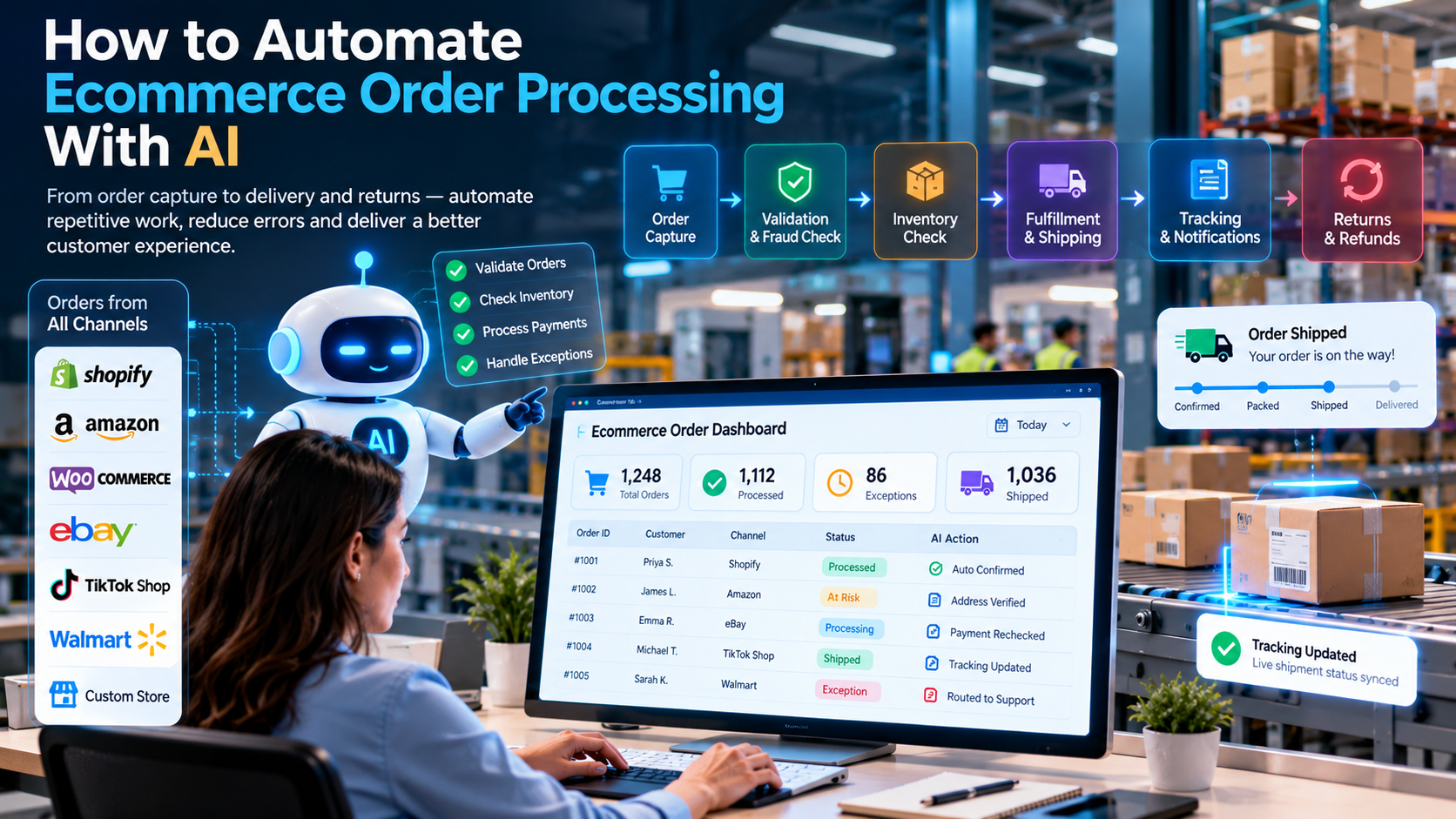
An AI agent for e-commerce order management helps online retailers automate order validation, inventory checks, fulfillment routing, shipment tracking, and customer updates. It connects AI models with your order management system, inventory software, payment gateway, and shipping platforms. Used well, it reduces manual work and handles order exceptions faster. The key is to combine AI with reliable business rules, secure integrations, and human approval for sensitive decisions.
For modern e-commerce businesses, managing orders is no longer just about receiving a purchase and shipping a package. Retailers must coordinate several sales channels, warehouses, payment systems, delivery partners, and customer service teams at once. When these systems do not communicate well, a small mistake can delay an order and leave a customer unhappy. Businesses that want this coordination handled safely can explore AI agent development.
This guide explains what an AI agent for order management does, how the architecture is built, which integrations matter, and how to automate real order workflows. It also covers the security steps and measurements that keep the system dependable.
What is an AI agent for e-commerce order management?
An AI agent for e-commerce order management is software that understands a task, retrieves information from connected systems, and takes permitted actions to move an order through its lifecycle.
A basic chatbot mostly answers questions. An AI agent can handle multi-step tasks. It can check an order's payment status, confirm inventory, identify a delivery exception, and prepare the next action based on your business rules.
A well-designed agent can help retailers:
- Collect orders from different sales channels
- Validate customer and product information
- Check inventory and payment status
- Route orders to the right warehouse or fulfillment partner
- Monitor shipping updates and flag delays
- Answer routine order questions
- Send exceptions to the right team with a clear summary
The agent should not control every transaction on its own. Payment authorization, inventory reservations, refunds, and cancellations should follow approved rules and permissions. The language model interprets the task, and trusted systems decide whether a transaction is valid.
Why e-commerce businesses need AI order management
Order management gets difficult once a business grows beyond one storefront or one warehouse. Teams may handle website orders, marketplace purchases, several inventory locations, multiple shipping providers, and a growing volume of customer requests. Manual processes tend to break down in four places.
Manual processes break down in four places: orders wait on repeated checks, inventory data drifts out of sync across channels, customers keep asking for status updates, and exceptions pass between teams without a clear owner. An agent can gather the records, apply the checks, and route each case with a summary. Predictable checks, such as required fields and payment status, belong in deterministic rules. AI helps with unusual messages and incomplete information.
The goal is not to remove people from order operations. It is to reduce repetitive work, so the team can focus on the exceptions that need judgment.
How to build an AI agent for e-commerce order management
Building an effective agent starts with a business workflow, not with a choice of AI model. The steps below help you design a solution that fits your existing systems.
Step 1: Identify the problem to solve
Document how an order moves through your business, from purchase to delivery and, when needed, return or refund. Note where staff spend the most time and where mistakes happen most often. Typical pain points include orders copied by hand from marketplaces, payment status checked in a separate dashboard, inventory updated late, and customers contacted one by one about delays.
Choose one or two high-volume problems for the first version. Order status checks or fulfillment exception handling are often more practical than automating the whole operation at once. Before you build anything, record baseline metrics such as processing time, error rate, manual touches per order, and exception resolution time. You will need them to prove results later.
Step 2: Design the architecture
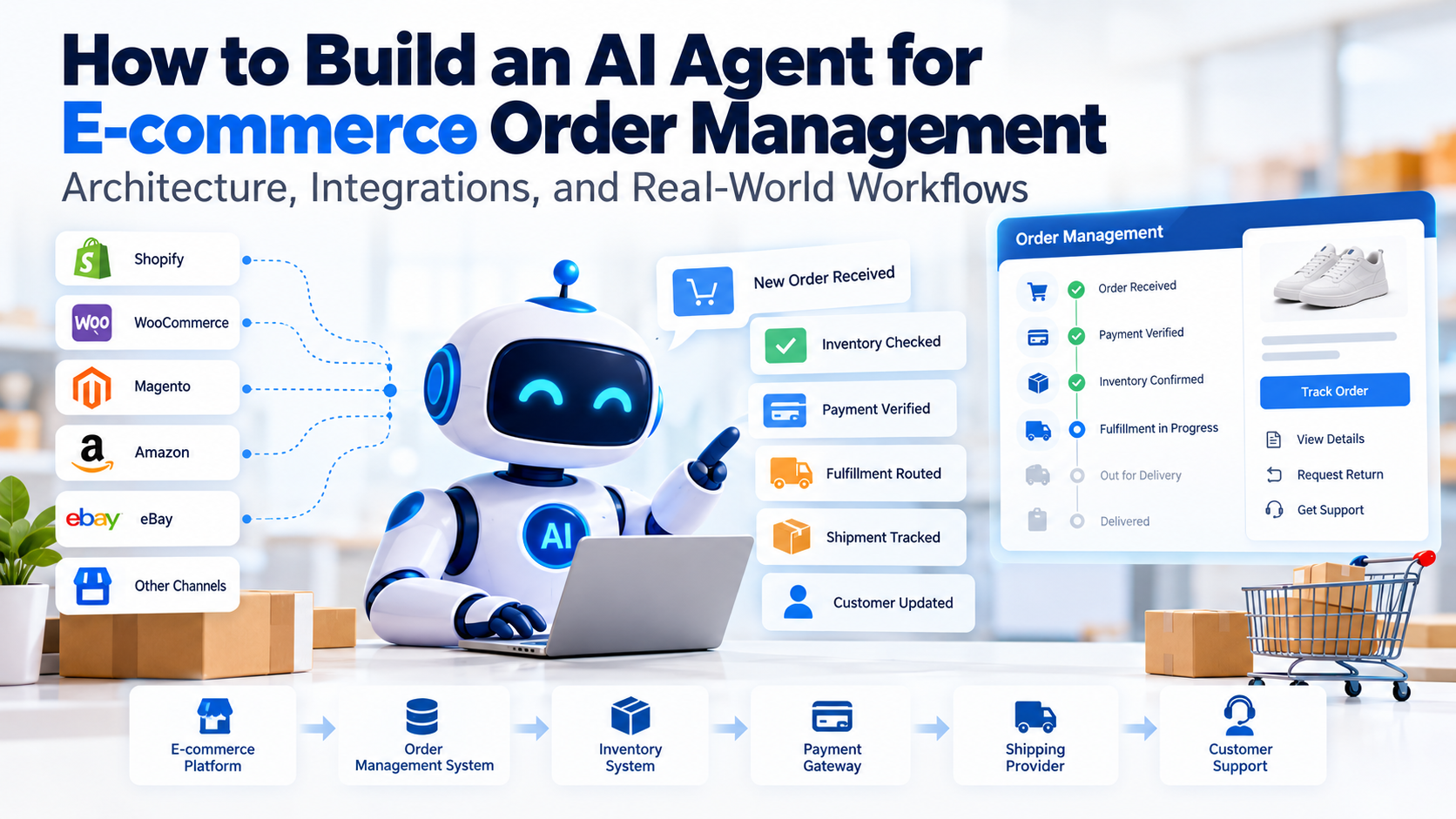
A reliable architecture connects your existing systems through a controlled integration layer. The agent retrieves information and requests approved actions. It never receives unrestricted access to business systems. A typical design has six layers.
- Sales channels. Storefronts such as Shopify, WooCommerce, or Magento, marketplaces, mobile apps, and other order sources.
- Integration layer. APIs and webhooks that connect channels with the order management system (OMS), inventory platform, payment provider, warehouse system, and shipping tools.
- Order management system. The OMS keeps order records and coordinates status and fulfillment. Which system is the system of record depends on your architecture.
- AI reasoning layer. The model interprets customer messages, summarizes issues, classifies exceptions, and selects one of the permitted tools.
- Business rules and workflow engine. This layer checks payment state, cancellation eligibility, inventory rules, and permissions, and it requires approval when needed.
- Monitoring and audit layer. Logs, alerts, and dashboards record what the agent requested, what was executed, and whether the workflow finished.
This separation is the most important design choice. Language understanding stays with the model. Transaction control stays with trusted systems and rules.
Anthropic's guide to building effective agents recommends finding the simplest solution that works and adding complexity only when it is needed. For order management, that often means a fixed workflow with an agent making decisions inside clear limits, rather than a fully open-ended agent.
Step 3: Connect the integrations
The agent is only as useful as the information and actions its integrations provide.
| Integration | What it enables |
|---|---|
| E-commerce platform | Orders, products, customer details, and order status |
| Order management system | Order processing and fulfillment coordination |
| Inventory system | Available stock and reservation status |
| Payment gateway | Payment and refund status |
| Warehouse management system | Picking, packing, and dispatch progress |
| Shipping provider | Tracking events and delivery updates |
| CRM or help desk | Support tickets and customer history |
| Notification service | Approved email, SMS, or messaging updates |
Platform events can reduce the need to check systems over and over. For example, Shopify's Admin GraphQL reference for the Order object exposes fields such as display fulfillment status, display financial status, and line items. An agent that reads these fields can answer "Has this order shipped?" from the source, rather than from a guess.
Plan for the messy parts of integration. Webhooks should be authenticated. Systems have rate limits, and requests fail. The same event can arrive twice. Repeated delivery must never create a duplicate order, refund, or message. Use idempotency keys and event deduplication from the start.
Step 4: Define tools and permissions
Give the agent a short, defined list of tools, such as reading order details, checking stock, verifying payment status, reading tracking events, opening support tickets, and sending approved notifications. These names are illustrative. Real interfaces depend on the systems involved.
Use read-only tools wherever you can. For any action that changes a record, validate the request, check the user's permissions, and confirm the latest system state before running it. Suppose a customer wants to cancel. The agent should check whether the order has already entered fulfillment, and whether company policy allows cancellation. If the order has shipped, it should route the request to the return workflow rather than force a cancellation.
Refunds, high-value changes, suspected fraud, and other sensitive actions should require explicit human approval.
Step 5: Build the workflow and exception logic
A useful agent needs a controlled workflow. A prompt alone is not enough. The workflow defines what happens after each result. A typical flow moves an order through validation, payment confirmation, inventory reservation, routing, carrier updates, and customer notifications. Any step that fails has a defined next action.
Each step needs a clear success condition and a recovery path. If the payment service is down, the agent must not assume the payment succeeded. It should pause that workflow, retry under a defined policy, and escalate if the issue continues. If two systems disagree about stock, the agent should not promise delivery. It should check the designated inventory system of record or send the conflict for review.
Real-world workflows for e-commerce operations
The examples below are illustrative workflows. They are not claims about a specific customer deployment.
Automated order validation. Staff check new orders for missing details, duplicates, and payment issues. The agent retrieves the order, checks required fields, flags inconsistencies, and requests verification when needed. Rules handle required fields and payment status. AI can help interpret free-text notes or unusual cases. The agent must never mark a payment as successful only because the order "looks valid." It must use the payment provider's confirmed status.
Inventory and fulfillment routing. Orders are sometimes sent to a warehouse that lacks the stock or cannot meet the delivery promise. The agent checks stock by location, applies shipping and capacity rules, and requests an allocation through the OMS. The final decision must respect reservations and fulfillment rules.
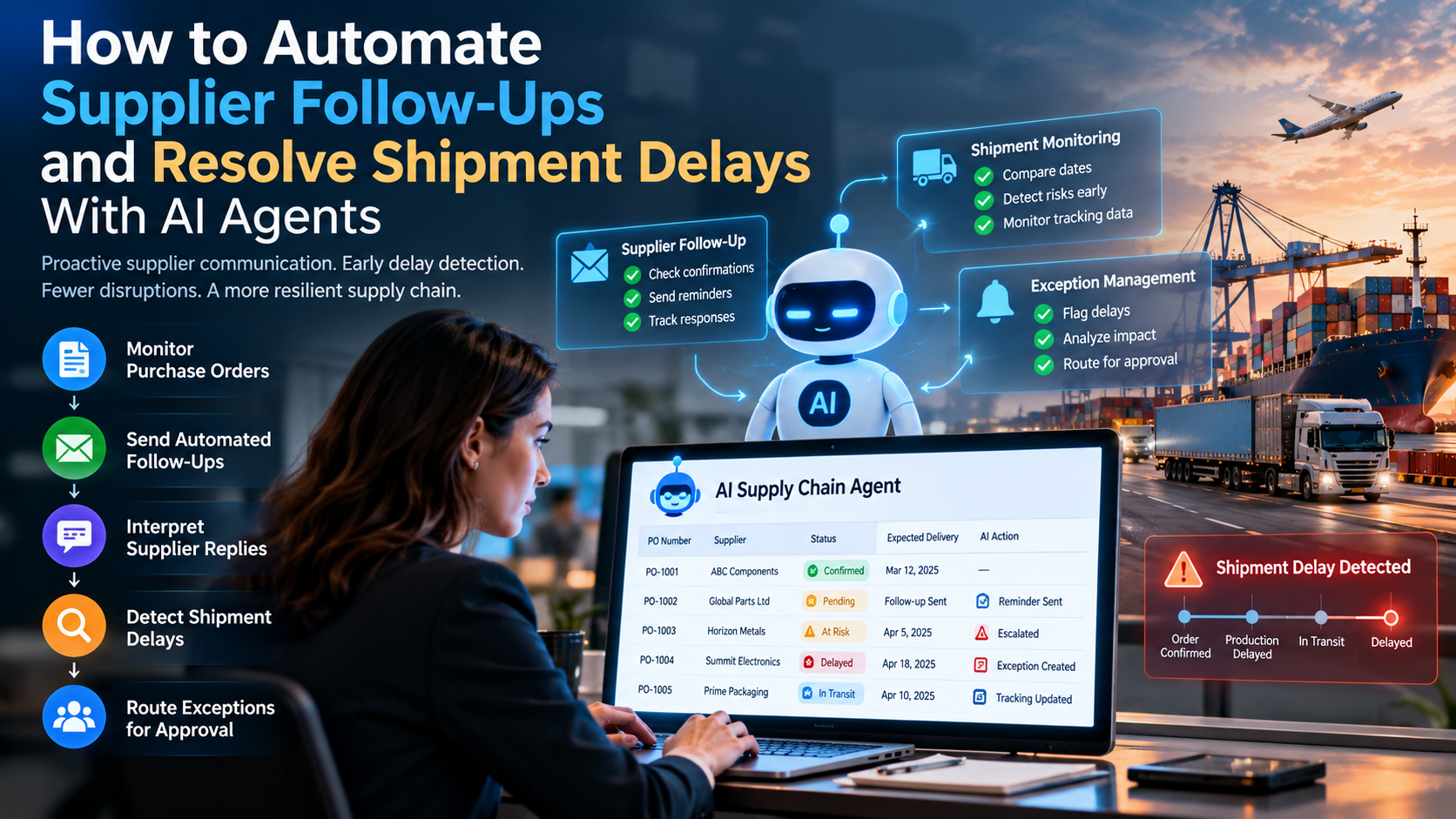
Proactive shipment delay management. Customers often learn about a delay only after they contact support. A carrier event can trigger the agent to retrieve the order, check the latest tracking, classify the exception, and prepare an update using verified details. If the shipment needs investigation, the agent opens a ticket with the order number, the latest carrier event, and the timestamps. It should not promise compensation or a new date unless the business has authorized it.
Order status and customer support. A customer asks, "Where is my order?" The agent verifies identity through your approved process, finds the matching order, checks tracking, and explains the current status. If the request involves a refund, damaged goods, or a policy exception, it collects the details and hands the case to a person. AI chatbot development for ecommerce can also connect customer questions to live order data.
Security and reliability
Order management involves customer data and money, so security belongs in the design from day one. The NIST AI Risk Management Framework provides voluntary guidance for managing AI risk across the system lifecycle, and its ideas map well to this work.
- Least privilege. Give the agent access only to the records and actions its task needs.
- Protect customer data. Use secure authentication, encrypted connections, retention rules, and tight access to personal information.
- Validate every transaction. Check order IDs, payment states, reservations, and policies before any change.
- Prevent duplicate actions. Retries must not create duplicate refunds, orders, or messages.
- Keep people in control. Require approval for high-risk or policy-sensitive decisions.
- Monitor continuously. Track tool failures, misclassifications, delays, exception rates, and blocked actions.
- Test failure modes. Simulate payment outages, missing stock, late carrier events, duplicate webhooks, and API downtime before launch.
How to measure results
Measure business outcomes, not the number of tasks the agent completes. Track order processing time, manual intervention rate, order error rate, exception resolution time, customer response time, cost per order, and workflow completion rate. Set a baseline before launch, then compare results in a controlled pilot. Break results down by order type, channel, and exception category, so you can see where the agent helps most. Full automation is not always the best target. An agent that completes routine orders and escalates unusual cases safely often delivers more value than one that tries to handle everything alone.
Build an AI agent that fits your operations
An effective AI agent for order management connects to your existing systems, understands the operational context, follows business rules, and handles exceptions through controlled workflows. The strongest solutions do not rely on AI alone. They combine AI reasoning with reliable APIs, authoritative data, transaction safeguards, and human oversight.
Start with one recurring order problem, define how you will measure success, and build a focused pilot. Teams that want help designing this can explore our AI agent development services. For a worked example of an order-handling workflow, see our illustrative e-commerce order case study.
Frequently asked questions
What is an AI agent for e-commerce order management? It is software that uses AI and connected business systems to handle order tasks. It can check order status, read inventory data, classify exceptions, and start approved workflows. Business rules control sensitive actions. Staff handle cases that need judgment.
How does an AI agent automate e-commerce orders? It connects to your storefront, OMS, inventory system, payment provider, and shipping platform. It reads order data, checks required fields, and triggers approved steps. When it finds a payment, stock, or delivery problem, it routes the case for review instead of guessing.
Which integrations are required? Most projects need the e-commerce platform, OMS, inventory system, payment gateway, warehouse system, shipping provider, and a support tool. The exact list depends on your current stack and workflow. APIs and webhooks let these systems share updates.
Can an AI agent process refunds and cancellations automatically? It can start an eligible refund or cancellation only when the connected systems, permissions, and business rules allow it. The agent must confirm order status, policy eligibility, and payment state first. High-value refunds, disputes, and unusual cases should always need human approval.
How long does it take to build an AI order management agent? The timeline depends on workflow complexity, integration access, data quality, security needs, and testing. A focused pilot with one channel and a few tasks is much simpler than a system spanning several warehouses and platforms. Review your architecture before estimating a timeline.
How do you measure the ROI of an AI order management agent? Measure processing time, manual intervention, error rates, exception resolution time, cost per order, and customer response time before and after launch. Include integration, infrastructure, monitoring, and maintenance costs. A controlled pilot will show whether the benefits justify wider rollout.