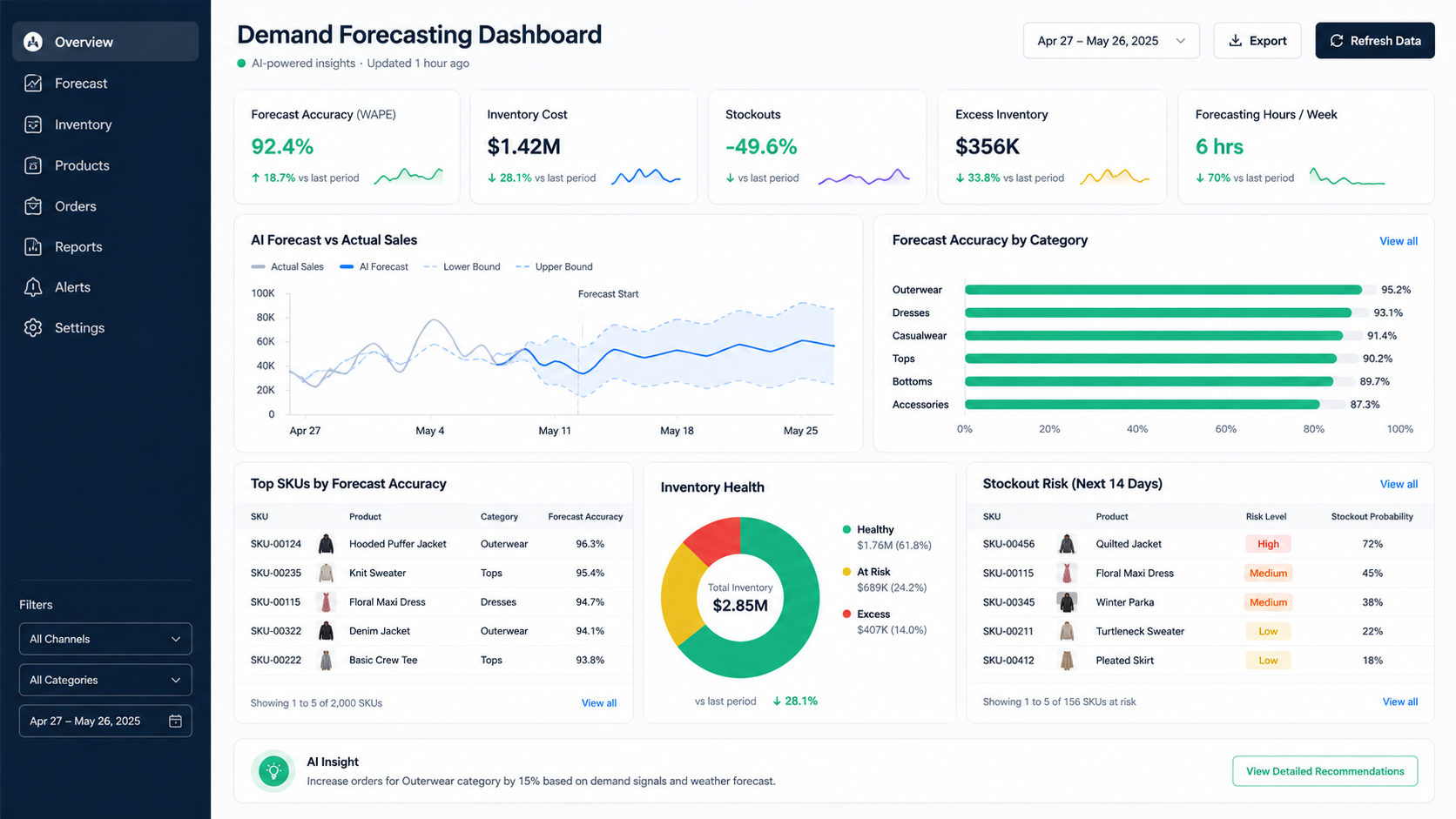
Quick Answer: Predictive analytics uses historical and behavioral data to forecast what ecommerce customers will do next — what they'll buy, when they're likely to churn, and which products will perform. Companies using it report 15–25% lower churn and 20–30% higher customer lifetime value than those relying on reactive, after-the-fact reporting.
Key Takeaways
- Non-subscription ecommerce stores face 55–75% annual churn, with roughly three out of four customers not returning the following year without a retention strategy.
- Customer churn costs American businesses an estimated $168 billion annually, making retention one of the highest-leverage areas for predictive analytics investment.
- Bain & Company's widely cited research found that a 5% improvement in customer retention can increase profits by 25–95%, depending on the industry.
- Companies using predictive analytics for retention report 15–25% lower churn rates and 20–30% higher customer lifetime value (CLV) compared to companies relying on historical reporting alone.
- Subscription ecommerce behaves very differently from one-time-purchase stores — subscription churn runs closer to 3.4% monthly, meaning the forecasting models and interventions need to be tailored to business model, not applied generically.
What Is Predictive Analytics in eCommerce?
Direct answer: Predictive analytics in ecommerce is the use of statistical models and machine learning to forecast future customer behavior — purchases, churn risk, and product demand — based on patterns in historical and real-time data.
Supporting explanation: Most ecommerce reporting is descriptive: it tells you what already happened — last month's revenue, last quarter's returning-customer rate. Predictive analytics instead answers forward-looking questions: which customers are likely to stop buying in the next 60 days, which products are trending toward a demand spike, and which segment is most likely to respond to a specific offer. The distinction matters because descriptive reporting only lets you react after revenue is already lost; predictive analytics lets you intervene before it happens.
Real example: A store that notices a customer hasn't ordered in 90 days is reacting too late — that customer likely already churned. A predictive model instead flags a customer at 60% churn probability at day 35, based on declining engagement and purchase frequency patterns, while there's still time to send a targeted win-back offer.
- Descriptive analytics explains the past; predictive analytics forecasts the future.
- Churn prediction models flag at-risk customers weeks before they actually stop buying.
- Product performance forecasting identifies demand shifts before they show up in sales reports.
Why Churn Prediction Deserves More Attention Than Most eCommerce Teams Give It
Most ecommerce teams focus heavily on acquisition — ad spend, conversion rate optimization, landing page tests — and treat retention as an afterthought. The data suggests this is backward.
Non-subscription ecommerce stores lose 55–75% of customers annually. That means most of the customer base a store worked hard to acquire this year won't be back next year without an active retention strategy. And per Bain & Company's research, the financial upside of fixing this is dramatic: a 5-percentage-point improvement in retention can lift profits by 25% to 95%, because retained customers cost less to serve, spend more over time, and generate more predictable revenue than a constant stream of new acquisitions.
Important note: Subscription and non-subscription ecommerce need fundamentally different churn models. A subscription store with 3.4% monthly churn is dealing with a different problem — and needs a different intervention — than a non-subscription store with 60%+ annual churn. Applying a one-size-fits-all model to both will produce misleading risk scores.
The Three Core Applications of Predictive Analytics in eCommerce
1. Demand Forecasting
Predicts which products will see rising or falling demand, incorporating seasonality, marketing calendar, and early sales velocity signals — closely related to, but distinct from, inventory-focused demand forecasting (see our related guide on AI demand forecasting for retailers).
2. Purchasing Behavior Prediction
Models customer-level buying patterns to predict next likely purchase, optimal contact timing, and price sensitivity — the foundation of effective personalization and email/SMS marketing timing.
3. Churn Prediction
Scores each customer's probability of churning based on declining engagement signals: order frequency drops, reduced email engagement, cart abandonment increases, and support ticket sentiment.
4. Product Performance Forecasting
Identifies which SKUs are trending toward becoming bestsellers or dead stock before the trend is obvious in a standard sales report, informing merchandising and marketing decisions earlier.
How Churn Prediction Models Actually Work
A churn model doesn't wait for a customer to stop buying — it watches for the behavioral signals that historically precede churn:
- Declining order frequency relative to that customer's historical pattern
- Reduced email/SMS engagement (open rates, click-through rates trending down)
- Increasing time between site visits
- Rising cart abandonment for a previously reliable buyer
- Support interactions with negative sentiment or unresolved issues
The model combines these signals into a churn probability score per customer, updated continuously, allowing marketing and CX teams to intervene — a personalized offer, a proactive support outreach, a loyalty incentive — while the relationship is still recoverable.
Predictive Analytics vs. Standard Ecommerce Reporting
| Factor | Standard Reporting | Predictive Analytics |
|---|---|---|
| Time orientation | Backward-looking | Forward-looking |
| Churn visibility | After the customer stops buying | Weeks before, via risk scoring |
| Granularity | Aggregate / segment-level | Individual customer-level |
| Action window | Reactive win-back only | Proactive intervention |
| Product insight | Confirms trends already visible in sales | Flags trends before they peak |
Common Mistakes eCommerce Companies Make
- Treating all customers with one retention offer. A high-value customer showing early churn signals needs a different intervention than a low-value, price-sensitive one.
- Reacting only after churn has already happened. Win-back campaigns sent 6 months post-churn convert far worse than interventions triggered at the first risk signal.
- Ignoring product-level demand signals. Missing an early trend means either stocking out on a rising product or overordering a declining one.
- Not separating subscription and one-time-purchase behavior. These customer types churn for different reasons and need different models.
- Over-relying on discounts as the only retention lever. Discounting every at-risk customer erodes margin; service, personalization, and loyalty programs often work as well or better.
Best Practices
- Start with a churn model on your highest-value customer segment, where the retention ROI is largest.
- Define what "churned" actually means for your business — 60 days without a purchase means something very different for a coffee subscription than for a furniture retailer.
- Connect the churn score to an actual workflow. A risk score that nobody acts on delivers zero value.
- Test interventions against a control group to confirm the retention actions are actually working, not just correlating with normal behavior.
- Feed product performance forecasts into merchandising decisions early, not just marketing.
Step-by-Step Guide to Getting Started
- Define your churn window based on your typical purchase cycle.
- Audit available data: purchase history, email engagement, site behavior, support interactions.
- Build or implement a churn scoring model on your highest-value segment first.
- Design intervention workflows tied to risk score thresholds (e.g., automatic outreach at 60%+ risk).
- Test against a control group before rolling out broadly.
- Extend to product performance forecasting once churn prediction is delivering results.
- Review and retrain models quarterly as customer behavior and catalog evolve.
Pros and Cons of Predictive Analytics in eCommerce
| Pros | Cons |
|---|---|
| Enables proactive retention instead of reactive win-back | Requires clean, connected customer data across systems |
| Improves marketing spend efficiency by targeting real risk | Needs ongoing model maintenance as behavior shifts |
| Surfaces product trends before they're obvious in sales reports | Initial setup requires data science or a specialized partner |
| Directly measurable ROI through retention and CLV improvement | Risk of over-automation without human oversight on offers |
Expert Tips
- Don't chase a perfect churn model on day one. Even a directionally accurate risk score, acted on consistently, beats no model at all.
- Combine churn prediction with a real customer service response — Cor Advance Solutions has seen AI-powered support automation meaningfully improve retention outcomes when paired with churn scoring; see our AI customer support automation guide.
- Revisit your churn definition every year. As your business and average purchase cycle change, a stale churn window will misclassify active customers as at-risk.
Frequently Asked Questions
What is a good churn rate for an ecommerce store?
A good annual churn rate for a non-subscription ecommerce store is below 60%, with strong performers under 50%. Subscription businesses should aim for monthly churn well under 5%.
How does predictive analytics reduce churn?
It flags at-risk customers based on behavioral signals — declining engagement, order frequency drops — weeks before they'd otherwise stop buying, giving teams time to intervene with a targeted offer or outreach.
How much can retention actually impact profit?
Bain & Company's research found a 5-percentage-point improvement in customer retention can increase profits by 25–95%, depending on industry and business model.
What data do I need for churn prediction?
At minimum: purchase history, order frequency, and basic engagement data (email opens/clicks or site visits). Support interaction data improves accuracy further.
Is predictive analytics only useful for large ecommerce companies?
No. Mid-market and smaller ecommerce businesses often see faster, clearer ROI because their customer base is more homogeneous and easier to model accurately.
How is subscription churn different from non-subscription churn?
Subscription churn is measured monthly and driven by billing/value perception issues; non-subscription churn is measured annually and driven more by declining engagement and competitive alternatives.
Can predictive analytics forecast which products will sell out?
Yes — product performance forecasting identifies early demand signals for individual SKUs, often before the trend is visible in standard sales dashboards.
How long before I see results from a churn prediction model?
Most ecommerce businesses see measurable retention improvement within one full churn-window cycle after launching intervention workflows — typically 60–120 days.
Does predictive analytics replace email marketing platforms?
No — it enhances them. Predictive analytics identifies who to target and when; the marketing platform still executes the outreach.
What's the biggest reason predictive analytics projects underperform?
Building an accurate model but never connecting the output to an actual retention or marketing workflow — insight without action doesn't move revenue.
Should I discount every at-risk customer to retain them?
No. Discounting works for price-sensitive segments but erodes margin broadly. Personalized service, loyalty perks, and relevant content often retain customers as effectively without the margin hit.
Conclusion
The gap between reactive ecommerce reporting and predictive analytics comes down to timing: one tells you what already happened, the other tells you what's about to happen while you still have time to act. With US businesses losing an estimated $168 billion annually to churn, and retention improvements capable of lifting profit 25–95%, predictive analytics addresses one of ecommerce's highest-leverage, most under-invested problems.
Cor Advance Solutions builds predictive analytics and demand forecasting systems for ecommerce businesses — see our related ecommerce demand forecasting case study. Explore our AI & Machine Learning services or get in touch to discuss your retention and forecasting needs.
Actionable Checklist
- Define your churn window based on your typical purchase cycle
- Audit available customer data across purchase, engagement, and support systems
- Build a churn scoring model on your highest-value segment first
- Design intervention workflows tied to specific risk thresholds
- Test interventions against a control group before scaling
- Extend predictive analytics to product performance forecasting
- Review and retrain models quarterly as behavior shifts
Disclaimer: Statistics in this article are drawn from cited industry research as of 2026 and represent industry-wide benchmarks, which vary by business model and category. This article is for general informational purposes and does not constitute financial or business advice.