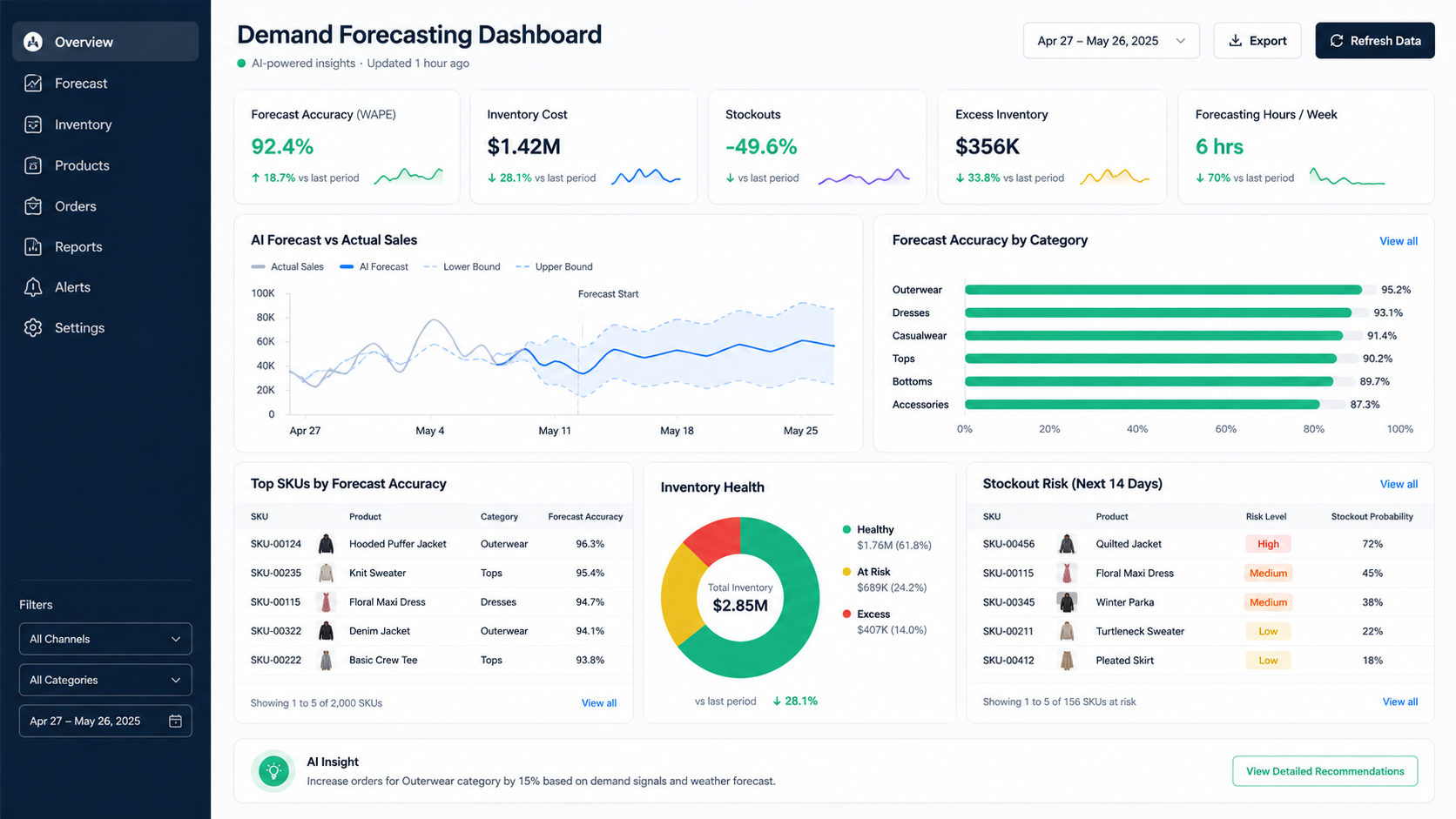
Quick answer: Retailers are investing in real-time data intelligence because inventory distortion — stockouts, overstock, and misplaced items — costs the industry an estimated $1.73 trillion in lost sales every year, and the retailers closing that gap fastest are pulling meaningfully ahead of competitors still running on periodic, batch-based reporting. This isn't a nice-to-have technology trend; it's becoming the line between retailers that grow and retailers that don't.
If you've watched your own IT budget conversations shift toward "real-time" and "unified data" over the past year, you're seeing the same pattern playing out across the industry. Here's the actual business case behind it, not just the buzzword.
Key Takeaways
- Retail AI spending is projected to grow 29% from 2025 to 2026, with retailers now allocating an average of 15% of IT budgets to AI, according to IHL Group's 2026 retail technology research.
- Inventory distortion — the combined cost of stockouts, overstock, and misplaced items — costs retailers an estimated $1.73 trillion in lost sales annually.
- Retail's profit winners are 94% more likely to invest in shelf and real-time intelligence than their struggling peers, according to IHL Group's research on the compounding retail AI advantage.
- Sales growth leaders are 482% more likely to be early technology adopters than laggards, and profit winners are growing IT spend at a rate 740% higher than retailers falling behind.
- Despite the investment conversation, only about 9.1% of retailers currently have computer vision deployed in stores — the gap between discussing real-time intelligence and actually running it is still wide.
What "real-time data intelligence" actually means for a retailer
Direct answer: Real-time data intelligence means having a continuously updated, accurate picture of what's happening across your stores, inventory, and customers right now, instead of piecing that picture together from reports that are hours or days old by the time anyone reads them.
Most retailers already collect enormous amounts of data — point-of-sale transactions, inventory counts, customer behavior. The gap isn't data collection; it's data freshness and connection. A retailer running nightly batch reports knows what happened yesterday. A retailer with real-time data intelligence knows what's happening on the floor right now, which is a fundamentally different operating position when a stockout, a pricing error, or a demand spike is actively costing money.
Real example: A store manager checking yesterday's sales report finds out about a stockout a full day after it started costing sales. A retailer with real-time shelf and inventory data gets an alert the moment stock drops below a threshold — while there's still time to reorder, transfer inventory from a nearby store, or adjust online availability before the lost sales pile up.
- Real-time data intelligence is about freshness and connection, not just having more data.
- The value is entirely in the response window it creates — hours, not days, to act on a problem.
- Most retailers already have the raw data; the investment is in connecting and speeding it up, not collecting more of it.
The actual cost driving this investment
The number worth sitting with is $1.73 trillion — the estimated annual cost of inventory distortion across global retail, split between stockouts (lost sales when an item isn't available) and overstock (capital tied up in excess inventory that eventually gets marked down). That figure alone explains why real-time inventory visibility specifically has become one of the most consistently funded retail technology investments in 2026, ahead of many flashier AI use cases.
This is also why the investment conversation has shifted from "should we do this" to "how fast can we do this." Retailers aren't debating whether inventory distortion is a real cost anymore — the number is well established. The competitive question has become how quickly a retailer can close that gap before competitors do it first.
Why leaders and laggards are pulling apart, not converging
Important note: The gap between retailers investing early in real-time intelligence and those waiting is not staying flat — it's widening. Sales growth leaders are 482% more likely to identify as early technology adopters compared to laggards, and profit winners are growing their IT spend at a rate 740% higher than retailers falling behind. That's not a small efficiency gap; it's a compounding one, where early movers reinvest the returns from real-time intelligence into further advantage.
This matters strategically: waiting for the technology to mature further before investing is a reasonable-sounding argument that's actually working against the retailers making it, since the leaders aren't waiting, and the gap between the two groups is growing every quarter, not shrinking.
Where retailers are actually putting the investment
1. Inventory and shelf intelligence
Real-time visibility into what's actually on the shelf versus what the system thinks is on the shelf — closing the gap that drives a large share of the $1.73 trillion inventory distortion figure.
2. Unified customer and transaction data
Connecting point-of-sale, e-commerce, and customer data into one current view, replacing the disconnected, channel-by-channel reporting that's historically been standard in retail.
3. Personalized experience infrastructure
83% of retailers now prioritize AI-powered personalized experiences as a top technology investment for 2026 — infrastructure that depends entirely on having real-time, connected customer data to work from.
4. Demand and pricing intelligence
Real-time signals feeding pricing and demand decisions, rather than periodic, batch-updated pricing and inventory models that lag actual market conditions.
The gap between investment and deployment
Here's the part of this story that gets less attention: despite how much of the current conversation centers on real-time intelligence and computer vision specifically, only about 9.1% of retailers currently have computer vision deployed in their stores. That's a meaningful gap between budget conversations and actual, running deployments — and it points to where the real competitive opportunity still sits, for retailers willing to move from planning to deployment faster than their peers.
Traditional retail reporting vs. real-time data intelligence
| Factor | Traditional Reporting | Real-Time Data Intelligence |
|---|---|---|
| Data freshness | Hours to a full day (batch) | Continuous, near-instant |
| Stockout detection | After the fact, in a report | While it's happening, as an alert |
| Decision window | Limited — problem often already cost money | Hours to act before losses compound |
| Investment focus | More reports, more dashboards | Faster, connected, current data |
| Competitive effect | Keeps pace with peers | Compounds advantage over time |
Common mistakes retailers make with this investment
- Buying analytics tools before fixing the underlying data foundation. Retailers are increasingly deploying pricing software, supplier collaboration platforms, and analytics tools before establishing the accurate, real-time shelf-level data those systems actually depend on — creating a gap between the investment and the return.
- Treating real-time intelligence as a single tool purchase. It's a data architecture shift, not a single software license — connecting existing systems matters more than any individual tool.
- Under-investing in deployment after over-investing in planning. With only 9.1% of retailers actually running computer vision despite widespread investment discussion, the execution gap is often the real bottleneck, not the budget decision.
- Ignoring the compounding nature of the gap. Waiting a year to start doesn't just delay the benefit — it lets faster-moving competitors extend their lead further in the meantime.
- Chasing personalization infrastructure before nailing inventory accuracy. Personalized experiences built on inaccurate inventory data create a worse customer experience than no personalization at all — sequence the investment correctly.
Best practices for this investment
- Fix inventory data accuracy first, since it's the foundation most other real-time use cases (personalization, pricing, demand) ultimately depend on.
- Move from pilot to deployment deliberately — the gap between retailers discussing real-time intelligence and those actually running it is where competitive advantage currently sits.
- Sequence investments by dependency, not by which use case sounds most exciting — shelf and inventory accuracy before personalization, personalization before advanced pricing AI.
- Track the compounding gap, not just your own year-over-year progress. A retailer improving steadily can still be losing ground if competitors are improving faster.
- Treat this as an ongoing capability, not a one-time project — the retailers pulling ahead are reinvesting continuously, not deploying once and stopping.
Step-by-step guide to getting started
- Audit your current data latency — how old is the data your team actually makes decisions on today?
- Identify your highest-cost blind spot — usually inventory accuracy, given its outsized share of total distortion cost.
- Fix the data foundation for that use case first, before layering additional tools on top.
- Pilot real-time visibility on a limited set of stores or categories.
- Measure results against your batch-reporting baseline — stockout rate, response time, lost sales recovered.
- Expand deliberately, moving from pilot to full deployment faster than the industry-wide 9.1% deployment rate suggests most competitors are moving.
- Reinvest returns into the next use case, following the same dependency sequence.
Pros and cons of investing in real-time data intelligence
| Pros | Cons |
|---|---|
| Directly targets a well-documented, massive cost (inventory distortion) | Requires fixing underlying data foundations, not just buying a tool |
| Creates a compounding competitive advantage over slower-moving peers | Many retailers stall between planning and actual deployment |
| Supports personalization, pricing, and demand use cases built on top of it | Needs sequenced investment, not a single purchase |
| Payback periods for specific use cases like shelf intelligence are relatively fast (3-14 months) | Meaningful investment required before returns materialize |
Expert tips
- Don't evaluate this investment in isolation. Real-time inventory data is the foundation personalization, pricing, and demand forecasting all depend on — sequence accordingly rather than chasing the most exciting use case first.
- Track your deployment rate against the 9.1% computer vision benchmark specifically. If your organization is still in planning while competitors are running production deployments, the gap is compounding faster than budget cycles typically account for.
- Treat the $1.73 trillion inventory distortion figure as your internal budget justification anchor — it's a well-established, widely cited cost that makes the business case concrete rather than abstract.
Frequently asked questions
Why are retailers investing in real-time data intelligence right now?
Retailers are investing because inventory distortion costs the industry an estimated $1.73 trillion annually in lost sales, and retailers closing that gap with real-time visibility are pulling measurably ahead of competitors still relying on batch, periodic reporting.
How much are retailers spending on AI and real-time data technology?
Retail AI spending is projected to grow 29% from 2025 to 2026, with retailers now allocating an average of 15% of their IT budgets to AI, according to IHL Group's 2026 research.
What is the difference between traditional retail reporting and real-time data intelligence?
Traditional reporting relies on batch updates that can be hours or a full day old; real-time data intelligence provides a continuously updated view, cutting the response window from days to hours when a problem like a stockout occurs.
How much more likely are profit-winning retailers to invest in real-time intelligence?
Profit winners are 94% more likely to invest in shelf and real-time intelligence than struggling peers, and they're growing IT spend at a rate 740% higher than laggards.
What percentage of retailers have actually deployed real-time technology like computer vision?
Only about 9.1% of retailers currently have computer vision deployed in stores, despite widespread investment discussion — showing a real gap between planning and execution industry-wide.
What should retailers invest in first: personalization or inventory accuracy?
Inventory accuracy should generally come first, since personalization and other real-time use cases depend on having accurate underlying data — personalizing around inaccurate inventory data can create a worse experience than no personalization at all.
How long does it take to see returns from real-time data intelligence investments?
Specific use cases like shelf intelligence typically show payback within 3 to 14 months, depending on the retailer's segment and pricing model, though full data foundation work can take longer to complete.
Is the gap between retail leaders and laggards on real-time data closing over time?
No — it's widening. Sales growth leaders are 482% more likely to be early technology adopters than laggards, and the advantage compounds as leaders reinvest returns into further capability.
What's the biggest mistake retailers make with this investment?
Buying analytics and personalization tools before establishing the accurate, real-time data foundation those tools actually depend on, which creates a gap between the investment made and the return realized.
Is real-time data intelligence only relevant for large retail chains?
No — while large retailers have led early investment, the underlying data infrastructure has become more accessible, and the core business case (reducing inventory distortion costs) applies at any retail scale.
Conclusion
The business case for real-time data intelligence isn't really about the technology — it's about a $1.73 trillion problem that batch, periodic reporting was never fast enough to solve, and a competitive gap between early movers and everyone else that's compounding, not closing. Retailers still weighing whether this investment is worth it are, in effect, watching that gap grow every quarter it takes to decide.
Cor Advance Solutions builds real-time data platforms for retailers moving off batch, disconnected reporting. See our unified data platforms for retail guide for what the underlying architecture looks like. Get in touch to talk through where your own data foundation stands today.
Actionable checklist
- Audit how old the data your team currently decides on actually is
- Identify your highest-cost blind spot, usually inventory accuracy
- Fix that data foundation before layering additional tools on top
- Pilot real-time visibility on a limited set of stores or categories
- Measure results against your batch-reporting baseline
- Expand deliberately, moving faster than the industry's 9.1% deployment rate
- Reinvest returns into the next use case in sequence
Disclaimer: Statistics in this article are drawn from cited industry research as of 2026 and represent industry-wide estimates, which vary by retailer and category. This article is for general informational purposes and does not constitute business advice.