Healthcare operations

AI Voice Agents for Healthcare to Automate Patient Calls and Scheduling

Build custom healthcare voice agents that answer patient enquiries, schedule appointments, send reminders and route complex calls to the right staff, integrated with your existing workflows and designed around your privacy requirements.

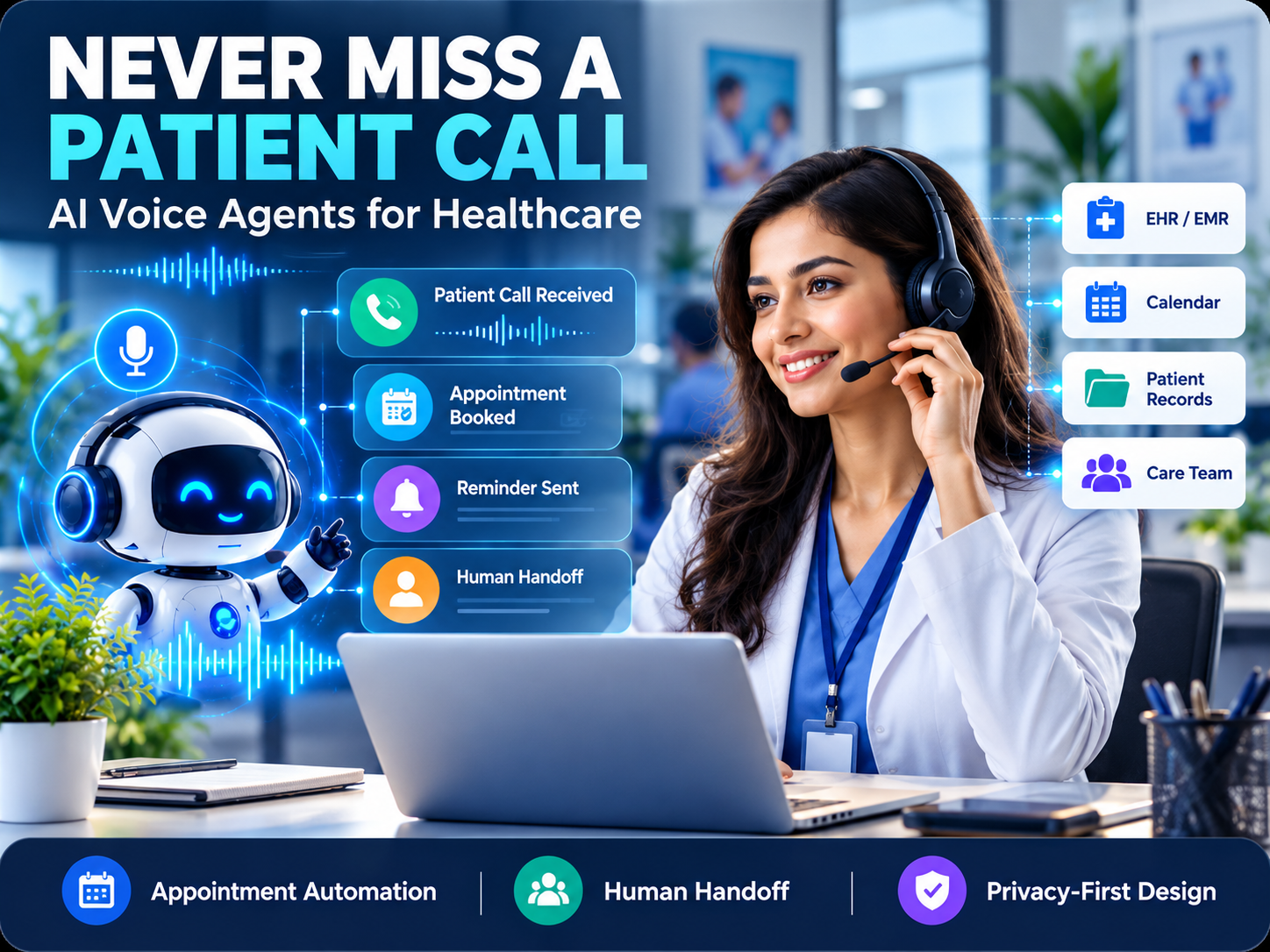
  • Appointment automation
  • Human handoff
  • Privacy-first design
  • Answer patient calls and capture the reason for the call.
  • Book, reschedule and confirm appointments against approved availability.
  • Send reminders and capture cancellations for waitlist follow-up.
  • Transfer complex or clinical calls to the right staff member with context.
AI voice agent for healthcare booking appointments, sending reminders and handing off to clinic staff, connected to EHR, calendar and patient records
Illustrative interface. The screens, labels and people are examples, not a live clinic or a real patient.

The healthcare communication problem

Your healthcare team should not spend hours managing repetitive patient calls

Patient calls peak during OPD hours, lunch breaks, evenings and weekends. Front-desk staff handle bookings, rescheduling, directions, reminders and routine enquiries, often at the same time.

Missed calls and delayed bookings

Calls peak during OPD hours, lunch breaks, evenings and weekends. When lines are busy, patients hang up and book elsewhere.

Front-desk time lost to routine questions

Staff handle bookings, rescheduling, directions, reminders and general enquiries on the same line, which slows down in-person patients.

Manual reminders and follow-ups

Reminder and recall calls are repetitive, easy to skip on busy days, and hard to track.

After-hours communication gaps

Patients who call after closing time often wait until the next working day, which can mean a lost booking or an unanswered question.

Language barriers

Patients who are more comfortable in another language may struggle to understand scheduling and preparation instructions.

Inconsistent call logs

Call outcomes and follow-up tasks often live in notes or memory, so nothing is tracked consistently across the team.

How voice agents solve these problems

Automate routine patient communication without replacing human care

Each step below shows how a booking call works today and how it works with an AI-assisted workflow. Actual actions depend on the permissions, integrations and workflow rules configured for your clinic.

StepCurrent workflowAI-assisted workflow
Patient calls to bookCall rings out during a busy shift, so the caller waits or gives up.The agent answers, identifies the request and gathers the preferred date and time.
Checking availabilityStaff switch between the phone and the scheduling screen.The agent checks approved scheduling availability in real time.
Confirming the bookingConfirmation depends on staff finishing the call and updating the record.The agent confirms the slot with the patient and records the booking after validation.
Reminders and follow-upManual reminder calls, often skipped when the team is busy.Scheduled reminder calls run automatically, and cancellations are captured for waitlist follow-up.
Complex or sensitive callsCallers may be transferred several times before reaching the right person.The agent routes the call to the right staff member with a short summary of the conversation.

Example workflow

From a patient call to a confirmed appointment

In this example, the agent books a follow-up visit, checks availability through the scheduling system and records the outcome. The steps are illustrative and depend on your configured rules.

Each step is logged, so the clinic can see which calls were booked, which were transferred and why. Read the full step-by-step breakdown, including failure handling, in how AI voice agents automate healthcare appointment scheduling.

  1. 01

    The patient calls the clinic about a follow-up visit.

  2. 02

    The agent identifies the appointment request and asks for the preferred day and time.

  3. 03

    It checks the connected scheduling system for available slots.

  4. 04

    The patient picks a slot, and the agent confirms it back to them.

  5. 05

    The booking is recorded and a confirmation is sent through an approved channel.

  6. 06

    If the patient asks a clinical question, the call goes to clinic staff.

Inside a booking call

What the clinic sees during an AI-handled appointment call

The transcript and the booking request are recorded side by side, so staff can review what happened without listening to the whole call.

Clinic line · Call in progress
AI handling
  • PatientI need a follow-up visit next week.
  • AI Voice AgentI can help with that. Do you prefer a morning or an afternoon slot?
  • PatientMorning, if possible.
  • AI Voice AgentThursday at 10:30 or Friday at 9:00 are available. Which one suits you?
  • PatientThursday at 10:30.
  • AI Voice AgentBooked for Thursday at 10:30. A confirmation will be sent through the approved channel.

Booking request

Request
Follow-up visit
Preferred time
Morning
Slots offered
Thu 10:30 · Fri 09:00
Patient selection
Thu 10:30
Booking status
Confirmed after validation
Confirmation
Sent via approved channel
Slot validated against the scheduling system before confirmation.

Illustrative view. Names, slots and times are sample data, not a real patient or clinic.

Healthcare AI voice agent use cases

One voice AI platform, multiple patient communication workflows

Each use case names the business problem, the workflow, the integrations it needs and the KPI to track.

Patient appointment scheduling

Problem
Staff are busy with other callers, so patients wait to book or reschedule.
Solution
The agent understands the appointment intent, checks approved availability, confirms the patient's choice and updates the booking.
Integrations
Scheduling system, calendar rules, patient access or CRM record.
KPI
Call-to-booking conversion, successful booking rate, average handling time.

Automated reminders and no-show follow-up

Problem
Manual reminder calls are missed, and unused slots reduce clinic capacity.
Solution
Reminder calls and confirmations run on your configured schedule. Cancellations are captured and offered to a waitlist.
Integrations
Scheduling system, messaging channel, waitlist records.
KPI
Reminder completion, confirmation rate, no-show rate.

24/7 patient enquiries and after-hours calls

Problem
Clinic hours, location, appointment preparation and routine questions arrive when no staff member is available.
Solution
The agent answers from approved clinic information, captures the caller's purpose and routes unresolved requests to the right team.
Integrations
Approved clinic knowledge base, call routing, ticketing or task system.
KPI
After-hours call coverage, resolution rate, callback backlog.

Patient intake and follow-up calls

Problem
Intake details, pre-visit instructions and post-visit check-ins are collected manually.
Solution
The agent follows approved scripts, records responses and creates tasks for the designated staff member.
Integrations
Intake forms or EHR where authorized, task management.
KPI
Intake completion, follow-up completion, staff handling time.

Diagnostic centre and lab appointment coordination

Problem
Test bookings, preparation instructions, collection timings and rescheduling calls add to the workload.
Solution
The agent shares approved test-specific instructions, records booking requests and escalates medical questions to staff.
Integrations
Lab or diagnostic scheduling system, approved preparation content.
KPI
Completed bookings, information accuracy, transfer rate.

Multilingual patient communication

Problem
Patients who prefer another language may not fully understand scheduling or routine information.
Solution
Supported languages are used for natural conversations, with language selection and a fallback to a human when confidence is low.
Integrations
Language configuration, approved translated content, escalation routing.
KPI
Task completion by language, misunderstanding rate, successful escalations.

Industry-specific solutions

Custom AI voice agents for hospitals, clinics and healthcare networks

Each segment has a different priority workflow and a different operational constraint. Each row shows what the agent focuses on first.

Hospitals and health systems

Priority workflow: High-volume calls and departmental routing

Desired outcome: Consistent call handling across departments

Requires routing rules for each department and clear escalation paths.

Outpatient clinics

Priority workflow: Scheduling and rescheduling

Desired outcome: Less manual booking work for front-desk staff

Works best with a single, well-maintained scheduling calendar.

Diagnostic centres

Priority workflow: Test booking and preparation reminders

Desired outcome: Fewer incomplete appointments

Preparation content must be approved by the centre before the agent uses it.

Dental practices

Priority workflow: Appointment confirmations and recall calls

Desired outcome: Better schedule utilization

Recall rules and treatment-specific slot lengths must be configured.

Specialty clinics

Priority workflow: Referral coordination and follow-up

Desired outcome: Fewer communication gaps between referrals and visits

Referral information flows depend on the systems the clinic already uses.

Multi-location provider groups

Priority workflow: Centralized call handling

Desired outcome: Consistent workflows across locations

Each location's hours, services and rules are configured separately.

Integrations and workflow automation

Integrate AI voice agents with your healthcare technology stack

The agent should not guess appointment availability or patient details. It should retrieve verified information from the right system, within the permissions you set.

Conceptual architecture

Patient phone call

Inbound or outbound

AI voice agent

Speech recognition · conversation logic · approved actions

Scheduling

Availability and booking

EHR / EMR

Authorized record access

CRM / patient access

Requests and follow-ups

Human escalation

Staff handoff and exceptions

Conceptual architecture only. The actual integration depends on available APIs, vendor permissions, data access, infrastructure and your healthcare systems.

What we cover in integration planning

  • EHR and EMR connectivity through supported APIs, and interoperability standards such as HL7 or FHIR where the system supports them.
  • Telephony, SIP and VoIP compatibility with your existing call routing.
  • Real-time availability checks and booking validation in your scheduling system.
  • CRM, ticketing and task management integrations for follow-up work.
  • Call summaries, structured outcomes and operational analytics.
  • Authentication, permissions, retries, duplicate prevention and error handling.
  • Human transfer, fallback routing and clear service-availability rules.

We only describe compatibility with a specific EHR, EMR or scheduling platform after we have verified it for your project. Native integrations are not assumed from a product name.

Escalation and safety boundaries

Where the agent stops and your staff take over

Every call follows the same routing steps. The agent handles approved, non-clinical tasks, and anything outside that scope goes to the right person with context.

  1. 1

    Receive the call

  2. 2

    Identify the request

  3. 3

    Answer from approved clinic information

  4. 4

    Ask a clarifying question if needed

  5. 5

    Route to staff if outside the agent's scope

  6. 6

    Create a task with the call summary

  7. 7

    Confirm the next step with the caller

The agent answers

  • Opening hours and location
  • Parking and payment methods
  • Approved preparation steps
  • Booking and rescheduling

The agent collects and routes

  • Appointment request details
  • Callback requests
  • General reason for the call

Clinical staff decide

  • Clinical questions and symptoms
  • Medication queries
  • Complaints and billing exceptions

Security, privacy and patient safety

Build healthcare voice AI with privacy, access controls and human oversight

Patient calls can include personal and sensitive health information. Privacy and safety are part of the design from the first workshop, not an add-on.

Data protection

Encryption in transit and at rest, access permissions and secure storage, where implemented in the deployment.

Data minimization

The agent can access only the patient information its workflow needs. Everything else stays out of reach.

Consent and recording

Recording controls follow applicable law, patient consent requirements and your retention policy.

Human escalation

Unclear requests, complaints, failed identity checks and clinically sensitive conversations go to staff.

Clinical boundaries

The agent does not diagnose, prescribe or make emergency care decisions unless a validated and authorized clinical system is specifically designed for that use.

Auditability

Call outcomes, approved actions, failures and escalation events are logged so each step can be traced.

Regulatory considerations

  • For US healthcare providers, applicable HIPAA obligations, Business Associate Agreements and vendor arrangements are discussed before any deployment.
  • For clients in India, applicable health data and privacy requirements are assessed for each deployment.
  • We do not describe a deployment as HIPAA compliant or fully compliant without substantiated evidence for that specific system.

This section is informational and does not replace legal advice. Compliance depends on the organization, its activities and its data flows.

Implementation and custom development

From healthcare workflow assessment to production deployment

Every phase ends with a tangible deliverable, so your team knows what it receives at each step.

  1. Step 1

    Workflow discovery

    We review call volume, recurring enquiries, escalation rules and baseline metrics.

    Deliverable: Workflow map and baseline report

  2. Step 2

    Solution and safety design

    We define conversation flows, permissions, language requirements and the human fallback.

    Deliverable: Conversation design and safety rules

  3. Step 3

    Voice agent development

    We build the speech pipeline, prompts, approved actions, telephony connection and required integrations.

    Deliverable: Working prototype in a test environment

  4. Step 4

    Testing and validation

    We test accents, medical terminology, noisy audio, interruptions, edge cases and unauthorized actions.

    Deliverable: Test report with pass and fail results

  5. Step 5

    Controlled deployment

    We start with a limited workflow or pilot group, with monitoring and human fallback active.

    Deliverable: Pilot dashboard and monitoring plan

  6. Step 6

    Optimization and support

    We improve flows based on call outcomes, failure patterns and task completion.

    Deliverable: Monthly optimization review

Business value and ROI

Measure the operational impact of healthcare voice AI

We agree on these measures before the pilot starts, using your own baseline. We do not publish percentage results without verified evidence.

Scenario-based estimate

We collect your current call volume, handling cost, target automation rate and estimated platform cost, then show the estimate with every assumption visible. Projected savings are never presented as guaranteed results.

KPIMeasurement approach
Missed-call rateUnanswered eligible calls ÷ total eligible inbound calls
Appointment completionCompleted bookings ÷ eligible booking requests
Average handling timeAverage duration per handled call
Staff time savedBaseline manual handling time minus post-deployment handling time
No-show rateMissed appointments ÷ scheduled appointments
Cost per resolved callTotal relevant operating cost ÷ successfully resolved calls
Escalation rateCalls transferred to staff ÷ total handled calls

Measurement dashboard

Track the same measures before and after launch

Your baseline is recorded before the agent goes live. The dashboard then shows the same measures afterward, so changes are compared against your own starting point.

First-response time

—

Baseline: set before launch

Measured from call connect to first answer

Correct routing

—

Baseline: set before launch

Checked on a sample of reviewed calls

Successful handoffs

—

Baseline: set before launch

Logged for every transfer to staff

Unresolved enquiries

—

Baseline: set before launch

Counted daily in the staff queue

Dashboard layout is illustrative. Values appear only once your baseline and post-launch data have been measured.

Why Cor Advance Solutions

A healthcare voice AI partner focused on your actual workflows

We design around your clinic's processes, the systems you already use and the safeguards your patients expect.

Custom workflow engineering

We design flows around your scheduling rules, departments and staff roles, not a generic script.

Integration planning first

We review your existing systems and their APIs before recommending an architecture.

Privacy requirements defined early

Access, retention, consent and escalation rules are agreed before implementation begins.

Tested against real edge cases

We test interruptions, unclear requests, accents and failed bookings, not only the happy path.

Measurable milestones

Each phase has a deliverable and success criteria agreed with your team.

Post-launch monitoring

We track call outcomes and failures after launch and optimize the workflows over time.

We are based in Ahmedabad, India, and work with healthcare organizations remotely. We publish case studies and testimonials only after they are verified and approved. Until then, we walk through our method with clearly labeled demonstrations.

Demo and pilot plan

See how a voice agent could handle your clinic's calls

We show a working demonstration of booking, rescheduling and human handoff, then agree on a pilot plan with a defined scope and measurement period.

Request a Tailored Demo

Illustrative call: appointment rescheduling

  • PatientI need to move my appointment to next week.
  • AI Voice AgentI can help with that. Which day suits you best?
  • PatientTuesday morning, if possible.
  • AI Voice AgentHere are the available slots. Please confirm one and I will update your booking.
  • PatientI have a question about my medication.
  • AI Voice AgentThat question is for our clinical team. I am transferring you now with a short summary.

Illustrative only. This is a sample conversation, not a record of a real patient or a completed deployment.

Frequently asked questions

Frequently asked questions about AI voice agents for healthcare

What are AI voice agents for healthcare?+

AI voice agents for healthcare are software systems that use speech recognition, language understanding and configured workflows to handle patient phone interactions, such as appointment scheduling, routine enquiries, reminders and call routing.

Can AI voice agents book healthcare appointments automatically?+

Yes, when they are connected to an authorized scheduling system with accurate availability, booking rules and confirmation workflows. The agent validates the booking before telling the patient it is confirmed.

Can AI voice agents integrate with EHR and EMR systems?+

Integration may be possible through supported APIs, interoperability standards or vendor-specific interfaces. Compatibility depends on the specific system, the permissions available and the workflow being automated.

Can AI voice agents support Hindi and regional Indian languages?+

They can be configured for supported languages and dialects, subject to the speech models selected and the testing performed. Recognition accuracy, medical terminology, accent handling and fallback options should be evaluated before deployment.

Can healthcare voice agents handle medical emergencies?+

No. A voice agent should never replace emergency services or qualified clinical staff. A carefully designed system recognizes configured emergency indicators, shares approved instructions where appropriate and routes the call through a tested escalation process.

How much does healthcare AI voice agent development cost?+

Cost depends on call volume, conversation complexity, languages, integrations, security requirements, the deployment model and ongoing telephony and model usage. A reliable estimate requires a workflow and technical assessment.

How long does implementation take?+

A limited prototype takes less time than a production deployment that involves EHR integration, security review, multilingual testing and clinical workflow validation. We estimate timelines after the requirements are assessed.

How is patient data protected?+

Protection can involve encryption, access controls, data minimization, recording and retention policies, audit logging and secure integrations. The exact safeguards and regulatory obligations are verified for each deployment.

Can AI voice agents reduce staff workload?+

They can automate eligible, repetitive interactions. The actual impact depends on the call mix, task completion rate, escalation rate and integration reliability, so we measure performance against a documented baseline.

Stop letting routine patient calls overload your healthcare team

Identify the patient communication workflow that uses the most staff time. We will assess the automation opportunity, the integration requirements and the safeguards your clinic needs.

When you contact us, it helps to share

  • Work email
  • Organization name and type
  • Approximate monthly call volume
  • Primary use case
  • Existing scheduling, EHR or CRM system
  • Preferred language and deployment requirements

Please do not send patient names, medical records or other sensitive patient details in your enquiry.

Read our privacy policy.

Get in Touch

Start Your ProjectWith Us

Tell us about your business goals and challenges. Our experts will get back to you within one business day with a free, no-obligation consultation.

  • Expert GuidanceDiscuss your ideas directly with our specialists
  • Tailored SolutionsGet a customized plan for your business
  • Quick ResponseWe reply within 1 business day
  • 100% ConfidentialYour information is always safe with us

100+ Projects Delivered

5+ years expertise

Free Consultation

Let's Discuss Your Project

Fill out the form and our team will get in touch with you shortly.

By submitting this form, you agree to our Privacy Policy. We never share your information.

Free

Consultation

Quick

Response

Dedicated

Support