
1. Introduction
In 2026, more businesses are moving from manual inventory tracking to automated inventory systems. Managing stock with spreadsheets or paper records is slow, error-prone, and difficult to scale. As companies grow and supply chains become more complex, businesses need faster and smarter ways to track products, monitor stock levels, and avoid costly mistakes. This is why inventory automation has become an essential tool for modern companies.
An automated inventory management system uses advanced software, artificial intelligence, and real-time data tracking to manage stock automatically. Instead of manually counting products or updating spreadsheets, the system records every sale, shipment, and stock movement instantly. This gives businesses accurate information about their inventory at all times and supports broader logistics automation strategies that streamline supply chain operations.

The Problem with Manual Inventory Tracking
Many businesses still rely on manual inventory tracking, using spreadsheets, paper logs, or basic software. While this method might seem simple, it comes with serious challenges that affect efficiency, accuracy, and profitability. Tracking stock manually is time-consuming, prone to errors, and often leads to costly mistakes.
Even small errors in counting or data entry can result in stockouts, overstocking, and delayed deliveries, which directly impact customer satisfaction and operational efficiency. Businesses also struggle to get real-time insights into inventory, making decision-making slow and less reliable.
Common Problems with Manual Inventory Tracking
- Human errors: Miscounting, misplaced items, or incorrect data entry can disrupt stock levels.
- Time-consuming processes: Staff spend hours updating logs and reconciling inventory instead of focusing on growth.
- Hidden costs: Mistakes lead to lost sales, excess stock, or wasted storage space.
- Lack of real-time visibility: Businesses cannot instantly see what stock is available or what needs replenishing.
- Difficulty in scaling: Expanding to multiple locations, warehouses, or online stores makes manual tracking unmanageable.
- Slow decision-making: Without accurate, real-time data, planning and forecasting become unreliable.
The problems with manual tracking highlight the importance of automated solutions. By switching to automated inventory systems, businesses can reduce errors, save time, and gain real-time supply chain insights. This not only improves efficiency but also helps companies stay competitive in fast-moving markets.
A 2025 report by Gartner found that over 70% of organisations are investing in automation to improve supply chain performance, highlighting a major shift towards smarter systems.
The Modern Solution: Automated Inventory Systems
In today’s fast-moving business world, manual inventory tracking is no longer enough. Companies are switching to automated inventory systems to manage stock efficiently and accurately. These systems use inventory management software to track products in real time, reduce errors, and save time for staff. Automation helps businesses focus on growth rather than routine stock management.
Modern automated systems can connect with ERP, CRM, and e-commerce platforms, giving businesses a complete view of their inventory across all locations. They also use AI and predictive analytics to forecast demand, plan purchases, and optimise warehouse space. This makes operations faster, smarter, and more reliable.
Key Benefits of Automated Inventory Systems
- Real-time stock visibility: Instantly know the quantity of products in warehouses, stores, or online.
- Reduced errors: Minimise mistakes from manual data entry or counting.
- Time savings: Free staff from tedious manual tracking to focus on strategic tasks.
- Cost efficiency: Avoid overstocking, reduce waste, and optimise storage costs.
- Better decision-making: Use AI forecasts and insights for smarter inventory planning.
- Scalable operations: Easily manage multiple locations or e-commerce channels without losing control.
- Improved customer satisfaction: Ensure products are always available for fast fulfilment.
By adopting automated inventory systems, businesses can operate more efficiently, reduce costs, improve accuracy, and gain a competitive edge in today’s market.
In 2026, businesses are switching to Automated Inventory Systems to manage complex, multi-channel operations more efficiently. Manual inventory tracking leads to errors, delays, and higher costs, while modern inventory management software offers real-time tracking, automation, and data-driven insights. Reports from the Office for National Statistics and Gartner show a strong shift towards automation, making it essential for businesses to stay competitive.
2. What Are Automated Inventory Systems?
Automated Inventory Systems are digital tools (also called Inventory Management Software) that track, update, and manage stock automatically in real time without manual effort. They use data, cloud technology, and smart algorithms to help businesses know exactly what they have, where it is, and when to reorder.
Understanding It in Simple Words
In very simple terms, an automated inventory system works like a smart assistant for your stock.
Instead of writing numbers in spreadsheets or counting items by hand, the system does everything for you—quickly, accurately, and continuously.
It helps businesses:
- Always know their exact stock levels
- Avoid running out of products
- Reduce excess stock sitting in storage
- Save time and labour costs
This is why automated inventory systems in 2026 are becoming essential for retail, eCommerce, manufacturing, and wholesale businesses.
Manual vs Automated Inventory Systems
Understanding the difference helps you see why businesses are making the switch.
Manual Inventory Systems
Manual systems rely on human effort, such as:
- Excel spreadsheets
- Paper records
- Physical stock counting
Problems with manual inventory management:
- High risk of human error
- No real-time updates
- Time-consuming processes
- Difficult to manage multiple locations or sales channels
- Poor demand planning
Automated Inventory Systems
Automated systems use technology and real-time data to manage stock.
Benefits of automated inventory management software:
- Accurate, real-time stock visibility
- Faster order processing
- Reduced labour costs
- Better decision-making with data insights
- Easy multi-channel management
👉 In short:
Manual systems react slowly. Automated systems respond instantly.
Key Features of Automated Inventory Systems
To truly understand why businesses are adopting inventory automation, it’s important to look at the core features that solve everyday problems.
1. Real-Time Inventory Tracking
This is one of the most important features.
The system updates stock levels instantly whenever a product is:
- Sold
- Returned
- Moved between locations
Why it matters:
- Prevents overselling
- Improves customer trust
- Gives full visibility across warehouses and stores
2. Automated Stock Updates
With automation, there is no need to manually adjust stock levels.
The system automatically:
- Updates quantities after every transaction
- Syncs stock across online and offline channels
- Alerts you when stock is low
Why it matters:
- Saves time
- Reduces costly mistakes
- Keeps data consistent across platforms
3. Predictive Inventory Forecasting
Modern inventory management software uses data and AI to predict future demand.
It analyses:
- Past sales trends
- Seasonal demand
- Customer buying patterns
Why it matters:
- Helps avoid stockouts and overstocking
- Improves cash flow
- Supports smarter purchasing decisions
4. Integration with ERP and POS Systems
Automated systems can connect with other business tools such as:
- ERP (Enterprise Resource Planning) systems
- POS (Point of Sale) systems
- eCommerce platforms like Shopify or Amazon
Why it matters:
- Creates a single source of truth for your business
- Ensures smooth data flow across departments
- Improves overall operational efficiency
Why This Matters for Businesses in 2026
In today’s fast-moving market, businesses cannot afford delays or errors in stock management. Customers expect speed, accuracy, and availability at all times.
Automated inventory systems solve these challenges by:
- Removing manual work
- Providing real-time insights
- Helping businesses scale with confidence
An automated inventory system is software that tracks and manages stock in real time using automation and data. Unlike manual systems, it reduces errors, saves time, and provides accurate inventory insights through features like real-time tracking, automated updates, demand forecasting, and system integration.
3. Why Businesses Are Switching to Automated Inventory Systems in 2026
In 2026, businesses are increasingly adopting Automated Inventory Systems to improve efficiency, reduce costs, and enhance customer satisfaction. These systems provide real-time stock updates, reduce human error, and give data-driven insights that help companies make smarter purchasing and operational decisions.

Modern businesses face high customer expectations, multi-channel sales, and complex supply chains. Manual inventory management is slow, error-prone, and costly. This is why more companies are switching to inventory management software that automates stock control, tracks data in real time, and improves decision-making.
3.1 Increased Operational Efficiency
Efficiency is the first reason businesses are moving to automated inventory systems. Manual processes are slow and prone to errors, but automation changes the game.
Faster and More Accurate Stock Updates
Automated systems update stock levels immediately whenever an item is sold, returned, or moved between locations. This ensures inventory data is always accurate and up to date.
Benefits include:
- Avoiding overselling or underselling products
- Keeping stock levels consistent across online and physical stores
- Reducing delays in order processing
With real-time updates, businesses can operate smoothly without waiting for manual counts or spreadsheet checks.
Reduced Human Error
Manual inventory relies on humans to enter data and update stock records. Mistakes such as wrong numbers, missed entries, or duplicate records can cost time and money.
Automated inventory systems minimise these errors by handling updates automatically. Businesses experience:
- More reliable stock data
- Fewer operational mistakes
- Improved confidence in inventory reports
Streamlined Warehouse Operations
Automation also improves warehouse efficiency. The system tracks inventory movement, organizes stock locations, and assists with order picking and packing.
Key advantages:
- Faster processing of orders
- Better organisation of stock
- More productive staff
Overall, businesses save time and resources while maintaining accuracy.
3.2 Cost Reduction and ROI
Automated inventory systems deliver significant financial benefits by reducing costs and improving return on investment (ROI).
Lower Labour Costs
Manual inventory requires staff to count, update, and manage stock. Automation reduces the need for these repetitive tasks, allowing staff to focus on higher-value activities.
Benefits include:
- Fewer staff hours spent on manual tasks
- Reduced labour costs
- Increased productivity
Minimized Stock-Outs and Overstocking
Stock-outs result in lost sales, while overstocking ties up cash in unsold products. Automated systems track demand and stock levels, ensuring the right products are available at the right time.
Benefits include:
- Improved sales and customer satisfaction
- Reduced storage costs
- Lower risk of product waste
Improved Cash Flow Management
Inventory ties up working capital. Poor stock control can leave money locked in excess inventory. Automated systems help businesses buy only what is needed, freeing up cash for other operations and improving overall financial health.
3.3 Real-Time Data Insights
Automation doesn’t just manage stock—it turns inventory data into actionable insights.
Accurate Demand Forecasting
Automated inventory software analyses past sales and trends to predict future demand. This allows businesses to plan inventory levels accurately and avoid shortages or surplus.
Better Purchasing Decisions
With real-time insights, businesses can make smarter purchasing choices. They know:
- What products to reorder
- How much to order
- When to reorder
This removes guesswork and ensures optimal stock levels.
Analytics-Driven Decision-Making
Most systems provide dashboards and reports that track:
- Sales trends
- Stock movement
- Product performance
These analytics enable businesses to make informed decisions quickly, improving overall efficiency and competitiveness.
3.4 Enhanced Customer Experience
Automated inventory systems help businesses meet rising customer expectations by ensuring fast, reliable, and transparent service.
Faster Order Fulfilment
Automation speeds up the process from receiving an order to dispatch. Orders are processed accurately and quickly, improving customer satisfaction.
Transparent Stock Availability
Customers can see real-time product availability online, reducing frustration and building trust in the brand.
Improved Delivery Times
Better inventory management ensures that products are in the right place at the right time. This improves delivery speed and reliability, creating a better overall customer experience.
In 2026, businesses are switching to automated inventory systems because they combine efficiency, cost savings, data-driven insights, and superior customer experience. Companies that adopt inventory management software gain faster operations, fewer errors, smarter decisions, and happier customers—making automation essential in today’s competitive market.
4. Emerging Trends Driving Inventory Automation in 2026
In 2026, the way businesses manage stock and inventory is evolving faster than ever. Companies are adopting new technologies to make inventory automation smarter, faster, and more efficient. This not only reduces costs but also improves accuracy and ensures customers get what they want, when they want it. Here are the key emerging trends driving inventory automation in 2026, explained in clear and simple words.
AI‑Powered Inventory Forecasting
One of the most important trends in inventory automation is AI‑powered inventory forecasting. Traditional forecasting relied on simple methods and often caused errors. Today, artificial intelligence (AI) uses advanced algorithms to predict future demand more accurately.
AI‑powered forecasting can:
- Analyse large amounts of data quickly
- Understand seasonal demand and buying patterns
- Predict stock shortages before they happen
With AI forecasting, businesses can plan better, avoid overstocking, and reduce wasted stock. This trend is central to modern inventory automation.
IoT‑Enabled Smart Warehouses
Another major trend is IoT‑enabled smart warehouses. The Internet of Things (IoT) connects sensors, machines, and devices so they can communicate in real time, giving managers a clear picture of warehouse operations.
IoT-enabled smart warehouses can:
- Track stock automatically without manual scanning
- Monitor temperature, humidity, and storage conditions for sensitive products
- Detect the precise location of items in real time
This makes inventory management more accurate, efficient, and less prone to human error.
Cloud‑Based Inventory Management
Cloud-based inventory management allows businesses to store inventory data online instead of local servers, making it accessible from anywhere.
Cloud-based inventory management can:
- Provide real-time updates across all teams
- Offer secure storage of inventory data
- Enable remote access and collaboration
Using cloud systems makes inventory operations more flexible, fast, and responsive to changes in demand.
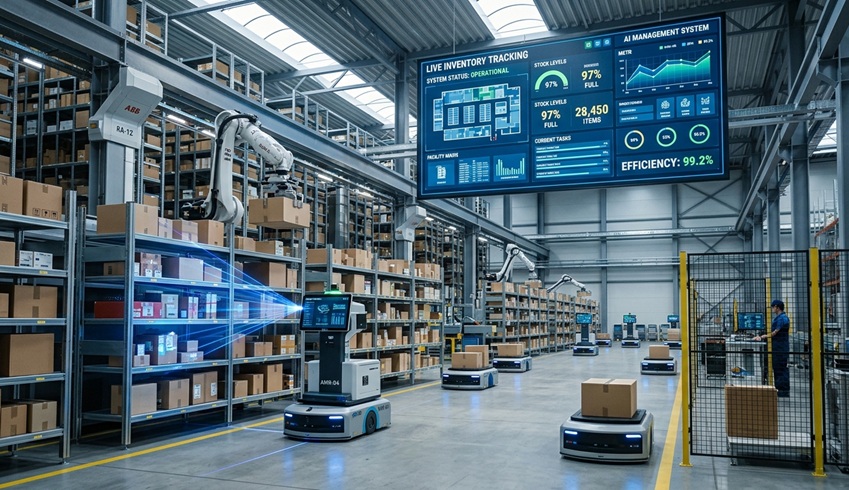
Robotics and Automation in Warehousing
Robotics and automation in warehousing are transforming how products are stored, picked, and packed. Robots work alongside human employees to improve speed and accuracy.
Robotics and automation can:
- Move and sort products quickly and safely
- Pick and pack orders with minimal errors
- Free human workers to focus on complex tasks
This trend boosts productivity, reduces errors, and enhances warehouse safety.
E‑Commerce and ERP Integration
With the growth of online shopping, e-commerce and ERP integration has become essential. Integrating e-commerce platforms with ERP systems ensures inventory data is updated instantly across all channels.
E-commerce and ERP integration can:
- Synchronise stock levels between online and offline channels
- Automatically update inventory after every sale
- Improve customer experience with accurate stock information
This makes inventory management seamless, accurate, and efficient.
5. Challenges Faced by Businesses Without Automation
Many businesses still rely on manual inventory management, and this creates several significant challenges. Without inventory automation, companies face inefficiencies, higher costs, and unhappy customers. Here are the main challenges explained clearly:
Human Errors in Manual Tracking
Manual inventory management depends on human effort, which can lead to mistakes. Employees may miscount stock, enter incorrect data, or misplace items.
Human errors in manual tracking can:
- Cause inaccurate inventory records
- Lead to wrong orders being shipped
- Increase the time needed to reconcile stock
Even small mistakes can multiply across the business, making operations slower and less reliable.
Frequent Stock-Outs or Overstocking
Without automation, it’s difficult to maintain the right amount of stock. Businesses often experience stock-outs when popular products run out or overstocking when items sit unsold.
This can:
- Frustrate customers when products are unavailable
- Increase storage costs for excess stock
- Hurt overall operational efficiency
Accurate demand forecasting and automated inventory management help prevent these issues.
Limited Visibility into Inventory Levels
Manual systems provide only partial insight into stock levels, making it hard for managers to make informed decisions.
Limited visibility can:
- Delay restocking decisions
- Increase the risk of lost or misplaced items
- Make it difficult to respond quickly to demand changes
Automation gives real-time visibility, so businesses always know exactly what they have in stock.
Inefficiencies in Scaling Operations
As a business grows, manual inventory processes become harder to manage. Tracking more products across multiple locations takes time and effort.
Inefficiencies in scaling operations can:
- Slow down expansion plans
- Increase labour costs for manual tracking
- Create bottlenecks in order fulfilment
Automated systems can handle larger volumes seamlessly, supporting faster and smoother growth.
Impact on Revenue and Customer Satisfaction
All these challenges—errors, stock issues, limited visibility, and inefficiencies—ultimately affect the bottom line.
The impact can include:
- Lost sales due to stock-outs
- Reduced customer trust and satisfaction
- Lower profitability and slower growth
Businesses that embrace inventory automation improve accuracy, meet customer expectations, and increase revenue consistently.
6. Logistics Automation: The Next Step in Smarter Inventory Management
While automated inventory systems help businesses track and manage stock more efficiently, logistics automation takes this transformation even further by improving how goods move through the entire supply chain. In 2026, companies are not only automating inventory tracking but also integrating logistics automation to streamline warehouse operations, transportation, and order fulfilment.
Logistics automation uses technologies such as AI, robotics, IoT sensors, and cloud-based logistics platforms to manage the flow of products from suppliers to warehouses and finally to customers. When combined with automated inventory systems, logistics automation creates a fully connected supply chain where information and goods move quickly and accurately.
This integration helps businesses reduce delays, eliminate manual processes, and ensure that products are delivered to customers faster and more reliably.
How Logistics Automation Works with Inventory Systems
Automated inventory systems track stock levels and product movement within warehouses, while logistics automation manages the transportation, handling, and distribution of those products.
Together, they create a seamless operational system that connects:
• Inventory management software
• Warehouse management systems
• Transportation and delivery networks
• ERP and e-commerce platforms
When a customer places an order, the system can automatically check stock availability, update inventory levels, and trigger the logistics process for picking, packing, and shipping. This reduces manual intervention and ensures orders are fulfilled quickly.
Key Benefits of Logistics Automation for Businesses
Faster Order Fulfilment
Logistics automation accelerates the entire order fulfilment process. Automated picking systems, conveyor belts, and robotic sorting technologies ensure products move through warehouses quickly and efficiently.
Benefits include:
• Reduced order processing time
• Faster shipping and delivery
• Improved operational efficiency
Improved Supply Chain Visibility
With logistics automation, businesses gain real-time visibility across the entire supply chain. Managers can monitor shipments, track product movement, and identify delays instantly.
This visibility helps companies:
• Improve planning and forecasting
• Respond quickly to disruptions
• Maintain better control over operations
Reduced Operational Costs
Manual logistics processes require significant labour and coordination. Automation reduces these costs by streamlining tasks such as product sorting, routing, and shipment tracking.
Companies benefit from:
• Lower labour costs
• Reduced transportation errors
• Optimised warehouse operations
Better Integration with E-commerce and ERP Systems
Modern logistics automation platforms integrate easily with ERP systems, CRM tools, and e-commerce platforms. This ensures that inventory data, order information, and shipping updates are synchronised across all systems.
As a result, businesses can provide customers with accurate delivery updates and maintain consistent stock records across multiple sales channels.
Why Logistics Automation Is Essential in 2026
In 2026, supply chains are more complex than ever. Businesses must manage multiple warehouses, international suppliers, and growing online orders. Without logistics automation, coordinating these operations becomes slow and inefficient.
By combining automated inventory systems with logistics automation, businesses can:
• Reduce delays in supply chain operations
• Improve warehouse productivity
• Deliver products faster to customers
• Scale operations without increasing operational complexity
For companies aiming to remain competitive in the modern digital economy, logistics automation is no longer optional—it is a critical part of building a smart, efficient, and future-ready supply chain.
7. How Cor Advance Solutions Helps Businesses
Managing inventory can be a major challenge for businesses, especially when relying on manual processes. Cor Advance Solutions provides modern automated inventory solutions that simplify stock management, reduce errors, and improve efficiency. Their systems are designed to support businesses of all sizes and across multiple industries, from retail to e-commerce and warehousing.
Expertise in Implementing Automated Inventory Systems
Cor Advance Solutions has extensive experience in implementing inventory management software. They understand that each business has unique challenges and design systems that are reliable and easy to use.
Their expertise helps businesses to:
- Analyse current inventory processes
- Identify inefficiencies and bottlenecks
- Implement automated systems that reduce human error and improve accuracy
With their support, companies can move from slow, error-prone manual tracking to efficient, fully automated inventory management.
Tailored Solutions for Retail, Warehouses, and E‑Commerce
Every business operates differently. Cor Advance Solutions provides tailored solutions to meet the specific needs of:
- Retail – Ensures shelves are stocked correctly and reduces lost sales
- Warehouses – Improves picking, packing, and storage accuracy
- E‑Commerce – Connects online orders with real-time stock levels to prevent overselling
By tailoring solutions, Cor Advance Solutions ensures businesses get exactly what they need for smooth and effective operations.
Key Features of Cor Advance Solutions
Cor Advance Solutions offers a wide range of features that make inventory management smarter and faster.
AI-Driven Analytics
AI-powered analytics analyse sales trends, predict demand, and help businesses make informed stock decisions. This reduces overstocking and prevents stock-outs.
Real-Time Inventory Monitoring
Real-time monitoring gives businesses complete visibility of inventory across all locations. Managers can track stock instantly and avoid delays or miscounts.
ERP & Logistics Integration
The system integrates with ERP and logistics platforms, ensuring smooth coordination between stock, orders, and delivery. This improves workflow efficiency and reduces operational errors.
Case Study: Measurable Improvements
A mid-sized retail company was struggling with frequent stock shortages and manual tracking errors. After implementing automated inventory system:
- Stock accuracy improved from 78% to 98%
- Stock-outs reduced by 70%
- Operational costs decreased within the first quarter
This shows how Cor Advance Solutions helps businesses improve efficiency, reduce errors, and increase profitability in a measurable way.
7. Benefits of Adopting Automated Inventory Systems
Adopting automated inventory systems can transform the way businesses manage their stock and streamline supply chain operations. Let’s explore the key benefits in detail.
1. Reduced Operational Costs
One of the most significant inventory automation benefits is the reduction of operational costs. Automated systems minimise human errors, reduce manual labour, and optimise inventory handling. By accurately tracking stock levels, businesses can avoid overstocking or stockouts, which saves money and prevents wastage. For example, smart sensors and software can automatically reorder products when inventory runs low, eliminating unnecessary emergency shipments and lowering overall expenses.
2. Increased Accuracy and Productivity
Manual inventory management often leads to mistakes in counting, tracking, and reporting. Automated systems ensure precise data capture, reducing errors and improving overall productivity. Warehouse staff can focus on higher-value tasks, such as packing, quality checks, and shipping, instead of repetitive manual counts. This increased efficiency allows businesses to fulfil orders faster and maintain consistent service quality, giving a boost to operational performance.
3. Data-Driven Decision Making
With automated inventory systems, businesses gain access to real-time data and actionable insights. Managers can analyse trends, monitor stock movements, and predict demand more accurately. This data-driven decision making supports smarter purchasing, pricing, and stocking strategies. For instance, historical sales data can help identify seasonal demand spikes, enabling proactive inventory adjustments and better resource allocation.
4. Scalability for Business Growth
As businesses grow, managing larger inventories manually becomes challenging and prone to errors. Automated systems are scalable, allowing companies to expand without compromising accuracy or efficiency. Whether opening new warehouses or handling increased online orders, automation ensures seamless operations and supports business growth effortlessly.
5. Competitive Advantage in Supply Chain Management
Implementing warehouse automation and other advanced inventory technologies gives businesses a clear edge in the competitive market. Automated systems enable faster order processing, reduced lead times, and improved customer satisfaction. By optimising the supply chain through automation, companies can stay ahead of competitors and build a reputation for reliability and efficiency.
8. Implementation Tips for Businesses in 2026
Transitioning to an automated inventory system in 2026 can bring significant efficiency, cost savings, and competitive advantage. However, a smooth implementation requires careful planning and execution. Below, we outline practical tips for businesses looking to adopt inventory management software and smart inventory technology effectively.
1. Steps to Transition from Manual to Automated Systems
Moving from manual inventory processes to automation can seem challenging, but breaking it down into clear steps makes it manageable:
- Assess Current Inventory Processes – Start by mapping your existing manual workflows. Identify bottlenecks, errors, or delays that slow operations.
- Set Clear Goals – Decide what you want to achieve with automation, such as faster stock replenishment, reduced errors, or real-time reporting.
- Choose the Right Inventory Management Software – Evaluate software options that fit your business size and sector. Look for features like real-time tracking, reporting dashboards, and mobile access.
- Pilot the System – Before full implementation, test the automated system in one department or warehouse. This helps spot issues early and minimise disruptions.
- Gradual Rollout – Implement automation in phases. Start with simple tasks like order tracking or stock alerts, then scale to full warehouse automation.
2. Choosing the Right Software Provider
Selecting a reliable software provider is crucial for a successful automated inventory implementation. Consider these factors:
- Experience and Reputation – Choose providers with proven expertise in smart inventory technology and a strong track record with similar businesses.
- Customisable Features – Ensure the software can adapt to your unique inventory processes and integrate with your existing systems.
- Support and Training – A provider offering ongoing support, updates, and training resources will help your team adjust smoothly.
- Cloud-Based Options – Cloud-enabled software allows remote access, automatic updates, and easier integration with e-commerce and ERP systems.
3. Staff Training and Change Management
Even the best inventory management software will fail without proper staff adoption. Best practices include:
- Comprehensive Training – Provide hands-on training sessions for all team members. Use tutorials, webinars, and step-by-step guides.
- Clear Communication – Explain why automation is being introduced, highlighting benefits like reduced errors, less manual work, and faster operations.
- Feedback Loops – Encourage staff to share challenges and suggestions during the transition. Adjust processes where necessary to ensure smooth adoption.
4. Best Practices for Integration with ERP, CRM, and E-commerce Platforms
Integration ensures that your automated system communicates effectively with other business tools. Consider these steps:
- ERP Integration – Sync inventory software with your ERP system to manage procurement, stock levels, and financial reporting seamlessly.
- CRM Integration – Link inventory data to your CRM to better track customer orders, fulfilment status, and stock availability.
- E-commerce Integration – Real-time inventory updates on your online store prevent overselling and improve customer experience.
- Automated Alerts and Reporting – Set up notifications for low stock, delayed shipments, or discrepancies to act promptly.
By following these tips, businesses in 2026 can implement automated inventory systems efficiently, reduce errors, and maximise productivity. Using the right smart inventory management software, companies can achieve a smooth digital transition and gain a significant competitive edge.
9. Future Outlook: Inventory Automation and Smart Technology (2026–2030)
Modern business is rapidly moving from manual stock tracking to fully automated inventory systems powered by smart inventory technology and AI forecasting. Across the world — and increasingly in the UK — leaders are investing in these solutions to stay competitive, reduce errors, and improve efficiency.
🔍 Market Growth & Demand for Inventory Technology
Research shows that the global inventory management software market is expanding strongly. In 2026, the inventory management sector is valued at about USD 2.7 billion and is expected to grow continuously through the next decade as businesses adopt smarter systems that use cloud‑based automation and predictive analytics.
In the UK specifically, the inventory software market is growing due to rising demand for real‑time stock tracking and omnichannel retail tools — especially among retail and e‑commerce businesses that must manage stock across stores, warehouses, and online platforms.
Predictions for Inventory Automation (2026–2030)
Between 2026 and 2030, we expect an even bigger shift towards automated inventory implementation that makes stock control faster, smarter, and less reliant on human input:
- Predictive demand planning — AI models will forecast what products customers will want weeks or months ahead using real‑time and historical data.
- Dynamic replenishment systems — Stock will be topped up automatically based on advanced patterns, not just static reorder levels.
- Smart, connected networks — Inventory will link directly with sales channels, ERP systems, e‑commerce platforms, and supply partners, giving real‑time stock visibility and reducing errors. This means fewer stockouts and less working capital tied up in excess stock.
By 2030, inventory systems will not just react to demand — they will predict, optimise, and adjust on their own, transforming how businesses operate.
Role of AI, Machine Learning & Predictive Analytics
The biggest driver of this change is artificial intelligence (AI) and machine learning (ML) — the brains behind smart inventory technology. These tools look at sales history, supplier data, seasonal trends, and even external factors like weather or market shifts to make highly accurate predictions about future stock needs.
Predictive analytics does more than guess demand—it helps businesses avoid costly mistakes like overstocking or running out of high‑demand products. Modern AI systems also:
- Continuously learn and improve forecasting accuracy as new data arrives.
- Combine data across channels (online, offline, ERP) to improve visibility and planning.
- Offer scenario planning tools so businesses can simulate demand spikes or supply issues before they happen.
AI isn’t just a future aspiration — it’s increasingly part of inventory management software that companies use today to improve accuracy and reduce waste.
Benefits for Early Adopters: Growth, Efficiency & Scalability
Implementing smart inventory technology early gives businesses real competitive advantages:
1. Faster Growth and Better Decision‑Making
With automated predictions and real‑time stock data, leaders can plan growth with more confidence. Manual counting and paper records become a thing of the past, freeing up teams to focus on strategy and customer service rather than repetitive tasks.
2. Higher Efficiency & Lower Costs
AI‑enabled systems reduce errors, improve demand forecasts, and help businesses avoid both surplus stock and shortages. As a result, companies can reduce inventory carrying costs and improve cash flow.
3. Scalability and Digital Resilience
Automated inventory systems make it easier to grow operations, expand into new markets, support omnichannel stores and integrate with broader business platforms like ERP, CRM, and logistics tools.
4. Real‑World Gains in the UK
Recent UK research found that many organisations are rapidly integrating AI in business operations — with around 78 % already using AI tools — though some struggle to see measurable results without clear strategy. This highlights that success isn’t just about adopting technology, but using it with clear goals — especially for inventory automation projects.
Addressing Common Pain Points
Here’s how future‑ready inventory technology directly tackles the biggest business challenges:
✔ Stock accuracy issues are solved with real‑time tracking and automated alerts.
✔ Forecasting errors are greatly reduced using AI forecasting and predictive analytics.
✔ Poor integration between tools is fixed by unified platforms that connect warehouse, online sales, ERP and supply data.
✔ Manual work bottlenecks disappear as automated systems perform tasks previously done by hand.
Together, these improvements lead to smoother operations, less waste, better customer service, and stronger growth.
Summary: What This Means for Your Business
The next few years — from 2026 to 2030 — will be critical for inventory automation. Businesses that leverage inventory management software and smart inventory technology with AI, predictive analytics, and real‑time visibility will:
- Predict demand with high accuracy
- Reduce inventory costs and stockouts
- Scale faster and integrate smoothly with other systems
- Improve decision‑making with easy‑to‑use, data‑driven tools
In short, automated inventory implementation is no longer a future wish — it’s today’s strategic advantage.
Conclusion
Automated inventory systems are now essential for every business. They help companies save time, reduce costs, and keep customers happy. By tracking stock automatically and giving real-time updates, businesses can avoid mistakes and make better decisions.
Cor Advance Solutions provides modern inventory management software. Their solutions make it easy for businesses to use automated inventory systems, connect with ERP, CRM, and online stores, and run operations smoothly.
Looking ahead, AI-powered inventory management is the future. Companies that use these smart systems today will grow faster, work more efficiently, and stay ahead of competitors. Simply put, smart, automated inventory management is the key to success in 2026 and beyond.
FAQ
What is an automated inventory system?
An automated inventory system is software that tracks stock levels, orders, and deliveries automatically. It replaces manual counting and spreadsheets, giving businesses real-time updates. Using smart inventory technology, these systems reduce errors and save time while ensuring accurate stock management across warehouses, stores, and online channels.
Why are businesses adopting automated inventory systems in 2026?
Businesses are adopting automated inventory systems to improve efficiency, reduce costs, and meet customer demand faster. In 2026, companies need real-time stock visibility, faster decision-making, and smoother integration with ERP, CRM, and e-commerce platforms. Smart inventory technology helps them stay competitive and scale operations easily.
How does real-time inventory tracking work?
Real-time inventory tracking uses sensors, barcodes, RFID, and cloud-based software to monitor stock continuously. Every addition or removal of items updates the system instantly. This allows businesses to see exact stock levels at any time, prevent stockouts, and plan purchases efficiently using AI-powered inventory management software.
Can automation reduce inventory errors?
Yes. Automation significantly reduces mistakes caused by human errors, such as overstocking or missing items. Automated inventory systems track every product in real time, generate accurate reports, and alert staff to discrepancies, ensuring smoother operations and better supply chain accuracy.
How do AI inventory systems improve supply chain visibility?
AI inventory systems analyse sales, stock, and supplier data to provide a full view of the supply chain. Businesses can monitor inventory at multiple locations, predict shortages, and respond quickly to changes. This smart inventory technology increases transparency, reduces delays, and improves decision-making across all channels.
Are automated inventory systems suitable for small businesses?
Absolutely. Modern inventory management software is scalable and affordable, making it ideal for small and medium businesses. Even smaller teams can track stock automatically, reduce errors, save time, and integrate with e-commerce platforms, giving them the same advantages as larger companies.
How can Cor Advance Solutions help implement inventory automation?
Cor Advance Solutions offers cutting-edge smart inventory technology and software to help businesses implement automation easily. Their systems integrate with ERP, CRM, and online stores, providing real-time stock tracking, AI forecasts, and tools to improve efficiency, reduce costs, and scale operations confidently.
What are the main benefits of switching to automated inventory systems?
Switching to automated inventory systems improves accuracy, efficiency, and customer satisfaction. Businesses can save time, reduce costs, prevent stockouts, and make data-driven decisions. Using AI and predictive analytics, companies gain better stock visibility and can plan growth more effectively.
How does automation save operational costs in inventory management?
Automation saves costs by reducing manual labour, preventing overstocking, and minimising errors. Smart inventory technology streamlines ordering, storage, and reporting, lowering unnecessary expenses. Accurate forecasts also help businesses optimise stock levels, freeing up cash flow and improving overall operational efficiency.
What are future trends in automated inventory systems?
Future trends include AI-driven forecasting, predictive analytics, robotics, IoT-enabled warehouses, and cloud-based inventory management. By 2030, automated inventory systems will become smarter, faster, and more integrated, giving early adopters a competitive edge with improved efficiency, scalability, and real-time supply chain insights.