
The eCommerce industry is growing at a very fast speed, and with this rapid growth comes one big challenge: warehouse complexity. As online orders increase every day, managing inventory and fulfilling orders on time is becoming more difficult for businesses.
Most eCommerce companies face common problems in their warehouse operations, such as:
- Inventory inaccuracies that lead to overstocking or stockouts
- Slow order fulfillment, which delays deliveries and affects customer satisfaction
- High operational costs due to manual processes and poor resource management
These issues not only reduce efficiency but also directly impact profit and customer trust.
This is where AI-powered warehouse management solutions for eCommerce businesses become a game changer. Artificial Intelligence helps automate and optimize warehouse operations by improving inventory tracking, speeding up order processing, and reducing human errors. With real-time data analysis and smart decision-making, AI makes warehouse management faster, smarter, and more cost-effective.

Companies like Cor Advance Solutions are leading this transformation by offering advanced AI-driven warehouse management systems designed specifically for modern eCommerce businesses. Their solutions help businesses streamline operations, reduce costs, and improve overall supply chain efficiency.
In today’s competitive market, adopting AI in warehouse management is no longer optional—it is essential for staying ahead.
What Are AI-Powered Warehouse Management Solutions?
AI-powered warehouse management solutions are advanced software systems that use Artificial Intelligence (AI), machine learning, and real-time data to manage and improve warehouse operations for eCommerce businesses.
In simple terms, it is a smart system that helps warehouses work faster, more accurately, and with less manual effort.
A traditional warehouse management system only records data and depends on human instructions. But an AI-powered warehouse management system for eCommerce businesses does much more. It analyzes data, learns from patterns, and makes smart decisions automatically to improve daily operations.
How AI-Powered Warehouse Management Works
These systems collect data from every activity inside the warehouse, such as stock levels, customer orders, delivery trends, and product movement. Then AI processes this data and provides real-time insights and automation.
This helps businesses:
- Track inventory in real time and avoid stock mismatches
- Predict future demand using past sales data
- Speed up order picking, packing, and shipping
- Reduce human errors in warehouse operations
- Improve space utilization and storage planning
Key Components of AI Warehouse Management Solutions
- AI-based inventory management for accurate stock control
- Predictive analytics to forecast demand and prevent shortages
- Automated order fulfillment for faster processing
- Smart routing and picking systems to save time
- Data-driven decision-making tools for better efficiency
Why It Is Important for eCommerce Businesses
In the fast-growing eCommerce industry, speed and accuracy are critical. Customers expect quick deliveries and error-free orders. AI-powered warehouse management solutions help businesses meet these expectations by making operations smarter and more efficient.
They also help reduce operational costs, improve productivity, and support business growth at scale.
This is why many companies are now adopting AI-powered warehouse management solutions for eCommerce businesses as a long-term strategy to stay competitive in the digital market.
Why eCommerce Businesses Need AI in Warehouse Management
In today’s fast-growing online shopping world, eCommerce businesses cannot depend on traditional warehouse systems anymore. Speed, accuracy, and real-time decision-making have become essential. This is where AI in warehouse management for eCommerce businesses plays a powerful role.
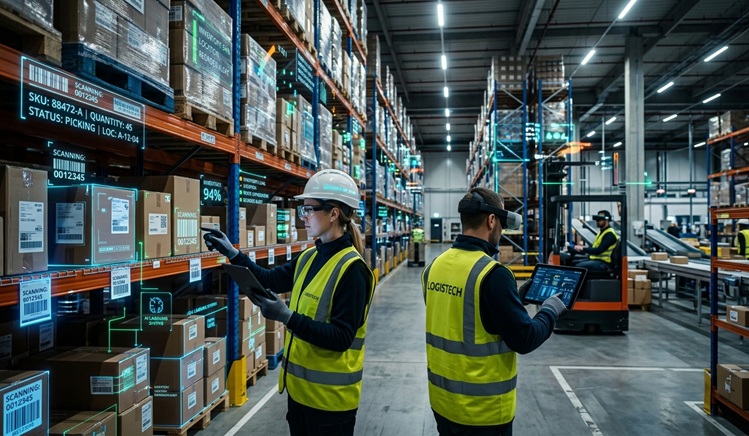
AI (Artificial Intelligence) helps warehouses work smarter, not harder. It reduces human errors, improves order processing speed, and ensures that customers get their products on time. In simple terms, AI turns a normal warehouse into a highly efficient, data-driven fulfillment center.
1. Faster Order Processing and Fulfillment
One of the biggest challenges in eCommerce logistics is handling a large number of orders quickly. AI-powered warehouse management systems automatically sort, pick, and pack items using intelligent algorithms and robotics. This reduces processing time and helps businesses deliver faster, which improves customer satisfaction and repeat sales.
2. Real-Time Inventory Tracking
AI provides real-time inventory visibility across the warehouse. It tracks stock levels, predicts shortages, and automatically updates inventory data. This helps eCommerce businesses avoid problems like overstocking or stockouts. With AI-powered inventory management, companies always know what is available and what needs to be restocked.
3. Improved Accuracy and Fewer Errors
Manual warehouse operations often lead to mistakes such as wrong item picking or shipping delays. AI reduces these errors by using smart scanning systems, machine learning, and automation tools. This ensures accurate order fulfillment, which builds trust and reduces return rates.
4. Demand Forecasting for Better Planning
AI analyzes customer behavior, seasonal trends, and sales history to predict future demand. This helps eCommerce businesses prepare in advance and manage inventory more efficiently. With accurate forecasting, companies can reduce waste, save costs, and improve supply chain planning.
5. Cost Reduction and Higher Efficiency
By automating repetitive warehouse tasks, AI reduces the need for manual labor and operational costs. It also optimizes space utilization and workflow inside the warehouse. This leads to higher productivity with lower expenses, making the entire operation more profitable.
6. Better Customer Experience
Fast delivery, accurate orders, and real-time tracking directly improve customer experience. AI ensures that orders are processed without delay and shipped correctly. In the competitive eCommerce market, this becomes a key advantage for business growth.
Key Features of AI Warehouse Management Systems
AI-powered warehouse management systems are changing how eCommerce businesses run their operations. These systems use AI in warehouse management for eCommerce businesses to improve speed, accuracy, and decision-making. Below are the most important features that make AI warehouse systems highly effective and future-ready.
Smart Inventory Forecasting
One of the strongest features of an AI warehouse system is smart inventory forecasting. It uses artificial intelligence to study past sales data, customer behavior, and market trends.
- Predict demand trends: AI can forecast which products will be in high demand during specific seasons or events.
- Prevent stockouts & overstocking: Businesses can maintain the right stock levels, avoiding both shortages and excess inventory.
This helps eCommerce companies reduce waste, improve planning, and always stay ready for customer demand.
Automated Order Processing
AI makes order handling faster and more accurate by automating key warehouse tasks.
- Intelligent picking & packing: AI guides workers or robots to pick the right items quickly and efficiently.
- Real-time order prioritization: Urgent orders are automatically identified and processed first for faster delivery.
This reduces delays and ensures smooth eCommerce warehouse automation, improving overall customer satisfaction.
Warehouse Layout Optimization
AI also improves how a warehouse is organized, making operations more efficient.
- AI-driven slotting: Products are placed in the best possible locations based on demand and frequency of orders.
- Faster picking routes: AI calculates the shortest and fastest paths for picking items.
This reduces walking time, increases productivity, and speeds up the entire fulfillment process.
Real-Time Inventory Tracking
Modern warehouses need complete visibility of stock at all times, and AI makes this possible.
- IoT + AI integration: Sensors and smart devices track inventory movement in real time.
- Accurate stock visibility: Businesses always know what is in stock, what is running low, and what needs restocking.
This feature is essential for AI-powered inventory management and helps avoid costly errors.
AI-Powered Analytics Dashboard
AI systems also provide powerful dashboards that turn data into useful insights.
- Actionable insights: Businesses can see clear recommendations to improve warehouse performance.
- Performance metrics: Track order speed, accuracy, stock movement, and efficiency in real time.
These insights help managers make smarter decisions and continuously improve warehouse operations.
AI warehouse management systems improve eCommerce operations through smart forecasting, automation, optimized layouts, real-time tracking, and advanced analytics. These features help businesses increase speed, reduce costs, and improve accuracy, making AI in warehouse management for eCommerce businesses a key driver of modern supply chain success.
Benefits of AI-Powered Warehouse Solutions for eCommerce
AI-powered warehouse systems are transforming how online businesses operate every day. By using AI in warehouse management for eCommerce businesses, companies can improve speed, accuracy, and overall performance while reducing unnecessary costs and delays. Below are the key benefits that make AI-driven warehouse solutions essential for modern eCommerce growth.
Increased Operational Efficiency
AI helps warehouses run smoother by automating repetitive and time-consuming tasks. It connects inventory, order processing, and logistics into one smart system.
With better coordination and automation, businesses can:
- Move products faster inside the warehouse
- Reduce manual workload
- Improve overall workflow speed
This leads to a more efficient AI-powered warehouse management system that handles higher order volumes without confusion.
Reduced Human Errors
Manual warehouse operations often lead to mistakes like wrong item picking, incorrect shipping, or misplaced stock. AI significantly reduces these issues.
- Smart scanning and automation ensure accurate order picking
- Machine learning systems double-check inventory updates
As a result, businesses can improve inventory accuracy to 99%+, reducing costly returns and customer complaints.
Lower Operational Costs
AI reduces dependency on manual labor and optimizes warehouse resources. It helps businesses save money in multiple areas:
- Less labor required for repetitive tasks
- Better use of warehouse space
- Reduced wastage and inventory loss
Over time, this leads to a major drop in operational expenses while improving productivity in eCommerce warehouse automation.
Faster Order Fulfillment
Speed is critical in eCommerce. AI ensures that orders are processed, packed, and shipped quickly.
- Intelligent systems prioritize urgent orders
- Optimized picking routes save time inside the warehouse
With AI automation, businesses can reduce picking time by up to 50%, leading to faster deliveries and happier customers.
Scalability for Business Growth
As eCommerce businesses grow, managing higher order volumes becomes challenging. AI makes scaling easy and stress-free.
- Systems automatically adjust to increased demand
- No need for large increases in manual staff
- Smooth handling of peak sales seasons
This ensures long-term scalability without affecting performance or delivery speed.
AI-powered warehouse solutions improve eCommerce performance by increasing efficiency, reducing errors, lowering costs, speeding up fulfillment, and supporting business growth. With advanced automation and smart analytics, companies can achieve 99%+ inventory accuracy and up to 50% faster order picking, making AI in warehouse management for eCommerce businesses a key advantage in today’s competitive market.
How AI Improves Warehouse Operations (Step-by-Step Workflow)
AI has completely changed how modern warehouses work. Instead of manual planning and slow processes, AI in warehouse management for eCommerce businesses creates a fast, accurate, and fully connected system. Every step is data-driven, which reduces mistakes and improves speed from start to finish.
Below is a simple step-by-step workflow showing how AI improves warehouse operations in real time.
1. Demand Forecasting
The first step starts before products even reach the warehouse. AI studies large amounts of data to predict what customers will buy in the future.
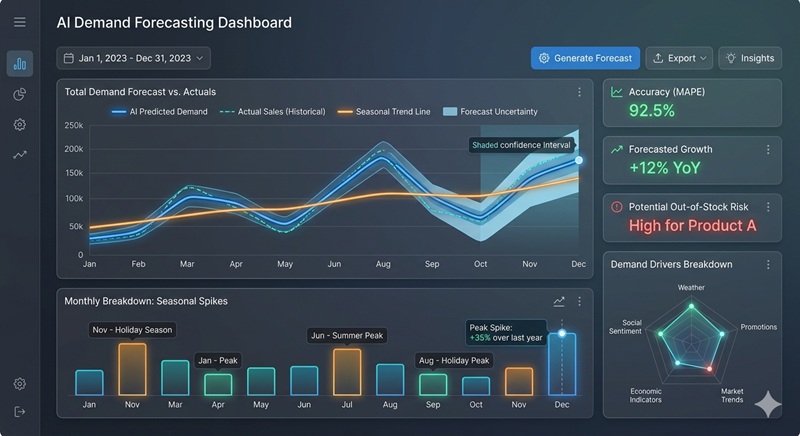
AI analyzes:
- Past sales history
- Seasonal trends (festivals, holidays, sales events)
- Customer buying behavior
- Market demand patterns
With this, businesses can predict demand more accurately and prepare in advance. This helps avoid overstocking or running out of products. In many cases, AI-powered warehouse management systems improve forecasting accuracy by up to 80–90% compared to manual planning.
2. Inventory Planning
Once demand is predicted, AI helps businesses plan inventory in a smart way.
AI ensures:
- Right quantity of products are ordered
- Popular items are always in stock
- Slow-moving products are controlled to avoid waste
This step reduces storage costs and improves cash flow. It is a key part of AI-powered inventory management, where every product is planned based on real demand, not guesswork.
3. Smart Storage Allocation
After inventory arrives, AI decides the best place to store each product inside the warehouse.
AI uses smart logic to:
- Place high-demand products near packing stations
- Store related items close to each other
- Optimize space usage across the warehouse
This reduces movement inside the warehouse and improves picking speed. It also helps create a highly organized system that supports fast eCommerce warehouse automation.
4. Automated Picking & Packing
When an order is placed, AI immediately activates the fulfillment process.
AI improves this step by:
- Assigning the fastest picking route
- Grouping multiple orders for efficiency
- Guiding workers or robots with real-time instructions
- Verifying items before packing
This reduces human effort and speeds up order processing. Businesses can reduce picking time by up to 50% and achieve 99%+ order accuracy, which is a major advantage in eCommerce operations.
5. Shipping Optimization
The final step is shipping, where AI ensures fast and cost-effective delivery.
AI helps by:
- Selecting the best courier based on speed and cost
- Optimizing delivery routes for faster shipping
- Providing real-time tracking updates to customers
- Reducing shipping delays and logistics costs
This ensures that customers receive their orders on time, improving satisfaction and trust.
AI improves warehouse operations step-by-step through demand forecasting, smart inventory planning, optimized storage, automated picking and packing, and intelligent shipping. With AI in warehouse management for eCommerce businesses, companies can achieve faster operations, up to 50% reduced picking time, and 99%+ accuracy, making warehouse management more efficient, scalable, and customer-focused.
Use Cases of AI Warehouse Management in eCommerce
AI is now used across all types of eCommerce businesses, from small startups to large global brands. With AI in warehouse management for eCommerce businesses, companies of every size can improve speed, reduce errors, and scale operations without complexity. Below are the most common real-world use cases.
Small eCommerce Startups
For small online stores, every order matters. Limited staff and tight budgets make warehouse management a big challenge. AI helps startups build a strong foundation from day one.
AI supports startups by:
- Automating basic inventory tracking to avoid manual errors
- Helping manage stock levels with simple demand predictions
- Reducing dependency on large warehouse teams
- Improving order accuracy even with small staff
This allows startups to operate like larger companies without heavy investment. Even early-stage businesses can achieve high efficiency using AI-powered warehouse management systems, helping them grow faster and reduce operational mistakes.
Mid-Sized Online Retailers
Mid-sized eCommerce businesses face a different challenge—growing order volume and increasing customer expectations. AI helps them scale smoothly without breaking operations.
AI improves mid-sized retailers by:
- Handling higher order volumes without delays
- Optimizing warehouse space for better storage efficiency
- Automating picking, packing, and inventory updates
- Providing real-time analytics for better decision-making
At this stage, eCommerce warehouse automation becomes very important. AI helps reduce workload pressure while improving delivery speed and customer satisfaction. Businesses can expand to new markets without increasing operational chaos.
Enterprise-Level eCommerce
Large eCommerce companies deal with massive order volumes, multiple warehouses, and global logistics. For them, AI is not optional—it is essential for survival and efficiency.
AI helps enterprise-level businesses by:
- Managing multiple warehouses in real time
- Coordinating global inventory across locations
- Using advanced predictive analytics for demand forecasting
- Optimizing supply chain and logistics at scale
- Ensuring consistent 99%+ accuracy across millions of orders
With AI, enterprises can handle peak sales events like Black Friday or seasonal rushes without delays or system breakdowns. AI-powered inventory management ensures full control over complex operations while reducing overall logistics costs.
AI warehouse management is useful for all eCommerce business sizes. Startups use it for automation and accuracy, mid-sized retailers use it for scaling operations, and enterprises use it for global warehouse coordination. With AI in warehouse management for eCommerce businesses, companies achieve better efficiency, faster fulfillment, and smarter growth at every stage.
AI Warehouse Management vs Traditional Systems
Understanding the difference between traditional warehouse systems and modern AI in warehouse management for eCommerce businesses is very important. It clearly shows why AI is becoming the new standard for fast-growing online businesses. Traditional systems depend heavily on manual work, while AI-powered systems use data, automation, and real-time intelligence to improve performance.
Below is a simple comparison that explains the key differences:
Feature Comparison Table
| Feature | Traditional WMS | AI-Powered WMS |
| Forecasting | Manual and guess-based | Predictive AI using real-time data |
| Accuracy | Moderate, error-prone | High accuracy (up to 99%+) |
| Scalability | Limited and slow | Highly scalable and flexible |
| Automation | Low automation | Advanced end-to-end automation |
Forecasting: Manual vs Predictive AI
Traditional warehouse systems rely on manual planning and human experience to predict demand. This often leads to mistakes like overstocking or stock shortages.
In contrast, AI-powered warehouse management systems use machine learning and data analysis to predict demand accurately. AI studies customer behavior, seasonal trends, and sales history to make smart forecasts that improve inventory planning.
Accuracy: Moderate vs High Precision
Traditional systems often depend on manual data entry, which increases the chance of human error. Mistakes in picking, packing, or inventory updates are common.
AI systems significantly improve accuracy by using barcode scanning, real-time tracking, and automated verification. This leads to inventory accuracy of 99% or higher, reducing returns and improving customer trust in eCommerce warehouse automation.
Scalability: Limited vs High Growth Capacity
Traditional warehouse systems struggle when order volume increases. They require more staff and manual effort, which slows down operations.
AI systems are built for scalability. They can handle thousands or even millions of orders without losing efficiency. Whether it’s peak sales season or rapid business growth, AI adjusts automatically without major disruptions.
Automation: Low vs Advanced
Traditional systems offer very limited automation. Most tasks like inventory updates, order processing, and reporting are done manually.
AI brings advanced automation to every stage of the warehouse process:
- Automated inventory tracking
- Smart order prioritization
- AI-guided picking and packing
- Optimized shipping decisions
This makes operations faster, smoother, and more cost-effective.
Traditional warehouse systems depend on manual work, limited forecasting, and low automation, while AI-powered systems offer predictive analytics, high accuracy, full scalability, and advanced automation. With AI in warehouse management for eCommerce businesses, companies achieve smarter operations, fewer errors, and faster growth compared to traditional methods.
How to Choose the Best AI Warehouse Management Solution
Choosing the right system is very important if you want to get real results from AI in warehouse management for eCommerce businesses. A good AI warehouse solution can improve speed, reduce errors, and scale your operations. But the wrong choice can slow down your business and increase costs.
Here is a simple, step-by-step guide to help you choose the best AI warehouse management solution for your eCommerce business.
1. Check AI Capabilities and Automation Level
The first thing to look at is how powerful the AI system is.
A strong AI-powered warehouse management system should offer:
- Smart demand forecasting
- Automated inventory updates
- Intelligent order processing
- Real-time decision-making
The more tasks it automates, the less manual work your team has to do. This directly improves efficiency in eCommerce warehouse automation.
2. Look for Real-Time Inventory Tracking
Accurate inventory control is the backbone of any warehouse system.
Make sure the solution provides:
- Live stock updates
- Instant alerts for low inventory
- Integration with IoT devices or scanners
Real-time tracking helps prevent stockouts and overstocking, which improves customer satisfaction and reduces losses.
3. Evaluate Scalability for Future Growth
Your business will grow, and your warehouse system must grow with it.
Choose a solution that can:
- Handle increasing order volumes
- Manage multiple warehouses
- Support peak sales seasons without slowdowns
A scalable AI system ensures long-term stability and supports business expansion without system failure.
4. Check Integration with eCommerce Platforms
Your AI warehouse system should easily connect with your existing tools.
Look for integration with:
- Shopify, WooCommerce, Amazon, or other eCommerce platforms
- Shipping and logistics providers
- ERP and CRM systems
Smooth integration ensures better data flow and reduces manual work across systems.
5. Focus on Analytics and Reporting Features
A good AI system should not only run operations but also provide insights.
It should include:
- Performance dashboards
- Order and inventory reports
- Predictive analytics for demand planning
These insights help you make smarter business decisions and improve overall warehouse performance.
6. Ensure Ease of Use and Support
Even the most advanced system is useless if your team cannot use it properly.
Check for:
- Simple and user-friendly dashboard
- Training and onboarding support
- 24/7 technical assistance
A system that is easy to use will save time and reduce operational confusion.
7. Compare Cost vs Value
Do not choose based only on price. Instead, focus on long-term value.
Ask yourself:
- Will this reduce operational costs?
- Will it improve delivery speed and accuracy?
- Will it help scale my business?
A good AI solution may cost more upfront but delivers higher ROI through automation and efficiency.
To choose the best AI warehouse management solution, businesses should focus on AI capabilities, real-time inventory tracking, scalability, platform integration, analytics, ease of use, and long-term value. A strong AI in warehouse management for eCommerce businesses solution improves efficiency, reduces costs, and supports scalable growth through smart automation and data-driven decisions.
Why Choose Cor Advance Solutions for AI Warehouse Management
When it comes to building a smart and efficient warehouse system, choosing the right partner is just as important as choosing the right technology. Cor Advance Solutions stands out as a trusted name in delivering AI in warehouse management for eCommerce businesses, helping companies improve speed, accuracy, and overall operational performance.
Here’s why businesses choose Cor Advance Solutions for AI-powered warehouse transformation:
Custom AI Solutions Tailored for eCommerce
Every eCommerce business is different, and Cor Advance Solutions understands that well. Instead of offering a one-size-fits-all system, they build custom AI-powered warehouse management systems based on your specific needs.
- Designed according to your business size and product type
- Optimized for your order volume and workflow
- Focused on solving real warehouse challenges
This ensures maximum efficiency and better results in eCommerce warehouse automation.
Seamless Integration with Platforms
A warehouse system should work smoothly with your existing tools. Cor Advance Solutions ensures easy and fast integration with major platforms.
- Shopify, WooCommerce, Magento, and other eCommerce platforms
- ERP, CRM, and inventory systems
- Shipping and logistics providers
This creates a fully connected system where data flows automatically, reducing manual work and improving accuracy.
Proven Track Record
Experience matters in technology solutions. Cor Advance Solutions has a strong history of delivering successful warehouse automation projects.
- Successfully implemented AI systems for multiple eCommerce businesses
- Improved operational efficiency and reduced errors
- Helped clients scale their warehouse operations smoothly
Their proven results make them a reliable choice for long-term growth.
Scalable Architecture for Future Growth
As your business grows, your warehouse system must grow with it. Cor Advance Solutions builds scalable AI systems that adapt easily to increasing demand.
- Handles high order volumes without performance issues
- Supports multiple warehouses and locations
- Easily expandable as your business grows
This ensures your investment stays valuable even as your operations expand.
Dedicated Support and Maintenance
Technology is only effective when it is supported properly. Cor Advance Solutions provides continuous support to ensure smooth operations.
- 24/7 technical assistance
- Regular system updates and improvements
- Fast issue resolution and maintenance support
This helps businesses avoid downtime and maintain consistent performance.
Cor Advance Solutions is a trusted provider of AI warehouse management for eCommerce businesses, offering custom AI solutions, seamless platform integration, proven results, scalable systems, and dedicated support. With strong case studies, client success stories, and real testimonials, they help eCommerce companies achieve faster operations, higher accuracy, and long-term scalable growth.
FAQs
What are AI-powered warehouse management solutions for eCommerce businesses?
AI-powered warehouse management solutions are smart systems that use Artificial Intelligence, machine learning, and real-time data to manage warehouse operations automatically. Instead of relying on manual work, these systems handle inventory tracking, order processing, and shipping decisions using data-driven automation. In simple words, they make warehouses faster, smarter, and more accurate for eCommerce warehouse automation.
How does AI improve warehouse management in eCommerce?
AI improves warehouse management by automating daily operations and making real-time decisions. It helps businesses track inventory, process orders faster, reduce errors, and optimize storage space. With AI in warehouse management for eCommerce businesses, everything from stock updates to delivery planning becomes more efficient and reliable.
Is AI warehouse management suitable for small eCommerce businesses?
Yes, AI warehouse management is suitable for small businesses. Even startups can use it to automate inventory tracking, reduce manual errors, and improve order accuracy. It helps small eCommerce businesses operate like larger companies without needing a big team or heavy investment.
How does AI improve inventory accuracy?
AI improves inventory accuracy by using barcode scanning, IoT sensors, and real-time tracking systems. Every item movement is automatically recorded and updated in the system. This reduces manual errors and ensures 99%+ inventory accuracy in modern warehouse operations.
Can AI prevent stockouts and overstocking?
Yes, AI helps prevent both stockouts and overstocking. It analyzes past sales data, customer behavior, and seasonal trends to predict how much stock is needed. This ensures businesses always maintain the right inventory levels through AI-powered inventory management.
How does AI predict product demand?
AI predicts product demand by studying historical sales data, market trends, and customer buying patterns. It uses machine learning models to identify future demand patterns. This helps businesses prepare inventory in advance and avoid shortages or excess stock.
How does AI speed up order fulfillment?
AI speeds up order fulfillment by automating picking, packing, and shipping processes. It also assigns the fastest routes for workers or robots inside the warehouse. This reduces delays and can reduce picking time by up to 50%, improving delivery speed.
Can AI reduce delivery delays?
Yes, AI reduces delivery delays by optimizing shipping routes and selecting the fastest courier options. It also helps manage warehouse workflows efficiently so orders are processed without bottlenecks, ensuring faster and more reliable deliveries.
How does AI reduce warehouse operational costs?
AI reduces operational costs by minimizing manual labor, improving space usage, and reducing errors. It automates repetitive tasks, which lowers staffing needs and improves productivity. Over time, businesses can reduce warehouse costs by 20% to 40%.
Can AI reduce human errors in warehouses?
Yes, AI significantly reduces human errors. It uses automation, smart scanning systems, and real-time validation to ensure correct picking, packing, and inventory updates. This reduces mistakes like wrong shipments or missing items.
Why is AI more accurate than traditional warehouse systems?
AI is more accurate because it uses real-time data, machine learning, and automated verification instead of manual input. Traditional systems depend on human work, which increases errors. AI systems continuously learn and improve, leading to 99%+ accuracy in warehouse operations.
Why should businesses choose Cor Advance Solutions for AI warehouse management?
Businesses should choose Cor Advance Solutions because they provide custom-built AI warehouse solutions designed specifically for eCommerce needs. They offer seamless integration, scalable systems, real-time analytics, and dedicated support. With proven results and successful case studies, they help businesses improve efficiency, reduce costs, and scale faster using advanced AI-powered warehouse management systems.
Conclusion
AI is no longer just an upgrade for warehouse operations—it is becoming a must-have technology for every eCommerce business. With AI powered warehouse management for eCommerce businesses, companies can achieve faster order processing, higher accuracy, real-time inventory control, and fully optimized logistics.
From reducing operational costs to improving delivery speed and customer satisfaction, AI-powered systems give businesses a clear competitive advantage. In today’s fast-moving eCommerce market, companies that still rely on traditional warehouse methods risk falling behind, while AI-driven competitors scale faster and operate more efficiently.
If you want to stay ahead in the market, improve efficiency, and scale your business without limits, now is the time to adopt intelligent automation. 👉 Transform your warehouse with AI today – Contact Cor Advance Solutions