Executive Summary
A leading logistics and supply chain company was struggling with high transportation costs, poor route planning, delivery delays, and limited visibility into daily operations. These challenges were increasing expenses, slowing down processes, and affecting customer satisfaction.
Cor Advance Solutions helped the company overcome these issues by implementing a solution powered by intelligent automation, logistics data analytics, and real-time reporting. We automated repetitive tasks, improved route planning, and brought all operational data into one centralized system to support faster and smarter decision-making.
As a result, the company reduced logistics costs, improved delivery performance, increased route efficiency, and gained better visibility across its supply chain. With streamlined operations and data-driven insights, the client was able to improve productivity, support future growth, and build a more efficient logistics network.
Results at a Glance
- 28% Reduction in Logistics Costs
- 22% Lower Fuel Consumption
- 35% Improvement in Route Efficiency
- 60% Faster Shipment Processing
- 50% Reduction in Manual Workload
- 35% Increase in On-Time Deliveries
- Real-Time Operational Visibility Across Operations
Client Overview
Industry
Logistics & Supply Chain Management
Company Profile
The client is a mid-to-large logistics company that manages transportation, warehousing, and distribution operations across multiple regions. The company handles a high volume of shipments and plays a critical role in ensuring products are delivered efficiently and on time.
Business Challenges
As the business expanded, the client faced several operational challenges, including:
- Rising fuel and transportation costs
- Manual logistics planning and scheduling
- Inefficient route optimization
- Delivery delays and missed service deadlines
- Limited visibility into fleet performance
- Poor warehouse coordination
- Lack of accurate demand forecasting
- High operational and administrative costs
These challenges were reducing efficiency, increasing expenses, and making it difficult to scale operations effectively.
The Challenge
Growing Logistics Costs Were Reducing Profitability
The client was experiencing rising operational costs due to disconnected systems, manual processes, and inefficient transportation management. Without real-time data and analytics, it was difficult to identify cost-saving opportunities, improve efficiency, and make informed decisions.
Key Challenges
Transportation Inefficiencies
- Poorly optimized delivery routes
- High fuel consumption
- Increased vehicle maintenance costs
Manual Processes
- Time-consuming shipment scheduling
- Spreadsheet-based reporting
- Frequent planning errors
Limited Visibility
- No real-time shipment tracking
- Delayed identification of operational issues
- Slow and reactive decision-making
Inventory and Demand Issues
- Overstocking and inventory shortages
- Unpredictable demand fluctuations
- Warehouse bottlenecks and delays
These challenges were increasing costs, reducing productivity, and impacting overall supply chain performance.
Our Solution
Intelligent Automation and Logistics Data Analytics Framework
To help the client reduce logistics costs and improve operational efficiency, Cor Advance Solutions developed a customized logistics optimization platform powered by intelligent automation, data analytics, and predictive intelligence. The solution streamlined daily operations, improved visibility, and enabled faster, data-driven decision-making across the supply chain.
1. Logistics Process Automation
We automated several time-consuming logistics tasks, including shipment scheduling, dispatch management, carrier assignments, and invoice processing. This reduced manual work, minimized errors, and accelerated operational workflows.
Key Benefits:
- Reduced manual effort
- Faster processing and response times
- Improved operational accuracy
2. Advanced Route Optimization
Using AI-powered route optimization, we helped the client identify the most efficient delivery routes based on traffic conditions, delivery schedules, and fuel usage. The system also optimized multi-stop deliveries to improve transportation efficiency.
Key Benefits:
- Reduced transportation costs
- Lower fuel consumption
- Faster and more reliable deliveries
3. Real-Time Logistics Dashboard
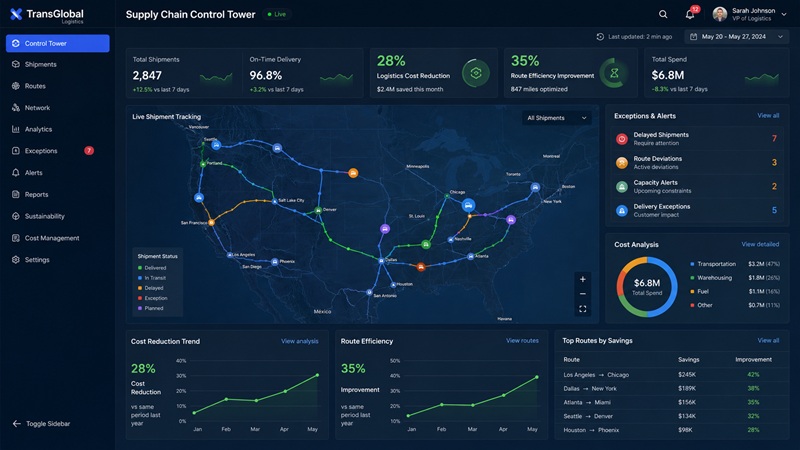
We created a centralized logistics dashboard that provided real-time visibility into fleet operations, shipment status, delivery performance, and key business metrics. This gave managers complete control over daily logistics activities.
Key Benefits:
- Better decision-making
- Improved supply chain visibility
- Faster issue identification and resolution
4. Predictive Analytics and Forecasting
Our predictive analytics solution helped the client forecast demand, plan capacity, identify seasonal trends, and optimize resource utilization. This allowed the company to make proactive business decisions instead of reacting to problems.
Key Benefits:
- Better inventory management
- Reduced warehouse costs
- Improved customer service levels
5. Performance Analytics and Reporting
We implemented advanced reporting dashboards that tracked logistics costs, transportation KPIs, fleet utilization, and operational performance. These insights helped leadership identify opportunities for continuous improvement and cost reduction.
Key Benefits:
- Ongoing operational optimization
- Greater visibility into performance metrics
- Data-driven strategic planning
By combining intelligent automation, logistics data analytics, and real-time visibility, Cor Advance Solutions helped the client build a more efficient, scalable, and cost-effective supply chain operation.
Implementation Process
Phase 1: Discovery & Assessment
- Reviewed logistics workflows
- Identified cost-saving opportunities
- Analyzed transportation and warehouse operations
Phase 2: Solution Design
- Designed automation workflows
- Created analytics dashboards
- Defined performance KPIs
Phase 3: Deployment
- Implemented automation tools
- Integrated operational data sources
- Trained internal teams
Phase 4: Optimization
- Monitored performance
- Fine-tuned analytics models
- Continuously improved logistics processes
Results Achieved
1. Reduced Logistics Costs
By implementing route optimization, intelligent automation, and predictive analytics, the client achieved a 28% reduction in overall logistics costs. Improved route planning also helped reduce fuel consumption by 22%, lowering transportation expenses across the network.
Key Outcomes
- 28% reduction in logistics operating costs
- 22% reduction in fuel consumption
- Lower transportation and fleet management expenses
2. Improved Operational Efficiency
Automating shipment scheduling, dispatch management, and reporting processes significantly improved productivity. The company reduced manual workloads by 50% and accelerated shipment processing times by 60%.
Key Outcomes
- 60% faster shipment processing
- 50% reduction in manual workload
- Improved resource utilization
3. Enhanced Delivery Performance
AI-powered route optimization improved delivery planning and execution, resulting in a 35% increase in on-time deliveries and fewer shipment delays.
Key Outcomes
- 35% increase in on-time delivery rates
- Reduced delivery delays
- Improved customer satisfaction
4. Greater Operational Visibility
The new logistics dashboard provided real-time visibility into fleet performance, shipment status, and operational KPIs, enabling faster and more informed decision-making.
Key Outcomes
- Real-time operational visibility
- Faster issue resolution
- Improved performance monitoring
5. Optimized Supply Chain Operations
Advanced forecasting and analytics improved inventory planning and warehouse management, helping the client reduce inefficiencies and improve overall supply chain performance.
Key Outcomes
- 30% improvement in inventory accuracy
- Better demand forecasting
- Reduced warehouse bottlenecks
Key Performance Improvements
| Metric | Before | After |
| Logistics Costs | High | 28% Lower |
| Fuel Consumption | High | 22% Lower |
| Route Efficiency | Moderate | 35% Improved |
| Shipment Processing Time | Manual & Slow | 60% Faster |
| Manual Workload | Extensive | 50% Reduced |
| On-Time Deliveries | Inconsistent | 35% Higher |
| Reporting Speed | Slow | Real-Time |
| Operational Visibility | Limited | Full Visibility |
| Fleet Utilization | Low Visibility | Optimized |
Client Testimonial
“Cor Advance Solutions transformed our logistics operations through intelligent automation and advanced analytics. The visibility, efficiency, and cost savings achieved have significantly improved our overall supply chain performance and profitability.”
— Operations Director
Why Cor Advance Solutions
Expertise Delivered
- Proven expertise in logistics automation and supply chain transformation
- Deep experience in data analytics and predictive intelligence
- Custom-built solutions tailored to business requirements
- Seamless integration with existing logistics systems
- Focus on measurable business outcomes and ROI
Conclusion
By combining intelligent automation, predictive analytics, and real-time operational visibility, Cor Advance Solutions helped the client reduce logistics costs, improve delivery performance, and build a scalable, data-driven logistics ecosystem. The transformation enabled sustainable growth, enhanced customer satisfaction, and long-term operational excellence.
Looking to Reduce Logistics Costs and Improve Supply Chain Efficiency?
Partner with Cor Advance Solutions to leverage AI, automation, and advanced analytics that transform logistics operations into a competitive advantage.
FAQ
What is logistics data analytics?
Logistics data analytics is the process of collecting, analyzing, and interpreting logistics data to improve operational performance and reduce costs. It helps businesses gain insights into transportation, inventory, fleet management, and delivery operations. By using logistics analytics, companies can make data-driven decisions, identify inefficiencies, and optimize supply chain performance. This leads to better visibility, improved efficiency, and higher customer satisfaction.
How does logistics automation reduce operational costs?
Logistics automation reduces operational costs by eliminating manual tasks, reducing human errors, and improving workflow efficiency. Automated processes such as shipment scheduling, dispatch management, and reporting help organizations save time and resources. By streamlining operations, businesses can increase productivity, lower administrative expenses, and improve overall logistics performance. Automation also enables faster and more accurate decision-making.
How does route optimization improve logistics efficiency?
Route optimization improves logistics efficiency by identifying the most effective delivery routes based on factors such as distance, traffic conditions, and delivery schedules. This helps reduce fuel consumption, transportation costs, and delivery times. Optimized routing also improves fleet utilization and enhances on-time delivery performance. As a result, businesses can operate more efficiently while providing better customer service.
How did automation improve shipment processing?
Automation improved shipment processing by reducing manual intervention and streamlining key logistics workflows. Tasks such as shipment scheduling, carrier assignment, and dispatch management were completed faster and with greater accuracy. This reduced delays, minimized errors, and increased operational productivity. Automated processes also enabled teams to focus on higher-value activities instead of repetitive administrative work.
What is a real-time logistics dashboard?
A real-time logistics dashboard is a centralized platform that provides live visibility into logistics and supply chain operations. It displays important data such as shipment status, fleet performance, delivery metrics, and operational KPIs in one place. With real-time monitoring, businesses can quickly identify issues and make informed decisions. This improves operational control, efficiency, and overall supply chain visibility.
Why is real-time visibility important in logistics?
Real-time visibility is important in logistics because it allows businesses to monitor shipments, fleet activities, and operational performance as they happen. Access to accurate and up-to-date information helps organizations respond quickly to disruptions and delays. It also improves decision-making, enhances customer communication, and increases supply chain efficiency. Greater visibility leads to better control over logistics operations and improved service levels.
How does data analytics support supply chain management?
Data analytics supports supply chain management by providing actionable insights into inventory levels, transportation performance, customer demand, and operational efficiency. It helps businesses identify trends, forecast future demand, and optimize resource allocation. With data-driven decision-making, organizations can reduce costs, improve service quality, and enhance overall supply chain performance. Analytics also enables proactive planning and risk management.
What are the advantages of predictive intelligence in logistics?
Predictive intelligence helps logistics companies anticipate future demand, identify potential disruptions, and make proactive business decisions. By analyzing historical and real-time data, predictive models improve forecasting accuracy and resource planning. This reduces inventory shortages, prevents overstocking, and improves operational efficiency. Predictive intelligence enables businesses to optimize supply chain operations while reducing costs and risks.
How can businesses reduce manual logistics processes?
Businesses can reduce manual logistics processes by implementing intelligent automation and workflow management solutions. Automating tasks such as scheduling, dispatching, reporting, and invoice processing improves efficiency and reduces errors. Digital tools also eliminate the need for spreadsheet-based workflows and repetitive administrative tasks. This allows logistics teams to work faster, improve accuracy, and focus on strategic activities.
How can predictive analytics reduce warehouse costs?
Predictive analytics reduces warehouse costs by helping businesses accurately forecast demand and optimize inventory levels. Better forecasting prevents overstocking and stock shortages, reducing storage and carrying costs. It also improves warehouse space utilization and resource planning. By using predictive insights, organizations can streamline warehouse operations, increase efficiency, and lower overall supply chain expenses.