
A unified data warehouse for retail brings together data from POS, inventory, CRM, and sales systems into one central platform. This allows businesses to access real-time analytics, faster reporting, and accurate insights for better decision-making.
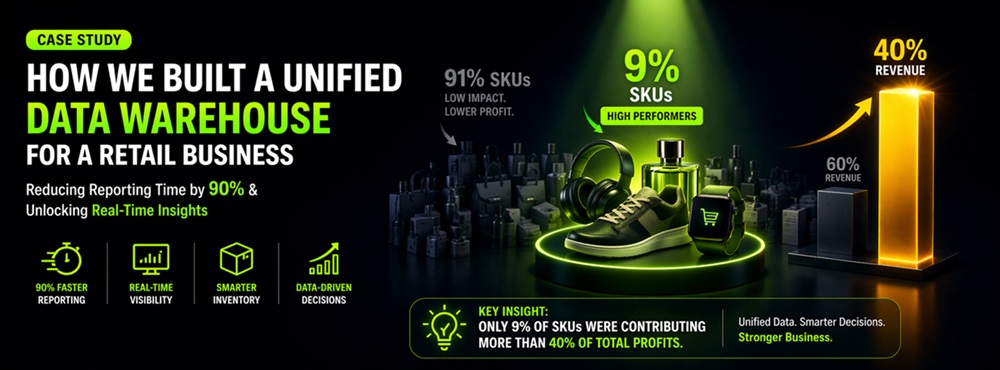
In this case study, we helped a fast-growing retail company replace manual reporting with a centralized retail data analytics solution. As a result, reporting time dropped by 90%, leadership gained real-time visibility, and the company identified high-profit SKUs using advanced dashboards.
Client Overview
We worked with a fast-growing multi-store retail business that operates across several physical locations. The company was expanding quickly, but its data systems were not keeping up with its growth.
Business Snapshot:
- Industry: Retail (multi-store operator)
- Business Model: Offline retail with multiple locations
- Growth Stage: Rapid expansion phase
- Data Complexity: High (multiple disconnected systems)
The Core Challenge
Like many retail businesses, the company was dealing with data fragmentation and reporting inefficiency.
Their data was spread across:
- POS systems (sales data)
- Inventory management tools
- CRM platforms (customer data)
- Promotion and marketing systems
Because these systems were not connected, the leadership team had no single source of truth.
The Problem: Fragmented Data & Slow Decision-Making
The business faced several operational challenges that are common in retail:
- Reports were created manually using Excel
- Data had to be pulled from multiple systems
- Decision-making was delayed due to outdated reports
- There was no visibility into SKU-level profitability
- Store performance could not be tracked in real time
In simple terms, the business was growing — but its data systems were slowing it down.
Many retail companies struggle with disconnected systems that prevent real-time insights and efficient operations. This leads to poor decisions, missed opportunities, and reduced profitability.
Our Solution: Unified Data Warehouse & Retail Analytics Platform
To solve these challenges, we designed and implemented a centralized data warehouse for retail analytics.
Our goal was simple:
👉 Create a single, reliable source of truth
👉 Enable real-time insights
👉 Remove manual reporting
1. Data Integration Across Systems
We connected all major data sources into one unified platform:
- POS (sales data)
- Inventory systems
- CRM (customer data)
- Promotions and campaigns
This created a fully integrated retail data ecosystem.
2. Centralized Data Warehouse
We built a scalable retail data warehouse that stores and organizes all business data in one place.
This allowed:
- Clean, structured data
- Consistent reporting
- Easy access for leadership
Now, instead of searching in multiple systems, everything was available in one dashboard.
3. Real-Time Analytics Dashboards
We developed powerful retail business intelligence dashboards to track:
- Sales performance across stores
- Profit margins by product
- Inventory aging and stock levels
- Store-wise performance comparison
These dashboards gave leadership instant visibility into operations.
4. Automated Reporting (No More Excel Work)
We eliminated manual reporting completely.
- Daily reports were automated
- Weekly summaries were auto-generated
- No more Excel consolidation
This saved hours of manual work every week.
5. Advanced Analytics & Insights
We added advanced analytics features to unlock deeper business insights:
- SKU-level profitability analysis
- Promotion performance tracking (ROI)
- Dead stock identification
- Demand trends and patterns
This turned raw data into actionable business intelligence.
The Results: Measurable Business Impact
After implementing the unified data warehouse for retail, the business saw immediate improvements:
- ⏱️ 90% reduction in reporting time (hours → minutes)
- 📊 Real-time visibility across all store locations
- 📦 Better inventory decisions based on data
- 📉 Identification of low-margin and underperforming products
- 👥 Improved alignment between store managers and leadership
Key Insight That Changed the Business
One insight stood out and had a major impact:
Only 9% of SKUs were contributing more than 40% of total profits.
This changed how the company approached:
- Inventory planning
- Product focus
- Pricing strategy
Instead of guessing, they now had clear, data-backed direction.
Why This Matters for Retail Businesses
This case study highlights a critical truth:
👉 Data is not valuable unless it is unified, accessible, and actionable.
With the right retail data analytics solution, businesses can:
- Make faster decisions
- Improve profitability
- Reduce operational inefficiencies
- Scale with confidence
Want Similar Results?
If your business is struggling with:
- Disconnected data systems
- Slow or manual reporting
- Lack of real-time insights
We can help you build a scalable data warehouse and analytics platform tailored to your needs.
Turn your data into a competitive advantage.
FAQs
What is a unified data warehouse for retail?
A unified data warehouse for retail is a centralized system that combines data from POS, CRM, inventory, and sales platforms into one place. It creates a single source of truth for the business. This allows retailers to access clean, structured, and real-time data. As a result, businesses can generate faster reports and gain accurate insights for smarter decisions.
Why do retail businesses need a data warehouse?
Retail businesses need a data warehouse to eliminate data silos and unify information across multiple systems. It improves reporting speed and accuracy by automating data processes. With centralized data, teams can access insights instantly. This enables better decision-making, improved efficiency, and scalable growth.
What problems does a retail data warehouse solve?
A retail data warehouse solves issues like fragmented data, manual reporting, and delayed insights. It removes the need to pull data from multiple disconnected systems. Businesses gain a clear view of performance across stores and products. This leads to faster decisions, reduced errors, and improved profitability.
How does a unified data warehouse improve decision-making?
A unified data warehouse provides real-time and accurate data across all business operations. Leaders no longer rely on outdated or incomplete reports. Instead, they get instant visibility into sales, inventory, and performance metrics. This allows faster, data-driven decisions that improve efficiency and growth.
What is the main goal of building a data warehouse in retail?
The main goal is to create a single, reliable source of truth for all business data. It ensures that all teams work with consistent and accurate information. This enables real-time analytics and faster reporting. Ultimately, it helps retailers make better strategic decisions and scale efficiently.
How did reporting time reduce by 90%?
Reporting time reduced by 90% by automating data collection and report generation processes. Instead of manually compiling data in Excel, reports were generated instantly. Data pipelines ensured real-time updates across systems. This eliminated repetitive work and significantly improved efficiency.
What type of reports were automated?
Key reports such as daily sales reports, weekly performance summaries, and inventory tracking reports were automated. Business intelligence dashboards replaced manual Excel sheets. Store-wise performance and SKU-level insights were also automated. This ensured consistent, accurate, and real-time reporting.
Why is manual reporting inefficient in retail?
Manual reporting is time-consuming and prone to human errors. It requires pulling data from multiple systems and combining it manually. This delays decision-making and reduces data accuracy. As retail businesses grow, manual processes become unsustainable and slow down operations.
How does automated reporting benefit retail teams?
Automated reporting saves time by eliminating manual data work. It improves accuracy by reducing human errors. Teams get instant access to real-time reports and insights. This allows them to focus on strategy, optimization, and business growth instead of repetitive tasks.
What are real-time insights in retail?
Real-time insights refer to live data updates that reflect current business performance. Retailers can track sales, inventory, and customer behavior instantly. This helps identify trends and issues as they happen. It enables quick actions and better decision-making.
How do real-time dashboards help retail businesses?
Real-time dashboards provide a visual overview of key business metrics in one place. They display live data on sales, inventory, and store performance. This helps leaders monitor operations without delays. It improves decision speed and enhances overall business visibility.
How does a data warehouse improve inventory management?
A data warehouse provides real-time visibility into stock levels and demand patterns. It helps track inventory across multiple locations. Businesses can identify slow-moving and high-demand products easily. This leads to better inventory planning, reduced stockouts, and optimized supply chain operations.
Is your solution customizable for my retail business?
Yes, the solution is fully customizable based on your retail business needs. It can integrate with your existing POS, CRM, and inventory systems. Dashboards and reports are tailored to your goals and KPIs. This ensures maximum value and scalability for your operations.
Why should I choose your data analytics solution?
Our solution delivers a centralized, scalable, and real-time data platform tailored for retail businesses. We focus on automation, accuracy, and actionable insights. With proven results like 90% faster reporting, we help you improve efficiency and profitability. Our approach ensures long-term growth and data-driven success.