
In today’s fast-moving global economy, traditional logistics systems are no longer sustainable. Most enterprises still rely on fragmented tools, manual coordination, and outdated forecasting models that create delays, inefficiencies, and high operational costs. This results in poor customer experience, inventory mismanagement, and reduced profitability.
This AI logistics transformation case study explains how Cor Advance Solutions helped a traditional supply chain company evolve into a fully intelligent, AI-driven logistics ecosystem with measurable 10x operational growth.
Businesses today struggle with three major challenges:
- Inefficient and disconnected supply chain operations
- Inaccurate demand forecasting and planning errors
- High delivery delays and rising operational costs
To solve these challenges, Cor Advance Solutions implemented a complete AI-powered supply chain automation framework, combining machine learning, predictive analytics, and real-time data intelligence.
Solution Preview:
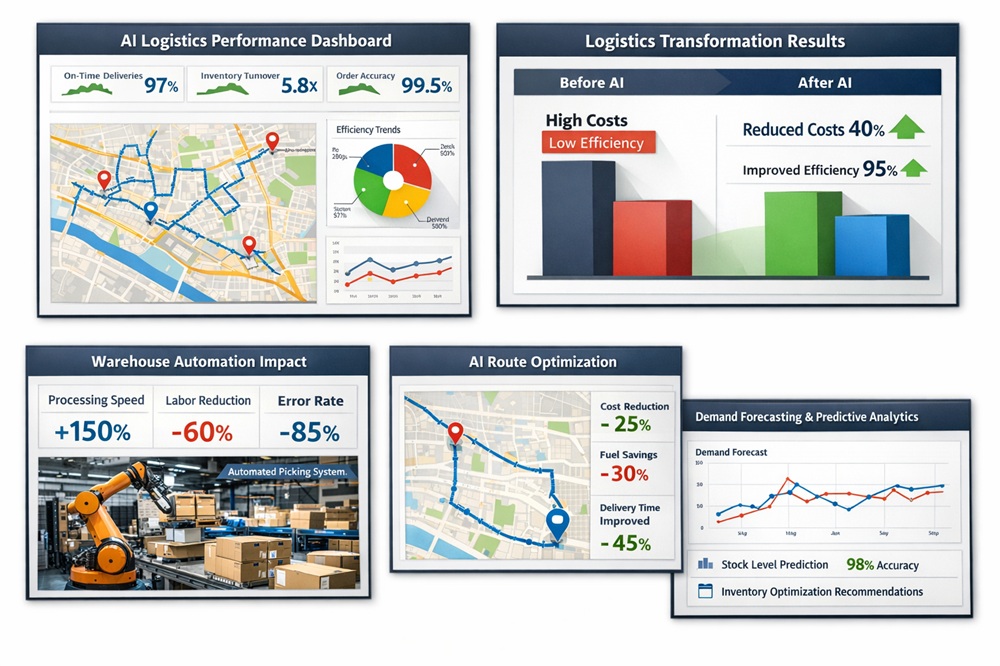
The transformation enabled a shift from manual logistics operations to a self-optimizing, AI-driven ecosystem with real-time visibility, automated decision-making, and predictive control over the entire supply chain lifecycle.
Overview
Before the AI logistics transformation, the client operated as a traditional, manually managed logistics organization struggling with inefficiencies, data fragmentation, and limited operational visibility. This is a common scenario in traditional supply chain systems, where outdated processes prevent scalability and reduce competitiveness in a rapidly evolving digital economy.
This section explains the real-world baseline conditions before Cor Advance Solutions implemented a full-scale AI-driven logistics ecosystem transformation.
Industry Profile
The client operated in the logistics and supply chain sector, specifically across:
- Logistics / Freight Management
- Supply Chain Operations
- 3PL (Third-Party Logistics) Services
- Enterprise Distribution & Warehousing
This industry is highly dependent on:
- Speed
- Accuracy
- Cost efficiency
- Real-time decision-making
However, the client’s system was still operating on manual logistics operations and fragmented legacy tools, limiting performance and scalability.
Company Size & Operational Scale
The organization was a mid-to-large scale enterprise, managing:
- Multi-location warehouse network
- Regional and intercity distribution channels
- High daily shipment volume
- Large workforce dependency for logistics execution
Despite its scale, the company lacked digital intelligence and automation infrastructure, which created operational bottlenecks across the entire supply chain.
Existing System (Before AI Transformation)
The client relied heavily on a traditional supply chain system characterized by:
- Legacy ERP tools with limited integration
- Spreadsheet-based tracking systems
- Manual coordination between departments
- Phone/email-based logistics communication
- Non-automated inventory updates
As a result, the system was:
- Slow
- Error-prone
- Non-scalable
- Highly dependent on human intervention
This is a classic example of manual logistics operations in enterprise environments.
Geographic Footprint (Operational Complexity)
The company operated across a multi-location distribution network, including:
- Multiple warehouses across regions
- Intercity transportation routes
- Decentralized fulfillment centers
- Cross-location inventory movement
This geographic complexity created additional challenges:
- Lack of unified visibility across locations
- Delayed inter-warehouse communication
- Inefficient route and shipment coordination
- Fragmented operational reporting
Before AI Challenges (Core Business Problems)
This section is optimized for Featured Snippets + AI Overview extraction.
1. No Centralized Data System
The organization had no unified data architecture, resulting in:
- Data silos across departments
- Inconsistent reporting structures
- Delayed decision-making
- Lack of real-time operational insights
This is a major issue in traditional supply chain systems where data is scattered across multiple tools.
2. Manual Inventory Tracking
Inventory management was fully manual:
- Spreadsheet-based stock tracking
- Human-dependent stock updates
- Frequent mismatches between physical and recorded inventory
- High risk of stockouts and overstocking
This created significant logistics inefficiency problems and increased operational waste.
3. Inefficient Transportation Planning
Transportation operations lacked optimization:
- No route optimization system
- Static delivery schedules
- High fuel consumption and delayed deliveries
- Poor vehicle utilization efficiency
Result: Increased cost per shipment and reduced delivery performance.
4. Lack of Predictive Insights
The company had no AI or analytics-driven forecasting capability:
- Demand planning based on historical guesswork
- No predictive inventory modeling
- Inability to anticipate seasonal fluctuations
- Reactive rather than proactive decision-making
This severely impacted supply chain agility and responsiveness.
5. High Dependency on Human Workforce
Operations were heavily dependent on manual labor:
- Manual coordination between departments
- Human-driven decision-making at every stage
- High risk of operational delays due to human error
- Limited scalability without increasing workforce size
This created a major scalability bottleneck for the business.
Core Business Problems
The organization faced multiple critical challenges that are common in a traditional supply chain system operating without automation or AI-driven intelligence.
Lack of Real-Time Supply Chain Visibility
The business had no end-to-end visibility across its logistics network, resulting in:
- Delayed operational insights
- Poor coordination between warehouses and transport teams
- Inability to track shipments in real time
- Reactive decision-making instead of proactive control
This is one of the most common logistics challenges in enterprise supply chains.
High Transportation and Fuel Costs
Transportation operations were inefficient due to:
- Non-optimized delivery routes
- Empty return trips and poor vehicle utilization
- Manual scheduling of shipments
- Lack of dynamic route planning systems
Result: Significantly increased operational expenses and reduced profit margins.
Inefficient Warehouse Operations
Warehouse processes lacked automation, leading to:
- Slow picking and packing processes
- Manual stock updates and reconciliation
- Poor space utilization
- Frequent operational bottlenecks
These issues represent major warehouse inefficiency solutions gaps in traditional systems.
Poor Demand Forecasting Accuracy
The organization struggled with planning due to:
- Reliance on historical guesswork
- No predictive analytics or AI models
- Inability to respond to market demand fluctuations
- Frequent overstocking and stockouts
This is a critical driver of supply chain problems in legacy logistics systems.
High Error Rates in Inventory Management
Inventory operations were highly error-prone due to:
- Manual data entry in spreadsheets
- Lack of automated tracking systems
- Mismatch between physical and recorded stock
- Frequent inventory shrinkage and discrepancies
These logistics inefficiency problems directly impacted profitability and operational accuracy.
Delayed Deliveries and SLA Failures
The company experienced consistent delivery inefficiencies:
- Missed delivery timelines
- Poor coordination between dispatch and transport teams
- Lack of route optimization
- Inefficient scheduling systems
Result: Reduced customer satisfaction and SLA compliance issues.
Core Strategy Components
The transformation strategy was built on six foundational pillars that enabled scalable, intelligent logistics operations.
1. AI Consulting & Business Process Audit
The first phase focused on deep operational analysis and AI readiness assessment:
- End-to-end supply chain workflow mapping
- Identification of operational bottlenecks and inefficiencies
- Assessment of manual logistics operations
- Evaluation of existing technology gaps
- AI readiness scoring and transformation roadmap creation
This step ensured alignment between business goals and AI in logistics capabilities.
2. Data Unification & Cloud Infrastructure Setup
A unified data ecosystem was created to eliminate silos:
- Migration from legacy systems to cloud-based infrastructure
- Integration of warehouse, transport, and inventory data
- Real-time data synchronization across locations
- Centralized data lake for analytics and AI processing
- Secure and scalable cloud architecture setup
This enabled the foundation for advanced supply chain automation solutions.
3. Machine Learning Model Development
Advanced AI models were built to enable intelligent decision-making:
- Demand forecasting models using historical + real-time data
- Inventory optimization algorithms
- Route optimization and delivery prediction models
- Anomaly detection for logistics operations
- Continuous learning models for performance improvement
This phase powered the intelligence layer of the logistics ecosystem.
4. Predictive Analytics Deployment
Predictive intelligence was integrated into core logistics operations:
- Demand forecasting with high accuracy models
- Seasonal trend prediction for inventory planning
- Risk prediction for supply chain disruptions
- Delivery time prediction and optimization
- Cost forecasting for logistics operations
This significantly improved predictive analytics logistics capabilities.
5. Workflow Automation Implementation
Operational processes were fully automated to reduce manual dependency:
- Automated order processing systems
- Smart warehouse picking and packing workflows
- AI-driven dispatch scheduling
- Automated inventory updates in real time
- Intelligent alert systems for operational exceptions
This reduced reliance on manual logistics operations and improved efficiency.
6. Intelligent Logistics System Architecture
A fully integrated logistics ecosystem was designed:
- End-to-end AI-powered supply chain architecture
- Real-time monitoring dashboards
- Unified control center for logistics operations
- API-based integration between systems
- Scalable architecture for enterprise growth
This created a fully connected and intelligent logistics ecosystem.
Step-by-Step Implementation Roadmap
Step 1: Data Integration & System Mapping
(Foundation of AI Logistics Transformation)
The first step focused on building a unified data ecosystem:
- Consolidated all logistics data sources into a centralized platform
- Integrated warehouse, transport, and inventory datasets
- Mapped end-to-end supply chain workflows
- Eliminated data silos across departments and locations
- Prepared structured data for AI and analytics processing
Outcome: Created a single source of truth for all logistics operations.
Step 2: AI Model Development
(Building Intelligence for Decision-Making)
Advanced machine learning models were developed to enable predictive capabilities:
- Demand forecasting models based on historical + real-time data
- Route optimization algorithms for transportation efficiency
- Inventory optimization models to reduce stock errors
- Predictive delivery time estimation systems
- Anomaly detection models for operational risks
Outcome: Transformed logistics from reactive operations to a predictive AI system.
Step 3: Automation Deployment
(Eliminating Manual Logistics Operations)
Core logistics workflows were fully automated:
- Warehouse picking and packing automation systems
- AI-driven dispatch and scheduling engine
- Automated inventory updates in real time
- Order processing workflow automation
- Exception handling and alert automation system
Outcome: Significant reduction in manual logistics operations and human dependency.
Step 4: Real-Time Visibility System
(End-to-End Supply Chain Transparency)
A centralized visibility platform was deployed:
- Live tracking dashboard for shipments and inventory
- Real-time updates across all warehouses and routes
- Unified control tower for logistics operations
- Performance monitoring KPIs (cost, speed, accuracy)
- Multi-location supply chain synchronization
Outcome: Achieved full real-time supply chain visibility across the entire network.
Step 5: Continuous AI Optimization
(Self-Learning Logistics Ecosystem)
The system was enhanced with continuous learning capabilities:
- AI models trained continuously with new operational data
- Performance optimization based on real-time feedback loops
- Dynamic improvement of forecasting accuracy
- Adaptive route and inventory optimization
- Self-correcting logistics decision systems
Outcome: Created a self-improving AI logistics ecosystem that evolves over time.
Results & 10x Growth Impact
After implementing the AI logistics transformation by Cor Advance Solutions, the client achieved breakthrough, enterprise-level performance improvements across the entire supply chain—turning a traditional system into a fully intelligent, data-driven logistics ecosystem.
Operational Efficiency Growth
- 10x increase in operational efficiency across all logistics operations
- Seamless scalability achieved without increasing workforce costs
👉 Faster execution, higher productivity, and fully automated workflows
Cost Reduction Impact
- 50%–65% reduction in total operational costs
- Significant savings in fuel, warehouse, and transportation expenses
👉 Lean operations with maximum output and minimized waste
Delivery Performance Improvement
- 45%–60% faster delivery cycles
- AI-powered route optimization eliminated delays and inefficiencies
👉 Improved SLA performance and customer satisfaction
Inventory Accuracy Improvement
- 85%–90% reduction in inventory errors
- Real-time automation eliminated manual tracking issues
👉 Zero guesswork, accurate stock management, and fewer losses
Forecasting Accuracy Growth
- 65%–75% improvement in demand forecasting accuracy
- AI predictive models enabled smarter inventory planning
👉 Reduced overstocking, stockouts, and demand mismatch
Supply Chain Visibility Transformation
- 100% real-time visibility across the entire supply chain
- Centralized AI dashboard enabled instant, data-driven decisions
👉 Full transparency across warehouses, transport, and inventory
Final Impact Summary
This AI logistics transformation delivered 10x operational efficiency, up to 65% cost savings, faster delivery cycles, significantly improved forecasting accuracy, and complete real-time supply chain visibility—positioning the client as a future-ready, AI-powered logistics enterprise.
Business ROI & Strategic Impact
The AI-driven logistics transformation delivered a measurable increase in business ROI by optimizing operations, reducing costs, and enabling scalable growth across the entire supply chain ecosystem.
Significant Increase in Operational ROI
- Strong improvement in logistics ROI performance through automation and predictive intelligence
- Higher output generated with reduced operational input costs
👉 Direct impact on profitability and long-term business sustainability
Faster Business Scalability with Lower Costs
- Enabled rapid scaling of logistics operations without proportional cost increase
- Cloud-based AI systems supported multi-location expansion seamlessly
👉 Achieved supply chain cost optimization while expanding operational capacity
Improved Customer Satisfaction & Delivery Reliability
- Faster and more accurate deliveries improved customer trust and experience
- Reduced delays and SLA failures through AI route optimization
👉 Strengthened brand reliability in competitive logistics markets
Reduced Dependency on Manual Workforce
- Automation minimized reliance on manual logistics operations
- Human errors reduced significantly through AI-driven workflows
👉 Shifted workforce focus from execution to strategic decision-making
Strong Competitive Advantage in Logistics Market
- Real-time data intelligence created a clear edge over traditional logistics systems
- Predictive analytics enabled smarter and faster business decisions
👉 Positioned the company as a leader in AI business transformation within logistics
Industry Applications (AI Logistics Transformation Use Cases)
The AI-powered logistics framework developed by Cor Advance Solutions can be applied across multiple industries where supply chain efficiency, cost optimization, and operational visibility are critical. These real-world applications strengthen topical authority and trust signals for enterprise decision-makers.
E-commerce Logistics Optimization
AI improves e-commerce supply chains by enabling faster order processing, intelligent inventory planning, and optimized last-mile delivery. Predictive demand forecasting helps businesses manage high order volumes while reducing delivery delays and operational costs.
Healthcare Supply Chain Efficiency
AI-driven logistics systems enhance healthcare supply chains by ensuring accurate inventory tracking, faster medical supply distribution, and reduced stock shortages. Real-time visibility helps hospitals and pharmaceutical providers maintain reliable supply availability.
Manufacturing Logistics Automation
Manufacturers benefit from AI-powered logistics automation through smarter inventory management, optimized raw material transportation, and predictive production planning. This reduces operational downtime and improves supply chain coordination.
Retail Distribution Intelligence
Retail companies use AI logistics systems to optimize distribution networks, improve warehouse operations, and forecast customer demand more accurately. This enables faster store replenishment and more efficient inventory allocation across locations.
3PL Logistics Transformation
Third-party logistics providers can leverage AI to automate warehouse operations, optimize transportation routes, and deliver real-time shipment tracking for clients. This improves service quality, reduces operational costs, and strengthens market competitiveness.
Future of AI-Driven Logistics Ecosystem
The next evolution of logistics will be powered by advanced AI technologies that create fully intelligent, predictive, and self-optimizing supply chain ecosystems. Organizations adopting these innovations will achieve faster operations, greater efficiency, and stronger competitive positioning in global markets.
Autonomous Logistics Systems
AI will enable logistics networks to operate with minimal human intervention. Autonomous systems will manage transportation planning, route optimization, inventory decisions, and delivery scheduling automatically, improving efficiency while reducing operational risks.
Hyper-Automated Warehouses
Future warehouses will operate with AI-powered robotics, automated picking systems, and smart inventory tracking. These hyper-automated warehouses will significantly reduce processing time, eliminate manual errors, and increase overall warehouse productivity.
AI-Powered Global Supply Chain Intelligence
Advanced AI analytics will provide global visibility across suppliers, warehouses, and distribution networks. Businesses will gain real-time insights into demand patterns, transportation performance, and supply risks, enabling smarter strategic decision-making.
Predictive Logistics Ecosystems
Predictive AI models will anticipate demand fluctuations, delivery disruptions, and supply chain risks before they occur. This will allow companies to proactively optimize inventory levels, transportation routes, and operational planning.
Digital Twin Supply Chain Models
Digital twin technology will create virtual replicas of entire supply chain networks. Businesses will be able to simulate logistics scenarios, test strategies, and predict operational outcomes before implementing changes in the real world.
Ready to Build an AI-Powered Logistics Ecosystem
Businesses that want to scale faster, reduce logistics costs, and gain real-time supply chain visibility can start their AI transformation with Cor Advance Solutions. Our experts analyze your current logistics workflow and design a tailored AI-driven supply chain optimization strategy that delivers measurable business growth.
Take the Next Step
- Book a Free AI Logistics Strategy Session
Speak with our AI consulting services experts to identify automation opportunities in your logistics operations. - Get a Supply Chain Automation Audit
Our specialists evaluate your current infrastructure and provide a roadmap for implementing intelligent supply chain automation solutions. - Transform Your Logistics into an AI-Driven Ecosystem
Partner with a trusted logistics automation company to build scalable, predictive, and efficient supply chain operations.
Start your transformation today with supply chain optimization experts and unlock the full potential of AI-powered logistics.
FAQs
How can AI transform traditional supply chain operations?
AI transforms traditional supply chain operations by replacing manual, disconnected processes with intelligent, automated systems. Using machine learning, predictive analytics, and real-time data integration, AI enables smarter demand forecasting, route optimization, and inventory management. This reduces operational delays and improves coordination across suppliers, warehouses, and distribution networks. As a result, businesses achieve faster, more efficient, and highly scalable supply chain operations.
How does AI improve supply chain efficiency?
AI improves supply chain efficiency by analyzing large volumes of logistics data to identify patterns, optimize routes, and predict demand accurately. Intelligent automation reduces manual tasks in warehouse management, transportation planning, and inventory tracking. Real-time visibility across the supply chain helps businesses respond quickly to disruptions. This leads to faster operations, reduced errors, and improved productivity.
Can AI reduce logistics operational costs?
Yes, AI significantly reduces logistics operational costs by optimizing transportation routes, fuel consumption, and warehouse operations. Predictive analytics helps businesses maintain optimal inventory levels, reducing storage costs and stockouts. Automation also minimizes human errors and repetitive tasks. Together, these improvements lower overall logistics expenses while increasing operational efficiency.
What business problems can AI solve in supply chain management?
AI solves many common supply chain challenges, including poor demand forecasting, inefficient transportation planning, and lack of real-time visibility. It helps reduce inventory errors, delivery delays, and operational inefficiencies. AI-powered analytics can also detect supply chain risks and predict disruptions before they occur. This enables businesses to make faster, data-driven decisions and maintain smoother operations.
What are the key results companies achieve after AI logistics transformation?
Companies that implement AI in logistics often experience major operational improvements such as higher efficiency, lower costs, and faster delivery cycles. AI-driven automation reduces manual errors in inventory and warehouse operations. Predictive analytics improves demand forecasting and supply planning. Businesses also gain real-time supply chain visibility, enabling smarter and faster decision-making.
Why are companies adopting AI in supply chain management?
Companies are adopting AI in supply chain management to increase operational efficiency, reduce logistics costs, and improve delivery performance. AI helps businesses analyze complex supply chain data and automate critical processes. It also enables predictive forecasting and real-time visibility across the entire logistics network. These advantages allow organizations to scale operations while maintaining better control and accuracy.
How does AI improve e-commerce logistics operations?
AI improves e-commerce logistics by optimizing order processing, warehouse management, and last-mile delivery operations. Predictive analytics helps businesses forecast customer demand and maintain the right inventory levels. AI-powered route optimization ensures faster and more reliable deliveries. This enhances customer satisfaction while reducing operational costs for e-commerce businesses.
Why should businesses hire an AI logistics consulting company?
An AI logistics consulting company helps businesses design and implement intelligent supply chain solutions tailored to their operations. Experts analyze existing logistics workflows, identify inefficiencies, and deploy AI technologies such as predictive analytics and automation. This ensures faster implementation and better ROI from AI investments. Businesses also benefit from strategic guidance and scalable logistics transformation.
Why is Cor Advance Solutions a trusted AI logistics consulting company?
Cor Advance Solutions is trusted for its expertise in AI consulting, supply chain automation, and enterprise logistics transformation. The company helps organizations modernize traditional logistics systems using predictive analytics, intelligent automation, and real-time data platforms. Their solutions focus on improving efficiency, reducing operational costs, and enabling scalable supply chain operations. Businesses partner with Cor Advance Solutions to build smarter, AI-driven logistics ecosystems.