
Introduction: How AI is Transforming Logistics and Supply Chains
The Rise of AI in Modern Logistics
The logistics industry is rapidly evolving with the help of AI in logistics. In the past, supply chain operations were managed through manual planning, spreadsheets, and traditional software systems. These methods often caused delays, errors, and inefficiencies. Today, companies are adopting artificial intelligence logistics solutions to automate operations, analyze large amounts of data, and make smarter decisions in real time.
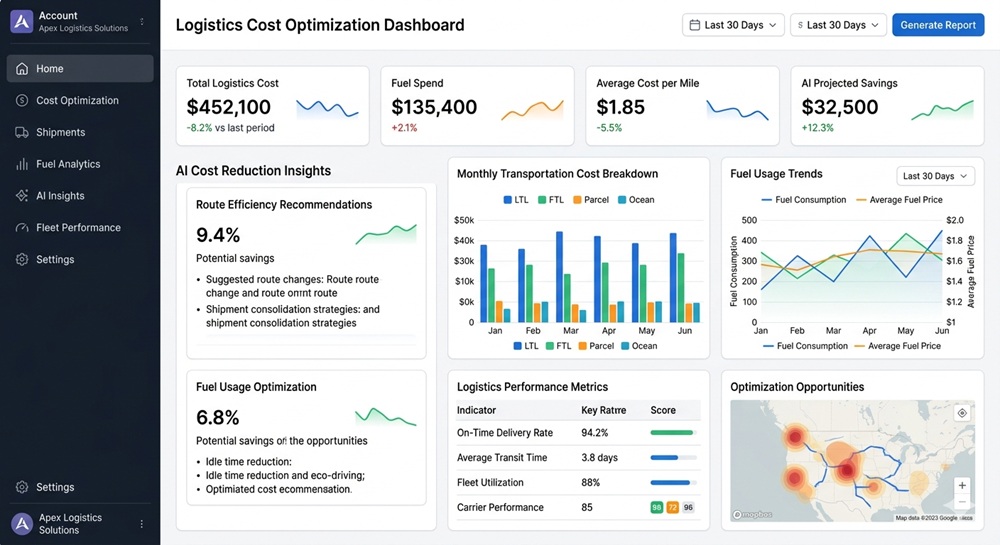
Artificial intelligence allows logistics companies to predict demand, optimize delivery routes, manage warehouse operations, and monitor shipments across the entire supply chain. With the help of AI logistics technology, businesses can reduce operational costs, improve delivery speed, and increase overall efficiency.
Growing Demand for Faster and Smarter Supply Chains
Customer expectations have changed dramatically in recent years. With the growth of e-commerce and global trade, customers now expect:
✔ Faster deliveries
✔ Real-time shipment tracking
✔ Accurate delivery timelines
✔ Seamless order fulfillment
Traditional logistics systems often struggle to meet these expectations. This is why many organizations are investing in AI in supply chain optimization. AI systems can analyze traffic conditions, weather patterns, shipping routes, warehouse capacity, and order demand to improve logistics planning and execution.
For example, AI can instantly identify the fastest shipping routes, adjust delivery schedules, and detect potential delays before they impact customers.
Why Businesses Are Adopting AI-Driven Logistics Solutions
Companies across the world are adopting AI logistics technology because it helps solve some of the biggest challenges in supply chain management. AI-powered logistics platforms provide advanced capabilities such as:
• Predictive analytics to forecast product demand and avoid stock shortages
• Route optimization to reduce transportation costs and delivery time
• Automated warehouse management to improve inventory accuracy
• Real-time supply chain visibility to monitor shipments and logistics performance
By implementing artificial intelligence logistics solutions, businesses can streamline their operations and make data-driven decisions that improve productivity and customer satisfaction.
Real-Time Visibility Across the Supply Chain
One of the most valuable benefits of AI in supply chain optimization is the ability to provide end-to-end visibility. AI-powered systems collect and analyze real-time data from multiple sources, including:
• Warehouses
• Transportation networks
• Inventory systems
• Shipping carriers
• Customer orders
This real-time data helps companies track shipments, detect delays, monitor inventory levels, and respond quickly to disruptions. As a result, businesses can maintain smoother operations and improve supply chain reliability.
Industries Benefiting from AI in Logistics
Many industries are already using AI logistics technology to improve efficiency and reduce operational risks. Some of the key sectors benefiting from AI in logistics include:
E-commerce and Retail
AI helps optimize warehouse management, demand forecasting, and last-mile delivery operations.
Manufacturing
Manufacturers use AI-driven supply chain systems to manage raw materials, production planning, and supplier coordination.
Healthcare and Pharmaceuticals
AI logistics solutions ensure the safe and timely delivery of medicines, medical devices, and healthcare supplies.
Food and Beverage
AI helps maintain cold chain logistics, reduce food waste, and improve delivery efficiency.
What is AI in Logistics and Supply Chain Management?
AI supply chain management refers to the use of artificial intelligence technologies to improve how goods are planned, produced, stored, transported, and delivered across the supply chain. In simple words, AI helps logistics companies use data and smart algorithms to make faster and more accurate decisions.
Traditional supply chains often rely on manual planning, historical data, and human judgment. While these methods work, they are slow and often lead to errors or delays. With AI logistics automation, businesses can analyze massive amounts of real-time data, identify patterns, and automatically optimize operations such as route planning, demand forecasting, inventory management, and warehouse operations.
For beginners and decision-makers, the key idea is simple: AI transforms a traditional supply chain into an intelligent, data-driven system that can predict problems, automate tasks, and improve efficiency.
Modern intelligent supply chain solutions allow companies to monitor the entire logistics process in real time—from suppliers and warehouses to transportation and final delivery.
Key Components of AI in Logistics
AI in logistics is powered by several advanced technologies that work together to improve supply chain performance.
1. Machine Learning (ML)
Machine Learning is one of the most important technologies behind AI supply chain management. ML systems analyze large volumes of logistics data and learn from patterns over time.
For example, machine learning can:
• Predict future product demand
• Identify the most efficient delivery routes
• Detect supply chain disruptions
• Improve warehouse operations
As the system processes more data, it continuously improves its accuracy and performance.
2. Predictive Analytics
Predictive analytics uses historical data and AI algorithms to forecast future events. In logistics, this helps companies plan better and avoid disruptions.
For example, predictive analytics can help businesses:
• Forecast customer demand
• Predict delivery delays
• Estimate transportation costs
• Identify supply chain risks
This capability makes intelligent supply chain solutions more proactive rather than reactive.
3. Computer Vision
Computer vision allows AI systems to interpret and understand images and videos. In logistics, this technology is commonly used in warehouses and distribution centers.
Examples include:
• Automated package scanning
• Quality inspection of products
• Barcode and label recognition
• Monitoring warehouse operations
By using computer vision, companies can reduce manual errors and improve operational efficiency.
4. Natural Language Processing (NLP)
Natural Language Processing (NLP) helps AI systems understand and respond to human language. This technology is widely used in logistics communication and customer service.
Examples include:
• AI chatbots for shipment tracking
• Automated customer support systems
• Processing shipping documents and emails
• Voice-based logistics management systems
NLP makes AI logistics automation more user-friendly and improves communication between systems, employees, and customers.
5. Robotics and Automation
Robotics and automation play a major role in modern warehouses and logistics centers. AI-powered robots can perform repetitive and time-consuming tasks with high accuracy.
Common applications include:
• Automated warehouse picking and packing
• Sorting packages in distribution centers
• Loading and unloading goods
• Autonomous delivery vehicles and drones
These technologies significantly improve speed, accuracy, and productivity in logistics operations.
Why Businesses Are Adopting AI in Supply Chain
Companies across different industries are rapidly adopting AI supply chain management because it offers major business benefits.
Reduce Operational Costs
AI systems help businesses reduce fuel costs, labor expenses, and operational inefficiencies. By optimizing delivery routes, warehouse operations, and inventory management, companies can significantly lower their logistics expenses.
Improve Delivery Speed
Fast delivery has become a major competitive advantage. AI logistics automation helps companies identify the fastest shipping routes, reduce delays, and improve last-mile delivery performance.
Predict Demand Accurately
Demand forecasting is critical for supply chain success. AI-powered predictive analytics can analyze historical sales data, seasonal trends, and market behavior to predict customer demand with high accuracy.
This helps businesses avoid overstocking or stock shortages.
Enhance Inventory Management
Managing inventory across multiple warehouses and locations is challenging. Intelligent supply chain solutions use AI to track inventory levels in real time and automatically adjust stock levels based on demand patterns.
This leads to better inventory control, reduced storage costs, and improved order fulfillment.
Benefits of Using AI in Logistics and Supply Chain
Before exploring real-world use cases, it is important to understand the business value of AI in logistics. Companies across the world are adopting AI logistics automation because it helps them improve efficiency, reduce costs, and deliver better customer experiences.
AI-powered systems analyze large amounts of logistics data in real time and automatically optimize different parts of the supply chain, including transportation, warehouse operations, inventory management, and delivery planning. These intelligent supply chain solutions allow businesses to operate faster, smarter, and more efficiently.
AI in logistics helps businesses automate operations, predict demand, optimize delivery routes, and improve overall supply chain efficiency. It enables companies to reduce operational costs, gain real-time visibility across the supply chain, and deliver products faster while improving customer satisfaction.
Key Benefits of AI in Logistics and Supply Chain
1. Increased Operational Efficiency
One of the biggest advantages of AI logistics automation is improved operational efficiency. AI systems can automate repetitive and time-consuming tasks such as order processing, route planning, warehouse sorting, and shipment tracking.
By reducing manual work and human errors, businesses can complete logistics operations faster and with greater accuracy. AI-powered systems also continuously analyze performance data to identify inefficiencies and suggest improvements in supply chain processes.
2. Real-Time Supply Chain Visibility
Modern supply chains involve multiple warehouses, transportation routes, suppliers, and delivery partners. Without proper visibility, it becomes difficult to track shipments and respond quickly to disruptions.
AI supply chain management platforms provide real-time monitoring of the entire logistics network. Businesses can track inventory levels, shipment status, delivery timelines, and transportation performance from a single intelligent dashboard.
This level of transparency helps companies make faster decisions and maintain smooth supply chain operations.
3. Reduced Transportation Costs
Transportation is one of the largest expenses in logistics operations. AI technology helps businesses optimize delivery routes by analyzing real-time data such as traffic conditions, weather patterns, fuel consumption, and delivery schedules.
With AI logistics automation, companies can choose the most efficient routes, reduce fuel usage, and minimize unnecessary transportation delays. As a result, businesses can significantly lower logistics costs while maintaining reliable delivery services.
4. Faster Delivery and Better Customer Experience
Today’s customers expect quick deliveries and accurate shipment tracking. AI systems help logistics companies meet these expectations by improving delivery planning and last-mile logistics.
Intelligent supply chain solutions analyze order locations, traffic data, warehouse capacity, and transportation availability to ensure faster and more reliable deliveries.
When businesses deliver products on time and provide real-time tracking updates, it greatly improves the overall customer experience and builds long-term customer trust.
5. Risk Prediction and Supply Chain Disruption Management
Supply chains often face unexpected disruptions such as transportation delays, supplier shortages, weather issues, or sudden demand changes. AI systems can analyze historical data and external factors to predict potential risks before they happen.
For example, AI supply chain management platforms can identify patterns that indicate shipment delays, inventory shortages, or supplier disruptions. Businesses can then take preventive actions such as adjusting delivery routes, increasing inventory levels, or switching suppliers.
This predictive capability helps organizations build more resilient and reliable supply chains.
Top 10 AI Use Cases in Logistics and Supply Chain Optimization
1. Predictive Demand Forecasting
Predictive demand forecasting is one of the most powerful AI use cases in logistics and supply chain optimization. It uses artificial intelligence and machine learning to analyze large amounts of data such as historical sales records, seasonal buying patterns, customer behavior, and market trends. By studying these data points, AI can accurately predict future product demand.
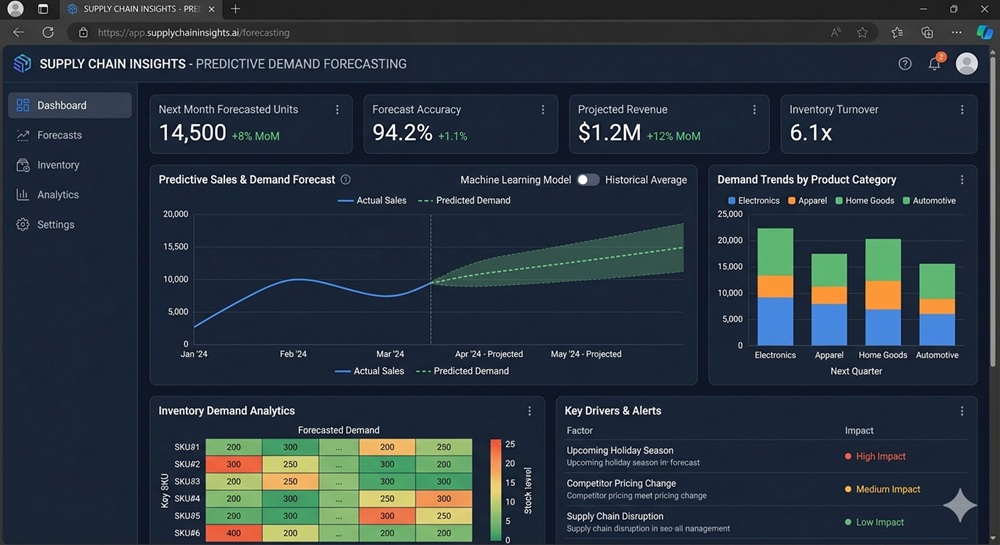
In traditional supply chains, companies often rely on manual analysis or simple spreadsheets to estimate demand. This approach is slow and often inaccurate. AI-powered forecasting systems, however, continuously analyze real-time data and update predictions automatically. This allows businesses to respond quickly to changing market conditions and customer needs.
For example, AI systems can identify patterns such as increased sales during holidays, sudden demand spikes due to promotions, or regional buying trends. Logistics managers can then adjust inventory levels, production schedules, and distribution plans accordingly. As a result, companies can avoid costly supply chain disruptions and ensure products are available when customers need them.
AI-driven predictive supply chain analytics also helps businesses make smarter purchasing decisions. Instead of ordering excessive stock to prevent shortages, companies can maintain optimal inventory levels. This reduces storage costs while still ensuring smooth operations.
Benefits
✔ Prevent stock shortages by predicting demand early
✔ Reduce overstocking and unnecessary warehouse costs
✔ Improve production planning and inventory management
✔ Enable faster decision-making using real-time insights
✔ Increase overall supply chain efficiency
Example
Retail companies widely use AI demand forecasting tools to manage seasonal demand spikes. For instance, during holiday shopping seasons, AI systems analyze previous years’ sales data, current market trends, and consumer purchasing behavior to predict product demand. Based on these insights, retailers adjust manufacturing schedules, increase inventory for high-demand products, and optimize their logistics networks to ensure faster delivery.
2. AI-Powered Route Optimization
AI-powered route optimization is a major innovation in AI-driven logistics and supply chain optimization. It uses artificial intelligence and advanced algorithms to analyze multiple real-time factors such as traffic conditions, weather updates, delivery priorities, road restrictions, and driver schedules. Based on this data, AI automatically calculates the fastest and most efficient delivery routes.
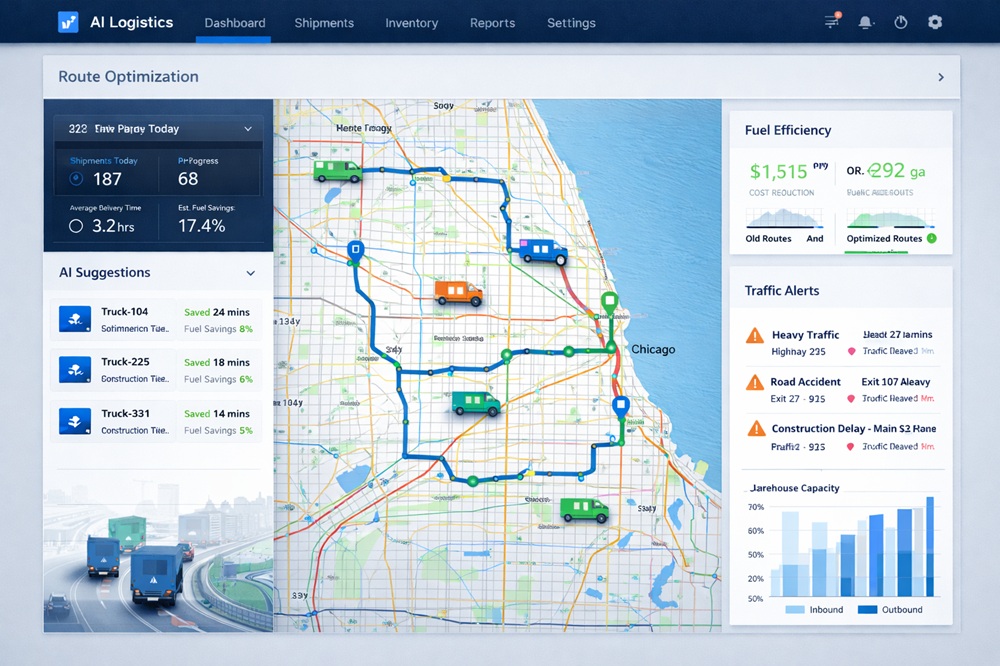
In traditional logistics systems, route planning is often done manually or with basic GPS tools. These methods cannot always respond quickly to sudden traffic jams, road closures, or weather disruptions. AI-powered systems, however, continuously analyze real-time data and instantly adjust routes when conditions change. This ensures that delivery vehicles always take the most efficient path.
AI also helps logistics companies manage large fleets more efficiently. For example, when hundreds or thousands of packages need to be delivered across multiple locations, AI systems analyze delivery addresses and automatically group them into optimized routes. This reduces unnecessary travel distances and improves overall delivery performance.
Another key advantage of smart delivery route planning is that it improves operational visibility. Logistics managers can track vehicles in real time, monitor delivery progress, and quickly respond to unexpected delays. This results in faster deliveries, lower operational costs, and improved customer satisfaction.
Benefits
✔ Reduced fuel consumption by minimizing unnecessary driving distances
✔ Faster delivery times through real-time route adjustments
✔ Lower transportation and operational costs
✔ Improved driver productivity and fleet management
✔ Better on-time delivery performance
Real-World Example
Large logistics and courier companies use AI route optimization logistics software to deliver thousands of packages every day. These AI systems analyze traffic patterns, delivery deadlines, and location clusters to determine the most efficient delivery routes. As a result, drivers can complete more deliveries in less time while reducing fuel costs and vehicle wear.
3. Intelligent Warehouse Automation
Intelligent warehouse automation is transforming how modern logistics and supply chains operate. By combining artificial intelligence, robotics, and advanced software systems, companies can automate critical warehouse tasks such as sorting products, picking items, packing orders, and tracking inventory in real time. This technology helps warehouses operate faster, more accurately, and with far less manual effort.
Traditional warehouses rely heavily on manual labor to manage inventory and process orders. This often leads to delays, human errors, and higher operational costs. With AI warehouse automation, smart systems continuously monitor warehouse operations, analyze product locations, and guide workers or robots to the exact items needed for an order. This significantly improves efficiency and reduces processing time.
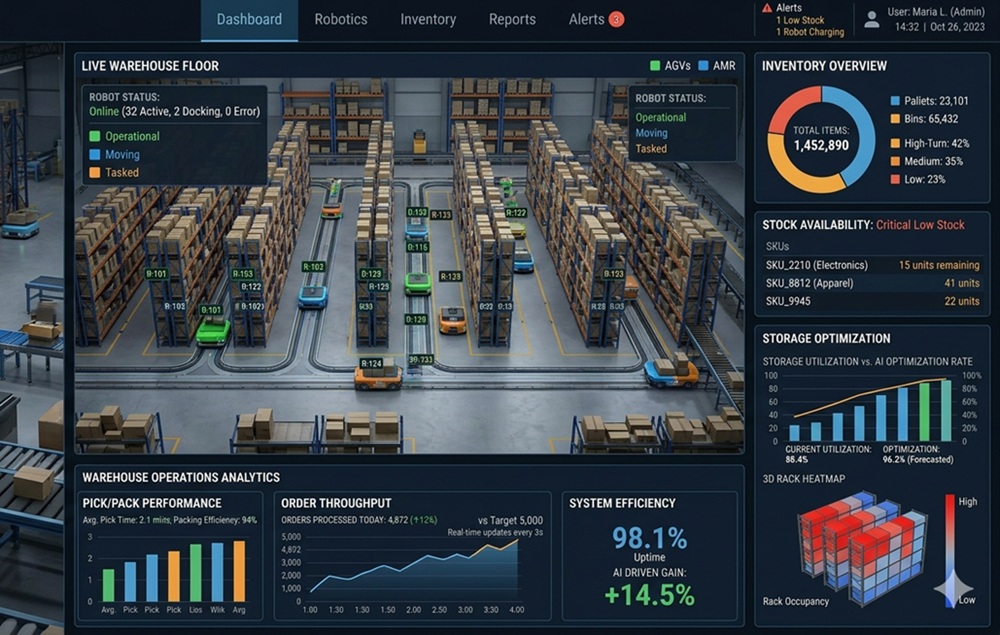
AI-powered warehouse systems also provide real-time visibility into inventory levels. Using sensors and computer vision technology, these systems can automatically detect stock levels, identify misplaced products, and alert managers when inventory needs to be replenished. As a result, businesses can avoid stockouts, reduce excess inventory, and maintain smoother operations.
Large e-commerce companies and global logistics providers are increasingly adopting smart warehouse technology to handle high volumes of orders. Automated robots move goods across warehouses, AI-powered systems optimize picking routes, and computer vision ensures accurate inventory tracking. Together, these technologies create faster and more reliable fulfillment processes.
Key Technologies
Autonomous Robots
Autonomous mobile robots move products across warehouse floors without human guidance. They transport items between storage areas, packing stations, and shipping zones, reducing the need for manual handling.
Smart Picking Systems
AI-driven picking systems guide workers or robots to the correct product locations using digital instructions, voice commands, or smart glasses. This significantly speeds up order processing and reduces picking errors.
Computer Vision Inventory Tracking
Computer vision technology uses cameras and AI algorithms to automatically identify products, track inventory movement, and monitor stock levels in real time.
Benefits
✔ Faster order fulfillment and shipping processes
✔ Reduced human errors in picking and packing
✔ Lower labor and operational costs
✔ Real-time inventory visibility
✔ Improved warehouse productivity and efficiency
4. AI-Driven Inventory Management
AI-driven inventory management plays a crucial role in modern logistics and supply chain optimization. It uses artificial intelligence and machine learning to continuously monitor stock levels, analyze purchasing patterns, and predict when products need to be restocked. This allows businesses to maintain the right inventory levels without relying on manual tracking or guesswork.
In traditional inventory systems, businesses often struggle with two major problems: stockouts and overstocking. Running out of products can lead to lost sales and unhappy customers, while storing too much inventory increases warehousing and operational costs. AI-powered systems solve this challenge by analyzing real-time inventory data, historical sales trends, supplier lead times, and seasonal demand patterns.
With smart inventory management, AI systems automatically send alerts or trigger replenishment orders when stock levels reach a predefined threshold. These systems can also recommend optimal reorder quantities based on demand predictions and supply chain conditions. This ensures that warehouses maintain the perfect balance between supply and demand.
Another major advantage of AI inventory optimization is improved warehouse efficiency. AI systems can track product movement, identify slow-moving items, and recommend better storage placement to speed up order picking and shipping processes. As a result, companies can reduce operational delays and improve overall supply chain performance.
Benefits
✔ Prevent stockouts by predicting replenishment needs early
✔ Reduce excess inventory and unnecessary storage costs
✔ Improve warehouse efficiency and product availability
✔ Enable real-time inventory visibility across the supply chain
✔ Support better purchasing and supply planning decisions
Example
Major e-commerce companies rely heavily on AI inventory management systems to maintain optimal stock levels across multiple warehouses. These systems analyze customer demand, order frequency, and regional buying trends to ensure that popular products are always available in the right locations. This helps companies deliver products faster while reducing inventory management costs.
5. Predictive Maintenance for Logistics Vehicles
Predictive maintenance is a powerful application of artificial intelligence in logistics and supply chain optimization. AI systems analyze real-time sensor data from logistics vehicles such as trucks, delivery vans, and transport equipment to detect early signs of mechanical problems. By identifying issues before they become serious failures, companies can repair vehicles at the right time and avoid unexpected breakdowns.
Modern logistics vehicles are equipped with multiple sensors that monitor engine performance, fuel usage, tire pressure, brake conditions, temperature, and vibration levels. AI systems collect and analyze this data continuously. When unusual patterns appear, the system can predict potential mechanical failures and send alerts to maintenance teams.
Unlike traditional maintenance methods that rely on fixed service schedules, AI predictive maintenance logistics focuses on the actual condition of the vehicle. This means companies only perform maintenance when it is truly needed, reducing unnecessary servicing while preventing costly breakdowns.
For logistics companies managing large fleets, this technology is extremely valuable. AI-powered fleet management systems provide real-time insights into vehicle health, allowing managers to schedule maintenance proactively. This ensures vehicles remain in optimal condition and reduces disruptions in delivery operations.
Benefits
✔ Reduced vehicle downtime and fewer unexpected breakdowns
✔ Lower maintenance and repair costs
✔ Improved fleet reliability and performance
✔ Better driver safety and operational efficiency
✔ Longer vehicle lifespan and optimized asset management
Example
Many transportation and logistics companies use AI fleet management platforms to monitor vehicle health across their entire fleet. These systems analyze sensor data from each vehicle and predict maintenance needs in advance. If a truck’s engine or brake system shows early warning signs, the system alerts managers so repairs can be scheduled before the vehicle fails on the road.
6. AI-Powered Supply Chain Risk Management
AI-powered supply chain risk management helps companies identify and manage potential disruptions before they impact operations. Modern supply chains are complex and global, which means they can be affected by many factors such as extreme weather conditions, geopolitical issues, supplier delays, transportation bottlenecks, labor shortages, or port congestion. Artificial intelligence analyzes large volumes of real-time and historical data to detect these risks early and help businesses respond quickly.
Traditional supply chain risk management often depends on manual monitoring and delayed reports. This makes it difficult for companies to react quickly when unexpected problems occur. AI systems, however, continuously monitor multiple data sources such as weather forecasts, global news, transportation data, supplier performance metrics, and logistics networks. When the system detects a potential disruption, it immediately alerts supply chain managers and suggests alternative solutions.
For example, if a major port is expected to face delays due to severe weather or political issues, AI systems can recommend alternative shipping routes or suppliers. This proactive approach helps companies minimize operational disruptions and maintain stable product flow across their supply chains.
Using predictive supply chain analytics, organizations can also simulate different risk scenarios and prepare contingency plans in advance. This improves decision-making and ensures supply chains remain resilient even during unexpected global events.
Benefits
✔ Early detection of supply chain risks and disruptions
✔ Faster and more informed decision-making
✔ Improved supply chain resilience and stability
✔ Reduced operational losses caused by delays or disruptions
✔ Better visibility across the entire supply chain network
7. Smart Demand–Supply Matching
Smart demand–supply matching is an advanced AI capability that helps companies balance product demand and supply across multiple warehouses, fulfillment centers, and distribution networks. Using artificial intelligence and real-time analytics, logistics systems analyze customer orders, regional demand patterns, inventory availability, and transportation capacity to ensure products are delivered from the most efficient location.
In traditional supply chains, companies often struggle with uneven product distribution. Some warehouses may run out of stock while others hold excess inventory. This imbalance can cause delivery delays, higher shipping costs, and inefficient resource usage. AI-powered systems solve this challenge by continuously monitoring demand across different locations and automatically adjusting supply allocation.
For example, if a particular region suddenly experiences a surge in demand, AI systems can quickly redirect inventory from nearby warehouses or distribution centers. This ensures faster deliveries and prevents stock shortages in high-demand areas. At the same time, the system avoids overloading any single warehouse by distributing orders intelligently across the network.
AI also supports intelligent logistics planning by analyzing transportation routes, delivery capacity, and warehouse workloads. This helps companies determine the best fulfillment center for each order, reducing shipping time and improving operational efficiency.
Benefits
✔ Reduced shipping delays by fulfilling orders from the closest location
✔ Optimized distribution networks and warehouse utilization
✔ Better resource allocation across supply chain operations
✔ Improved inventory balance across multiple warehouses
✔ Faster and more reliable customer deliveries
8. Autonomous Delivery and Robotics
Autonomous delivery and robotics are transforming the future of logistics and supply chain operations, especially in last-mile delivery. Artificial intelligence enables drones, autonomous vehicles, and delivery robots to transport packages without human intervention. These smart systems use AI algorithms, sensors, cameras, and GPS technology to navigate roads, avoid obstacles, and deliver packages efficiently.
Last-mile delivery is often the most expensive and complex part of the supply chain. Traffic congestion, long delivery distances, and high labor costs can slow down deliveries and increase operational expenses. AI-powered autonomous systems solve these challenges by automating the delivery process and optimizing routes in real time.
With autonomous delivery logistics, drones and robotic vehicles can deliver packages directly to customers’ locations, sometimes within minutes. AI navigation systems continuously analyze road conditions, environmental factors, and delivery routes to ensure safe and efficient transportation. This technology is especially useful for urban deliveries, remote locations, and high-demand e-commerce operations.
Large logistics and technology companies are already testing AI delivery robots and autonomous trucks to improve delivery speed and efficiency. As AI technology continues to evolve, autonomous delivery systems are expected to become a key component of future smart logistics networks.
Technologies
Autonomous Delivery Trucks
Self-driving trucks powered by AI can transport goods between warehouses and distribution centers without human drivers. These vehicles use sensors, radar, and AI decision systems to navigate roads safely.
Delivery Drones
AI-powered drones can deliver small packages quickly by flying directly to customer locations. They reduce delivery times and help avoid traffic congestion.
AI Navigation Systems
Advanced AI navigation systems analyze maps, traffic conditions, and environmental data to guide autonomous vehicles and robots through safe and efficient routes.
Benefits
✔ Faster and more efficient deliveries
✔ Reduced labor and operational costs
✔ Improved logistics scalability for high demand
✔ Ability to deliver to remote or difficult locations
✔ Enhanced efficiency in last-mile delivery operations
9. AI Chatbots for Logistics Customer Support
AI chatbots are becoming an essential part of modern logistics customer service systems. These intelligent virtual assistants use artificial intelligence and natural language processing (NLP) to interact with customers, answer questions, and provide instant support related to shipments, delivery schedules, order tracking, and service issues.
In traditional logistics operations, customer support teams often receive a high volume of queries about shipment status, delivery delays, or order updates. Handling these requests manually can be time-consuming and expensive. AI chatbot solutions help automate this process by instantly responding to common customer questions through websites, mobile apps, and messaging platforms.
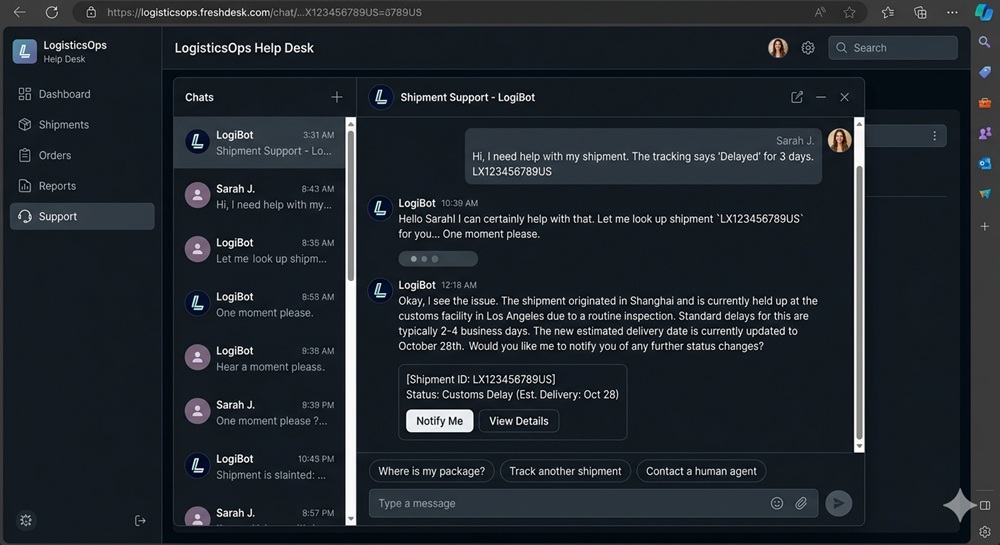
For example, when a customer asks about the status of a shipment, the chatbot can instantly access the logistics system, retrieve tracking information, and provide real-time updates. It can also notify customers about delivery schedules, potential delays, or changes in shipment status.
Advanced AI chatbots can handle multiple conversations at the same time, learn from previous interactions, and continuously improve their responses. This ensures faster service, reduced waiting times, and improved customer satisfaction.
Many logistics companies are now integrating AI customer service logistics platforms into their customer support systems to streamline communication and reduce operational costs while maintaining high-quality service.
Benefits
✔ 24/7 customer support without human intervention
✔ Faster responses to shipment and delivery queries
✔ Reduced operational and support costs
✔ Improved customer satisfaction and experience
✔ Ability to handle thousands of customer requests simultaneously
10. Real-Time Supply Chain Visibility
Real-time supply chain visibility is one of the most important applications of artificial intelligence in modern logistics. AI systems integrate and analyze data from multiple sources such as transportation systems, warehouse management platforms, IoT sensors, GPS tracking devices, and inventory databases. By combining this information, companies can monitor shipments, inventory levels, and delivery progress in real time across the entire supply chain.
In traditional logistics operations, businesses often face delays because they lack clear visibility into where their products are located at any given moment. AI-powered real-time supply chain visibility solves this problem by providing a centralized dashboard that continuously tracks the movement of goods from suppliers to warehouses and finally to customers.
Using AI shipment tracking, logistics managers can quickly identify potential issues such as shipment delays, route disruptions, or inventory shortages. The system automatically sends alerts and provides recommended actions, allowing businesses to respond immediately and minimize operational disruptions.
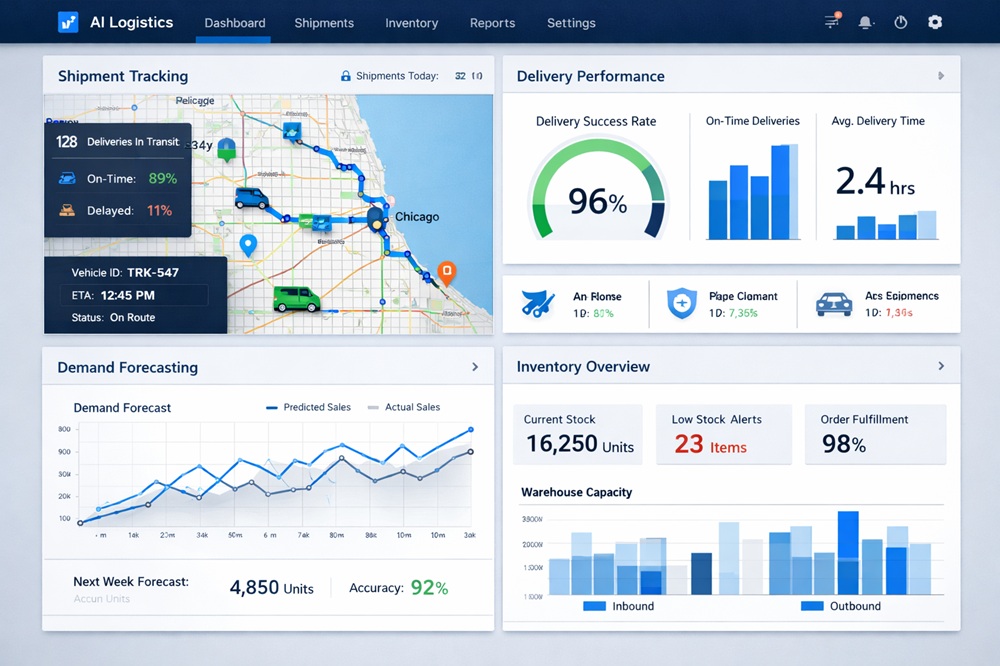
Real-time visibility also improves collaboration between suppliers, logistics providers, and customers. With accurate and up-to-date data available at every stage of the supply chain, companies can make faster and more informed decisions, ensuring smoother operations and better customer experiences.
Benefits
✔ End-to-end supply chain transparency and tracking
✔ Improved and data-driven decision making
✔ Faster response to disruptions and delays
✔ Better coordination between logistics partners
✔ Enhanced delivery accuracy and customer satisfaction
Real-World Examples of AI in Logistics
Artificial intelligence is no longer just a concept in logistics—it is actively transforming how global logistics companies manage transportation, warehouses, deliveries, and supply chain operations. Leading logistics organizations are investing heavily in AI technologies to improve efficiency, reduce costs, and deliver faster services to customers. Below are some real-world examples of how major companies are successfully implementing AI in logistics.
1. Amazon – AI-Powered Warehouse Automation
Amazon is one of the most advanced companies using AI in logistics. Its fulfillment centers use thousands of AI-powered robots that automatically move products across warehouses. These robots help employees locate items quickly, reducing the time required for order picking and packing.
AI systems also analyze customer purchasing patterns and predict demand in different regions. This allows Amazon to position products in the right warehouses before customers even place orders, enabling extremely fast delivery services like same-day and next-day shipping.
2. DHL – AI for Smart Logistics and Route Optimization
DHL uses artificial intelligence to optimize delivery routes and improve warehouse efficiency. The company applies AI algorithms to analyze traffic patterns, delivery schedules, and transportation data to determine the most efficient routes for drivers.
DHL also uses AI-powered smart glasses and computer vision systems in warehouses to help workers identify products faster and reduce picking errors. These technologies increase productivity and improve overall supply chain efficiency.
3. UPS – AI Route Optimization System
UPS developed an advanced AI system called ORION (On-Road Integrated Optimization and Navigation). This technology analyzes millions of delivery routes every day and determines the most efficient paths for drivers.
The system helps UPS reduce fuel consumption, shorten delivery times, and minimize unnecessary driving distance. As a result, the company saves millions of gallons of fuel each year and significantly lowers operational costs.
4. FedEx – AI for Predictive Analytics and Shipment Tracking
FedEx uses artificial intelligence and predictive analytics to improve shipment tracking and delivery accuracy. AI systems monitor packages in real time and analyze data from transportation networks, weather forecasts, and logistics hubs.
If the system predicts potential delivery delays, it automatically suggests alternative routes or operational adjustments. This ensures that packages reach customers as quickly and efficiently as possible.
5. Maersk – AI for Global Supply Chain Optimization
Maersk, one of the world’s largest shipping and logistics companies, uses AI to manage global shipping operations. The company applies machine learning models to analyze shipping demand, optimize container routes, and improve port operations.
AI systems also help predict supply chain disruptions such as port congestion or shipping delays. This allows Maersk to adjust schedules and routes in advance, improving reliability for global trade operations.
Why These Examples Matter
These real-world implementations show how AI is transforming logistics operations worldwide. Companies using AI technologies can:
✔ Deliver packages faster
✔ Reduce operational and fuel costs
✔ Improve warehouse productivity
✔ Increase supply chain visibility
✔ Provide better customer experiences
As AI continues to evolve, more logistics companies will adopt intelligent technologies to build smarter, faster, and more efficient supply chain networks.
Industries Using AI in Logistics and Supply Chain
Artificial intelligence is rapidly transforming logistics operations across many industries. Businesses today manage complex global supply chains that require faster deliveries, accurate inventory management, and real-time decision-making. AI technologies help companies automate operations, predict demand, optimize transportation routes, and improve supply chain efficiency.
Different industries adopt AI in logistics and supply chain management to solve specific operational challenges. From e-commerce deliveries to healthcare supply chains, AI helps organizations improve productivity, reduce costs, and ensure faster product movement.
Below are some major industries where AI is playing a significant role in logistics optimization.
1. E-commerce
The e-commerce industry relies heavily on efficient logistics to deliver products quickly to customers. AI helps online retailers analyze customer behavior, forecast demand, and optimize warehouse operations.
For example, companies like Amazon use AI-powered systems to predict which products will be in demand in different regions. These systems automatically place inventory in nearby warehouses before customers even place orders. AI also powers warehouse robots, route optimization tools, and smart delivery systems to enable faster shipping and same-day deliveries.
How AI improves efficiency in e-commerce
✔ Predicts customer demand and seasonal buying patterns
✔ Automates warehouse picking, sorting, and packing
✔ Optimizes delivery routes for faster shipments
✔ Improves real-time order tracking and customer experience
2. Retail
Retail businesses use AI-driven logistics solutions to manage inventory across multiple stores, warehouses, and distribution centers. AI systems analyze sales trends, seasonal demand, and supply chain performance to maintain the right stock levels.
For instance, global retailers like Walmart use AI-powered inventory management systems that monitor product availability in real time. These systems automatically recommend restocking when inventory levels drop and help retailers distribute products efficiently across store locations.
How AI improves efficiency in retail
✔ Prevents stockouts and overstocking
✔ Improves store-level inventory planning
✔ Optimizes warehouse and distribution operations
✔ Enhances demand forecasting and supply planning
3. Manufacturing
Manufacturing companies use AI to manage raw material supply, production schedules, and global distribution networks. AI-powered supply chain systems analyze production data, supplier performance, and transportation conditions to ensure smooth manufacturing operations.
For example, automotive manufacturers such as Tesla use AI to coordinate global supply chains and manage component deliveries. AI helps ensure that manufacturing plants receive materials at the right time, preventing production delays.
How AI improves efficiency in manufacturing
✔ Predicts raw material demand and supplier performance
✔ Optimizes production planning and distribution schedules
✔ Reduces supply chain disruptions and delays
✔ Improves coordination between suppliers and factories
4. Healthcare Logistics
Healthcare logistics requires highly accurate and reliable supply chain management. Hospitals, pharmacies, and medical suppliers must ensure that critical medical products, vaccines, and medicines are delivered quickly and safely.
Organizations like World Health Organization and pharmaceutical companies use AI systems to monitor vaccine distribution and track medical shipments in real time. AI-powered logistics platforms help ensure temperature-controlled transportation and accurate delivery of sensitive medical supplies.
How AI improves efficiency in healthcare logistics
✔ Real-time tracking of medical supplies and pharmaceuticals
✔ Improved vaccine and medicine distribution planning
✔ Reduced risk of supply shortages in hospitals
✔ Better cold chain management for temperature-sensitive products
5. Food and Beverage Supply Chains
The food and beverage industry relies on fast and efficient logistics to maintain product freshness and prevent spoilage. AI systems help companies manage perishable goods by predicting demand, optimizing delivery routes, and monitoring storage conditions.
Companies like Nestlé use AI-powered supply chain analytics to track food products across global distribution networks. AI systems monitor temperature, humidity, and transportation conditions to ensure that food products remain safe and fresh during delivery.
How AI improves efficiency in food supply chains
✔ Predicts demand for perishable food products
✔ Reduces food waste through better inventory planning
✔ Optimizes transportation and cold chain logistics
✔ Ensures product quality and safety during delivery
Future of AI in Logistics and Supply Chain
The future of AI in logistics and supply chain management looks extremely promising. As global trade grows and customer expectations for faster delivery increase, companies are turning to artificial intelligence to build smarter, faster, and more resilient supply chains. AI technologies will continue to automate complex logistics operations, improve decision-making, and provide real-time insights across the entire supply chain network.
In the coming years, AI will not only optimize existing logistics processes but will also introduce completely new ways of managing transportation, warehousing, inventory, and deliveries. Businesses that adopt AI early will gain a strong competitive advantage by reducing costs, improving operational efficiency, and delivering better customer experiences.
Below are some key trends shaping the future of AI in logistics and supply chain optimization.
1. Fully Autonomous Supply Chains
Future supply chains will become highly automated with minimal human intervention. AI systems will coordinate warehouses, transportation networks, and distribution centers automatically. Autonomous trucks, warehouse robots, and AI-driven decision systems will manage logistics operations more efficiently than traditional manual processes.
2. AI-Powered Predictive and Prescriptive Analytics
AI will move beyond simple predictions to provide prescriptive analytics, which means systems will not only identify problems but also recommend the best solutions. For example, if a shipment delay is predicted, AI systems will automatically suggest alternative routes, suppliers, or transportation methods.
3. Hyper-Automated Smart Warehouses
Warehouses will become smarter with advanced robotics, AI vision systems, and IoT-connected devices. Autonomous robots will handle sorting, picking, packing, and inventory tracking with greater accuracy and speed. These AI-powered smart warehouses will significantly increase order fulfillment efficiency.
4. Expansion of Autonomous Delivery Systems
Autonomous delivery technologies such as self-driving trucks, delivery drones, and AI-powered robots will play a major role in last-mile logistics. These technologies will help companies deliver packages faster while reducing labor and transportation costs.
5. Real-Time Global Supply Chain Visibility
Future AI systems will provide complete visibility across global supply chains. Businesses will be able to track shipments, inventory, and supplier performance in real time. This will help companies quickly respond to disruptions such as port congestion, weather issues, or transportation delays.
6. Sustainable and Green Logistics
AI will also support sustainability goals by optimizing transportation routes, reducing fuel consumption, and improving warehouse energy efficiency. Smart logistics systems will help companies lower carbon emissions and build environmentally friendly supply chain operations.
7. AI + IoT Integration for Smart Logistics
The combination of Artificial Intelligence and the Internet of Things (IoT) will create fully connected logistics networks. Sensors, GPS devices, and smart equipment will continuously send data to AI systems, enabling real-time monitoring and automated decision-making across the supply chain.
Why the Future of AI in Logistics Matters
AI will redefine how goods move across global supply chains. Companies that adopt AI-powered logistics solutions will benefit from:
✔ Faster and more reliable deliveries
✔ Lower operational and transportation costs
✔ Improved supply chain resilience
✔ Better customer satisfaction
✔ Smarter data-driven decision making
As artificial intelligence continues to evolve, logistics companies will move toward fully intelligent supply chains that are automated, predictive, and highly efficient. AI will become the backbone of modern logistics operations, enabling businesses to manage complex global supply networks with greater speed, accuracy, and reliability.
How Businesses Can Implement AI in Their Supply Chain
Implementing AI in supply chain management requires a strategic and structured approach. Businesses must first understand their logistics challenges, organize their operational data, and gradually introduce AI-powered technologies that can automate and optimize supply chain processes.
Companies across industries are adopting AI to improve forecasting accuracy, automate warehouse operations, optimize transportation routes, and enhance supply chain visibility. However, successful AI adoption requires proper planning, the right technology, and trained teams.
Below are the key steps businesses should follow to successfully implement AI-powered supply chain solutions.
1. Identify Operational Challenges
The first step in implementing AI in logistics is to clearly identify the major operational challenges within the supply chain. Businesses should analyze areas where inefficiencies occur, such as demand forecasting errors, inventory shortages, delayed deliveries, or warehouse bottlenecks.
By understanding these pain points, companies can determine where AI technologies will have the greatest impact. For example, if delivery delays are a major issue, AI route optimization systems can significantly improve transportation efficiency.
Examples of common logistics challenges
✔ Inaccurate demand forecasting
✔ Poor inventory management
✔ Transportation inefficiencies
✔ Lack of supply chain visibility
✔ High operational costs
2. Collect and Organize Supply Chain Data
Artificial intelligence relies heavily on high-quality data. Businesses must collect and organize supply chain data from different systems such as inventory databases, warehouse management systems, transportation management platforms, and sales records.
Clean and well-structured data allows AI systems to analyze patterns, detect inefficiencies, and generate accurate predictions. Companies should also integrate data from multiple departments to create a unified supply chain data platform.
Important data sources for AI logistics systems
✔ Sales and order history
✔ Inventory and warehouse data
✔ Transportation and delivery records
✔ Supplier performance data
✔ Customer demand patterns
3. Implement AI-Powered Logistics Software
Once the data infrastructure is ready, businesses can start implementing AI-powered logistics software. These platforms use machine learning algorithms to automate supply chain operations and provide real-time insights.
Common AI logistics technologies include:
• AI demand forecasting tools
• AI route optimization software
• Intelligent warehouse management systems
• AI inventory optimization platforms
• Real-time shipment tracking systems
These tools help organizations make faster decisions and significantly improve supply chain performance.
4. Train Teams for AI-Driven Operations
Technology alone is not enough for successful AI adoption. Employees must understand how to work with AI systems and interpret the insights they generate.
Companies should invest in training programs to help logistics managers, warehouse staff, and supply chain analysts learn how to use AI-powered platforms effectively. This ensures smooth adoption and maximizes the value of AI technologies.
Key training areas
✔ Understanding AI-powered dashboards and analytics
✔ Using automated logistics tools
✔ Interpreting predictive insights for decision-making
✔ Managing AI-enabled warehouse and transportation systems
5. Monitor and Optimize Performance Continuously
AI implementation is an ongoing process. After deploying AI systems, businesses should continuously monitor performance and analyze results to identify improvement opportunities.
AI platforms often provide dashboards that track key supply chain metrics such as delivery times, inventory turnover, warehouse productivity, and transportation costs. Businesses can use these insights to refine strategies and optimize operations over time.
Continuous monitoring ensures that AI systems keep improving and adapting to changing market conditions.
Why Choose Cor Advance Solutions for AI Logistics Solutions
Choosing the right technology partner is essential when implementing AI in logistics and supply chain management. Businesses need a company that not only understands advanced AI technologies but also has deep knowledge of real-world logistics challenges. Cor Advance Solutions helps organizations transform traditional supply chains into intelligent, data-driven logistics systems that improve efficiency, visibility, and scalability.
With strong expertise in AI-powered software development and digital transformation, the company delivers advanced logistics solutions designed to optimize supply chain performance, reduce operational costs, and improve decision-making.
Below are some key reasons why businesses trust Cor Advance Solutions for AI logistics solutions.
AI-Driven Logistics Software Expertise
Cor Advance Solutions specializes in building AI-powered logistics software that helps businesses automate complex supply chain operations. Their technology solutions integrate artificial intelligence, machine learning, and real-time analytics to improve demand forecasting, route optimization, inventory management, and warehouse automation.
By leveraging intelligent algorithms and advanced data analytics, the company develops solutions that enable organizations to make faster and smarter logistics decisions.
Scalable Supply Chain Solutions
Modern businesses require logistics systems that can scale as operations grow. Cor Advance Solutions designs scalable supply chain solutions that support expanding logistics networks, growing order volumes, and multi-location distribution systems.
Whether a company manages regional distribution or global supply chains, these AI-driven platforms can adapt to increasing operational complexity while maintaining high efficiency and performance.
Data-Driven Optimization Strategies
One of the biggest advantages of AI in logistics is the ability to make decisions based on data rather than assumptions. Cor Advance Solutions uses advanced data analytics and machine learning models to analyze logistics data, identify inefficiencies, and optimize supply chain performance.
These data-driven optimization strategies help businesses improve delivery speed, reduce transportation costs, maintain optimal inventory levels, and increase overall operational efficiency.
Industry Experience and Proven Results
With extensive experience in building enterprise software solutions, Cor Advance Solutions understands the operational challenges faced by logistics companies, manufacturers, retailers, and e-commerce businesses.
Their proven development expertise and deep understanding of AI technologies enable them to deliver reliable logistics solutions that drive measurable business results. From improving warehouse productivity to optimizing transportation networks, the company focuses on creating solutions that generate real value for businesses.
Trusted Technology Partner for Smart Logistics
Organizations looking to modernize their supply chains need a trusted technology partner capable of delivering innovative AI solutions. By combining AI-driven logistics expertise, scalable technology architecture, and data-focused strategies, Cor Advance Solutions helps businesses build smarter, faster, and more resilient supply chain systems.
As logistics continues to evolve with artificial intelligence, companies that partner with experienced technology providers like Cor Advance Solutions will be better positioned to stay competitive and lead in the digital supply chain era.
FAQ
What is AI in logistics and supply chain management?
AI in logistics and supply chain management refers to the use of artificial intelligence technologies such as machine learning, predictive analytics, and automation to improve how goods are planned, stored, transported, and delivered. AI analyzes large amounts of supply chain data to predict demand, optimize routes, and automate repetitive tasks. This helps companies make faster and smarter decisions. As a result, businesses can reduce costs, improve delivery speed, and increase operational efficiency.
How is artificial intelligence transforming the logistics industry?
Artificial intelligence is transforming the logistics industry by automating operations, improving decision-making, and enabling real-time supply chain visibility. AI systems analyze data from shipments, warehouses, traffic, and weather to optimize logistics operations. Companies can predict delays, reduce transportation costs, and improve delivery accuracy. This technology allows logistics companies to operate faster, smarter, and more efficiently in a highly competitive market.
Why is AI important for modern supply chain operations?
AI is important for modern supply chain operations because it enables businesses to manage complex logistics networks with greater accuracy and efficiency. AI tools analyze real-time data, predict demand fluctuations, and automate supply chain planning. This reduces manual errors and improves decision-making. As supply chains become more global and complex, AI helps companies stay competitive by improving speed, transparency, and reliability.
What are the main benefits of using AI in logistics?
The main benefits of using AI in logistics include improved demand forecasting, optimized delivery routes, reduced operational costs, and faster order fulfillment. AI also enhances warehouse automation and improves supply chain visibility. By analyzing real-time logistics data, AI helps companies make smarter decisions and avoid disruptions. These benefits lead to higher efficiency, better customer satisfaction, and more reliable supply chain operations.
How does AI improve supply chain efficiency?
AI improves supply chain efficiency by analyzing large datasets to identify patterns, predict demand, and optimize logistics processes. It automates inventory management, route planning, and warehouse operations. AI also detects potential disruptions before they occur, allowing companies to take preventive actions. This results in faster deliveries, reduced waste, and improved coordination across the entire supply chain network.
What challenges can AI solve in supply chain management?
AI can solve many common supply chain challenges, including inaccurate demand forecasting, delivery delays, inventory shortages, and inefficient transportation planning. By analyzing historical and real-time data, AI helps businesses predict problems and respond quickly. It also improves supply chain visibility and risk management. As a result, companies can maintain smoother operations and reduce costly disruptions.
How does AI improve demand forecasting in supply chains?
AI improves demand forecasting by analyzing historical sales data, market trends, seasonal patterns, and customer behavior. Machine learning algorithms identify patterns that traditional forecasting methods may miss. This allows businesses to predict future demand more accurately. Better forecasting helps companies maintain optimal inventory levels, reduce stockouts, and prevent overstocking.
What is AI-powered route optimization in logistics?
AI-powered route optimization uses artificial intelligence to determine the most efficient delivery routes for transportation and logistics operations. The system analyzes factors such as traffic conditions, weather, delivery schedules, and fuel consumption. Based on this data, AI recommends the fastest and most cost-effective routes. This helps logistics companies reduce delivery time and transportation costs.
How does AI help optimize delivery routes?
AI helps optimize delivery routes by analyzing real-time traffic data, road conditions, and delivery priorities. Machine learning algorithms continuously update route recommendations to avoid congestion and delays. This enables logistics companies to deliver packages faster while reducing fuel consumption. As a result, businesses can improve delivery reliability and lower operational costs.
How do AI chatbots help logistics companies?
AI chatbots help logistics companies improve customer service by providing instant responses to customer queries. They can track shipments, provide delivery updates, and answer common logistics questions 24/7. This reduces the workload on customer support teams and improves response time. AI chatbots also enhance the overall customer experience by providing quick and accurate information.
What is the future of AI in logistics and supply chains?
The future of AI in logistics and supply chains is expected to include smarter automation, autonomous delivery systems, predictive supply chain planning, and intelligent warehouses. AI will enable companies to build highly efficient and resilient logistics networks. Emerging technologies like robotics, IoT, and AI analytics will work together to improve supply chain visibility and efficiency. This transformation will make logistics faster, more reliable, and more cost-effective.
How do companies choose the right AI logistics solutions provider?
Companies choose the right AI logistics solutions provider by evaluating their industry experience, technology expertise, and ability to deliver scalable solutions. Businesses should look for providers with strong data analytics capabilities and proven logistics AI implementations. It is also important to consider integration with existing systems and long-term support. Selecting the right AI partner ensures successful digital transformation and improved supply chain performance.
Conclusion
Artificial intelligence is transforming the way modern supply chains operate. By integrating AI-driven technologies into logistics operations, businesses can automate complex processes, gain real-time visibility, and make smarter data-driven decisions. From predictive demand forecasting and route optimization to intelligent warehouse automation and real-time shipment tracking, AI enables companies to build faster, more efficient, and highly responsive supply chain networks.
Organizations that adopt AI-powered logistics solutions can significantly improve operational efficiency, reduce transportation and inventory costs, and enhance customer satisfaction through faster and more reliable deliveries. AI also helps businesses anticipate disruptions, optimize resources, and continuously improve supply chain performance using advanced analytics.
As global supply chains become more complex and customer expectations continue to rise, businesses must embrace artificial intelligence to remain competitive. Companies that invest in AI-enabled logistics technologies today will be better positioned to drive innovation, scale operations efficiently, and achieve long-term success in the rapidly evolving logistics and supply chain landscape.