
In today’s digital age, data is the most valuable asset for any business. Making informed decisions relies heavily on how effectively companies can collect, store, and analyse their data. This growing need has given rise to cloud data platforms that simplify complex processes, offering powerful tools for data analytics and business insights. Among these platforms, Snowflake and Databricks stand out as leaders, each catering to different business requirements.
Snowflake is widely recognised as a robust data warehouse solution, ideal for structured data storage, reporting, and seamless integration with analytics tools. It simplifies tasks like ETL vs ELT processes and allows businesses to scale their storage without affecting performance. On the other hand, Databricks excels in big data processing and real-time data processing, making it a preferred choice for organisations working with unstructured data, advanced analytics, or machine learning workflows.

Choosing between Snowflake vs Databricks ultimately depends on your business goals, scalability needs, and budget. Whether you are looking for a reliable data engineering platform, advanced cloud analytics tools, or solutions tailored for business data solutions, understanding the strengths of each platform will help you make an informed, strategic decision.
What is Snowflake?
Snowflake is a leading cloud data warehouse platform designed to help businesses store, manage, and analyze large volumes of data with ease. Unlike traditional data warehouses, Snowflake is fully cloud-native, meaning it runs entirely on cloud infrastructure and requires no on-premises hardware. Its key strengths include scalability, simplicity, and multi-cloud support, working seamlessly on AWS, Microsoft Azure, and Google Cloud Platform (GCP).
Snowflake is ideal for data warehousing, business intelligence, and analytics. Companies use it to centralize data from multiple sources, generate actionable insights, and support data-driven decision-making. Its ability to handle structured and semi-structured data makes it a versatile choice for businesses of all sizes.

Key Features of Snowflake
- Cloud-native architecture – Built specifically for the cloud, Snowflake separates storage and compute, allowing businesses to scale resources independently.
- Automatic scaling and elasticity – Snowflake automatically adjusts compute resources based on workload, ensuring consistent performance without manual intervention.
- Secure data sharing capabilities – Users can safely share data across departments, partners, or clients without creating duplicate copies.
- SQL support for queries – Snowflake supports standard SQL, making it easy for data analysts and engineers to query data efficiently.
- Time Travel and zero-copy cloning – These features allow users to access historical data, restore deleted records, and create clones of databases instantly without extra storage costs.
Pros & Cons of Snowflake
Pros:
- Quick and easy setup with minimal IT overhead
- Strong support for analytics and reporting tools
- Flexible multi-cloud deployment options
Cons:
- Limited built-in AI/ML integration compared to platforms like Databricks
- Costs can increase significantly with high query volumes or frequent scaling
What is Databricks?
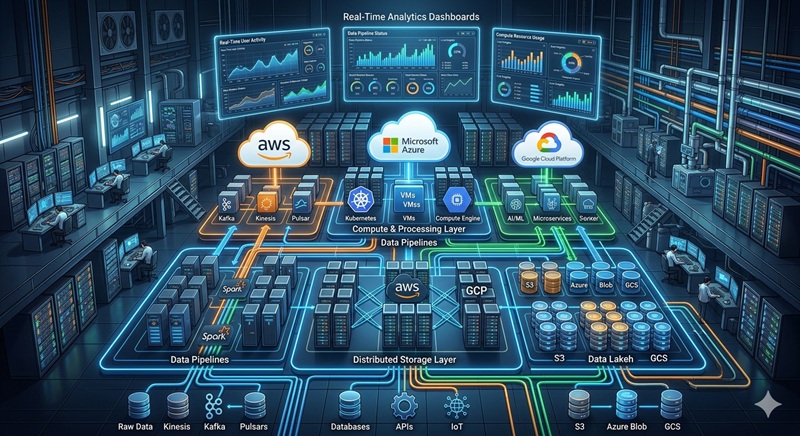
Databricks is a unified analytics and data engineering platform built on Apache Spark, designed to help businesses process large volumes of data efficiently. Unlike traditional data warehouses, Databricks focuses on big data processing, machine learning (ML), and artificial intelligence (AI), making it an ideal choice for organisations that want to leverage advanced analytics.
Databricks allows companies to build data lakes, run real-time analytics, and develop predictive models. Its collaborative environment supports data engineers, analysts, and scientists working together, enabling faster insights and smarter decision-making. Common use cases include machine learning projects, building reliable data pipelines, and analysing both structured and unstructured data at scale.
Key Features of Databricks
- Apache Spark-based scalable architecture – Databricks leverages Spark to handle large datasets efficiently, providing high-speed processing for complex queries.
- Delta Lake for reliable data pipelines – Ensures data quality and consistency while allowing incremental updates, making pipelines more dependable.
- Collaborative notebooks for data science – Teams can write, share, and execute code in a single workspace, improving collaboration and productivity.
- Machine Learning & AI integration – Supports building, training, and deploying ML models directly on the platform, with prebuilt AI tools and frameworks.
- Real-time analytics support – Enables businesses to analyse streaming data and make instant decisions, which is critical for fast-moving industries.
Pros & Cons of Databricks
Pros:
- Advanced capabilities for AI and machine learning projects
- High-speed analytics and flexible data processing
- Scalable architecture suitable for big data environments
Cons:
- Steeper learning curve for beginners and small teams
- Higher costs compared to traditional cloud data platforms, especially for smaller workloads
Snowflake vs Databricks: Key Differences
Choosing the right cloud data platform is crucial for businesses looking to harness the power of their data. Snowflake vs Databricks comparison highlights how each platform caters to different needs, depending on use cases, architecture, performance, and AI/ML requirements. Understanding these differences can help organisations make informed decisions.
| Feature | Snowflake | Databricks | Best For |
| Primary Use Case | Data warehousing & analytics | Big data & ML pipelines | Depends on business needs |
| Architecture | Cloud-native, multi-cluster | Apache Spark, Delta Lake | Data engineering & analytics |
| Data Storage | Structured & semi-structured | Structured, semi-structured, and unstructured | Large-scale ML projects |
| Performance & Scalability | Auto-scaling compute & storage | High-speed distributed computing | High-volume real-time data |
| Pricing | Pay-per-use compute & storage | Subscription-based with compute scaling | Based on query volume vs ML workloads |
| Ease of Use | SQL-friendly, low learning curve | Requires Spark/technical expertise | Team skill-dependent |
| AI & ML Support | Limited | Extensive | AI-focused workflows |
Use Cases & Architecture
Snowflake is best suited for companies focused on data warehousing and business analytics. Its cloud-native architecture separates storage and compute, enabling automatic scaling without downtime. For example, companies like Adobe and Capital One use Snowflake to centralize their structured data and streamline reporting.
Databricks, on the other hand, is designed for big data processing and AI/ML workflows. Built on Apache Spark with Delta Lake, it supports large-scale, real-time analytics and machine learning pipelines. Firms like Shell and HSBC leverage Databricks for advanced predictive analytics and streaming data projects.
Performance & Scalability
Snowflake provides auto-scaling compute and storage, making it ideal for fluctuating workloads without manual intervention. Databricks delivers high-speed distributed computing, which is perfect for massive datasets or real-time processing where latency matters.
Pricing & Ease of Use
Snowflake uses a pay-per-use model, which can be cost-efficient for analytics-heavy workloads but may grow with frequent queries. Databricks offers subscription-based pricing with compute scaling, which benefits AI-heavy operations but may be expensive for small teams. Snowflake is more SQL-friendly, whereas Databricks requires Spark or technical expertise, making the choice skill-dependent.
AI & ML Capabilities
When it comes to AI and ML, Databricks clearly leads. It provides built-in tools for machine learning, AI integration, and predictive analytics, whereas Snowflake’s support is limited to external ML tools.
In summary, choosing Snowflake or Databricks depends on your business priorities. For structured analytics and easy-to-use SQL queries, Snowflake is ideal. For advanced AI/ML and big data projects, Databricks is the better choice.
Use Case Scenarios: Which Platform Should Your Business Choose?
Choosing the right cloud data platform depends on your business size, data needs, and future growth plans. Here, we break down typical use case scenarios to help you decide whether Snowflake, Databricks, or a hybrid approach fits your organisation best.
Scenario 1: SMB Focused on Analytics – Snowflake Preferred
For small and medium-sized businesses (SMBs) focused primarily on data analytics and reporting, Snowflake is the ideal choice. Its SQL-friendly interface, easy setup, and cloud-native architecture make it simple for teams to centralize data, run queries, and generate actionable insights without a steep learning curve. Snowflake’s pay-per-use pricing is also attractive for SMBs with moderate workloads.
Example: A growing e-commerce startup can use Snowflake to consolidate sales, marketing, and customer data for business intelligence dashboards and trend analysis.
Scenario 2: Enterprise Needing AI/ML – Databricks Preferred
Large enterprises that rely heavily on AI, machine learning, and big data processing will benefit more from Databricks. Its Apache Spark-based architecture and Delta Lake allow handling of structured, semi-structured, and unstructured data at scale. Databricks also supports real-time analytics, predictive modelling, and collaborative notebooks for data science teams.
Example: A financial institution like a bank can use Databricks to run risk assessment models, fraud detection algorithms, and real-time customer analytics across multiple departments.
Scenario 3: Mixed Workloads with Structured & Unstructured Data – Hybrid Approach
Some businesses have diverse workloads, needing both analytics for structured data and ML/AI processing for unstructured data. In such cases, a hybrid approach using Snowflake for warehousing and Databricks for AI/ML can deliver the best results. This strategy ensures cost efficiency while leveraging the strengths of both platforms.
Example: A media company might store content metadata and user behavior in Snowflake for analytics, while using Databricks to run recommendation engines and video content analysis.
Suitability by Business Size, Industry, and Workload
| Business Size | Best Platform | Workload Type | Industry Examples |
| SMB | Snowflake | Analytics-heavy | Retail, E-commerce |
| Enterprise | Databricks | AI/ML & real-time data | Finance, Healthcare |
| Mixed | Hybrid | Structured & unstructured | Media, Manufacturing |
By evaluating Snowflake use cases, Databricks use cases, and your business requirements, you can select the best data platform for business success, ensuring faster insights, scalability, and smarter decision-making.
Pricing Comparison: Snowflake vs Databricks
Understanding Snowflake pricing and Databricks pricing is essential for businesses looking to balance performance with cost efficiency.
Snowflake uses a pay-per-use model based on compute and storage. You are billed for the exact time your queries run, measured in seconds, along with the amount of data stored. This model allows automatic scaling of compute resources, so you only pay for what you use, making it ideal for analytics-heavy workloads and SMBs that want predictable spending.
Databricks, in contrast, charges based on compute clusters and workspace subscriptions. Costs depend on the size of the cluster, runtime hours, and the number of users accessing the workspace. For businesses running AI/ML workflows or processing big data pipelines, expenses can rise quickly due to high compute demand and long-running jobs.
Several factors influence costs on both platforms:
- Workload type – Real-time processing and heavy ML models increase usage.
- Storage needs – More data storage results in higher charges.
- Query frequency – Frequent or complex queries can drive up Snowflake costs.
- AI/ML usage – Extensive machine learning tasks on Databricks require larger clusters and more runtime.
Cost optimisation tips: SMBs should leverage Snowflake’s per-second billing and pause unused clusters. Enterprises using Databricks can optimise by scheduling compute clusters during peak workloads only and using spot instances when possible.
By understanding the pricing structure of Snowflake vs Databricks, businesses can make strategic choices, control costs, and ensure they get maximum value from their cloud data platforms.
Integration & Ecosystem
A strong integration ecosystem is crucial for maximizing the value of any cloud data platform. Both Snowflake and Databricks offer extensive integrations, but they cater to different needs depending on your business goals and workflows.
Snowflake integrations focus on business intelligence (BI) and ETL workflows. It connects seamlessly with popular BI tools like Tableau and Power BI, allowing users to create interactive dashboards and visual reports with minimal setup. For data ingestion and transformation, Snowflake integrates with ETL tools such as Fivetran and Talend, enabling smooth movement of structured and semi-structured data from multiple sources. These integrations make Snowflake a powerful choice for companies aiming to simplify analytics and reporting.
Databricks integrations cater to machine learning, AI, and big data pipelines. It works with major ML libraries like TensorFlow and PyTorch, allowing data scientists to build and deploy models directly on the platform. Databricks also integrates with data lakes and cloud storage solutions, supporting advanced AI pipelines and real-time analytics for unstructured and streaming data. This makes it ideal for enterprises focused on predictive analytics, AI applications, and large-scale data processing.
Why integrations matter: In a modern data strategy, the ability to connect your cloud platform with other tools and workflows is critical. Proper integration ensures data consistency, faster insights, and seamless collaboration across teams. Whether your focus is business intelligence, machine learning, or a hybrid approach, understanding the ecosystem around your platform can significantly impact efficiency and ROI.
In summary, leveraging Snowflake integrations or Databricks integrations allows businesses to unlock the full potential of their cloud data platform ecosystem, streamline workflows, and accelerate data-driven decision-making.
Security & Compliance
Security is a top priority when choosing a cloud data platform, as businesses need to protect sensitive information while meeting regulatory standards. Both Snowflake and Databricks offer strong security features, but they focus on different areas.
Snowflake security includes end-to-end encryption, ensuring that data is protected both at rest and in transit. It also meets major regulatory standards like HIPAA for healthcare and GDPR for data privacy in the EU. These features make Snowflake ideal for businesses that handle sensitive structured data and need a reliable, compliant platform for data analytics and warehousing.
Databricks security focuses on secure data processing for large-scale analytics and AI/ML workflows. It offers role-based access control (RBAC) to ensure only authorised users can access specific data or projects. Databricks also supports compliance requirements for industries using machine learning pipelines and real-time analytics, giving enterprises confidence when handling complex, high-volume datasets.
Security considerations directly influence business decisions. Choosing a platform with strong data compliance not only protects your company from breaches but also ensures legal adherence, maintains customer trust, and reduces operational risks. Companies in finance, healthcare, and e-commerce, for instance, often prioritize platforms with robust security features when selecting Snowflake or Databricks.
Final Recommendation: Snowflake vs Databricks
Choosing between Snowflake and Databricks depends on your business needs, team skills, and long-term goals. Both platforms are powerful, but they serve different purposes.
For small and medium-sized businesses (SMBs) focused on analytics and reporting, Snowflake is usually the better choice. Its SQL-friendly interface, easy setup, and pay-per-use pricing make it cost-effective and simple for teams without advanced technical expertise. Snowflake is ideal for businesses that need a reliable data warehouse and want to generate insights quickly.
For large enterprises or organisations focusing on AI, machine learning, and big data processing, Databricks is the preferred platform. Its Apache Spark-based architecture, Delta Lake, and support for real-time analytics make it perfect for advanced data science projects. However, it requires a skilled team and may be more expensive for smaller workloads.
If your business handles mixed workloads with both structured and unstructured data, a hybrid approach combining Snowflake for analytics and Databricks for AI/ML workflows can provide the best of both worlds.
Other factors to consider:
- Budget constraints: Snowflake is often more predictable for smaller workloads, while Databricks scales with compute-intensive tasks.
- Team expertise: Snowflake is easier for SQL-savvy teams; Databricks requires familiarity with Spark and ML workflows.
Ultimately, the right choice depends on your business size, focus, and future plans. To ensure you select the best cloud data platform for business, consult Cor Advance Solutions to choose the right platform for your business.
FAQ
What is Snowflake?
Snowflake is a cloud-based data platform designed for storing, processing, and analysing large volumes of structured and semi-structured data. It separates compute and storage, allowing businesses to scale resources independently. Snowflake is widely used for data warehousing, business intelligence, and real-time analytics, offering fast query performance and strong security features.
What is Databricks?
Databricks is a unified data analytics platform built on Apache Spark, designed to handle big data and AI workloads. It enables data engineering, machine learning, and advanced analytics in a collaborative environment. Databricks is ideal for organisations that require large-scale data processing, predictive modelling, and AI-driven insights.
Do small businesses need Databricks or Snowflake?
Small businesses usually benefit more from Snowflake due to its simplicity, easy setup, and cost-efficient data storage. Databricks is powerful but better suited for organisations with large datasets and AI/ML needs. Snowflake allows small teams to quickly analyse data without extensive infrastructure or technical expertise.
What are the main differences between Snowflake and Databricks?
Snowflake focuses on data warehousing, fast querying, and secure storage, while Databricks specialises in big data processing, machine learning, and AI workflows. Snowflake is user-friendly for SQL users, whereas Databricks requires programming knowledge for complex analytics. Essentially, Snowflake manages data storage, and Databricks processes and analyses data at scale.
Which is better, Snowflake or Databricks?
The choice depends on your business needs. Snowflake is better for fast analytics, reporting, and data warehousing. Databricks excels in AI, machine learning, and large-scale data engineering. Many enterprises use both together to combine the strengths of secure storage with advanced data processing.
What is a cloud data platform?
A cloud data platform is a scalable, online system that stores, processes, and analyses data from multiple sources. It eliminates the need for on-premises infrastructure, enabling real-time insights, secure storage, and seamless integration with analytics tools. Examples include Snowflake, Databricks, and Google BigQuery.
How does Snowflake store data?
Snowflake stores data in a cloud-native architecture that separates compute and storage. Data is automatically compressed, encrypted, and organised in a columnar format for fast querying. Users can scale storage independently and pay only for what they use, making it highly cost-efficient.
How does Databricks handle big data?
Databricks processes big data using Apache Spark’s distributed computing engine, allowing large datasets to be analysed in parallel. It supports batch and real-time processing, machine learning, and AI models. Its collaborative workspace enables data engineers and scientists to build pipelines and predictive models efficiently.
Can Snowflake and Databricks be used together?
Yes, many businesses integrate Snowflake with Databricks to combine secure storage with powerful analytics. Snowflake acts as the data warehouse, while Databricks performs advanced processing, AI modelling, and machine learning. This integration enables seamless workflows and faster insights.
What is Snowflake primarily used for?
Snowflake is primarily used for data warehousing, business intelligence, and analytics. It allows organisations to store large datasets securely and run fast queries. Companies use it to generate reports, dashboards, and real-time analytics for strategic decision-making.
What is Databricks primarily used for?
Databricks is primarily used for big data processing, AI, and machine learning. Organisations leverage it to clean, transform, and analyse massive datasets, build predictive models, and gain actionable insights. It is ideal for research, AI development, and data-driven innovation.
Which platform is better for small businesses?
Snowflake is generally better for small businesses due to its easy setup, cost-effectiveness, and straightforward data analytics capabilities. It does not require advanced technical skills and provides fast access to insights for small teams.
Which platform is better for large enterprises?
Large enterprises often benefit from using both platforms together. Snowflake handles secure data storage and reporting, while Databricks manages big data analytics, machine learning, and AI workloads. This combination provides scalability, speed, and advanced intelligence for complex operations.
Conclusion
Choosing the right data platform is critical for business success. Snowflake and Databricks both offer powerful capabilities, but the best choice depends on your specific needs. Consider your use case, data volume, AI or machine learning requirements, and budget before deciding. Snowflake excels at fast, secure data storage and analytics, while Databricks is ideal for big data processing and AI-driven insights. For many businesses, combining both platforms provides the ultimate flexibility and performance. To ensure your team makes the right choice and maximizes data potential, contact Cor Advance Solutions today for expert guidance on implementing Snowflake or Databricks tailored to your business goals.