
In today’s fast-paced digital world, businesses generate vast amounts of data every second. Managing, analysing, and extracting insights from this data can be overwhelming without the right systems in place. This is where data warehousing services become essential.
A data warehouse is a centralised repository that stores structured and unstructured data from multiple sources. It allows businesses to consolidate their information into a single, organised platform, making it easier to access, analyse, and act upon. Modern organisations rely on data warehouse solutions to turn raw data into actionable intelligence, enabling smarter and faster decision-making.

Choosing the right modern data platform is critical for businesses that want to leverage data effectively. With scalable storage, real-time analytics, and automated ETL/ELT processes, companies can streamline their operations and gain a competitive edge. By understanding the features and benefits of data warehousing services, you can make an informed choice when selecting a provider that aligns with your business goals.
In this guide, we’ll cover everything you need to know before hiring a data warehousing service – from evaluating your needs to exploring the top solutions in the market. By the end, you’ll be equipped to choose a platform that supports scalable data storage, seamless ETL/ELT automation, and advanced analytics platforms for smarter, data-driven decisions.
2. What is Data Warehousing?
Understanding what is data warehousing is the first step for any business looking to manage and leverage data effectively. Simply put, a data warehouse is a centralised storage system where data from multiple sources is collected, organised, and made ready for analysis. It allows businesses to gain actionable insights, make faster decisions, and improve overall performance.
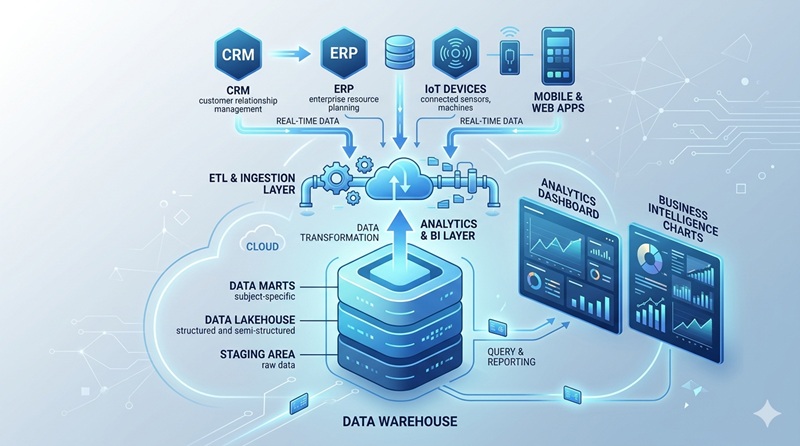
Core Components of a Data Warehouse
- ETL/ELT Processes – ETL (Extract, Transform, Load) or ELT (Extract, Load, Transform) automates the movement of data from different sources into the warehouse. This ensures that data is clean, consistent, and ready for analysis. For businesses, automated ETL/ELT pipelines reduce manual errors and speed up reporting.
- Storage Layer – This is the backbone of any data warehouse. It holds structured and unstructured data in an organised format. Modern warehouses offer scalable data storage, allowing businesses to grow without worrying about capacity limits.
- Analytics Layer – The analytics layer connects the stored data to reporting and business intelligence tools. This layer enables real-time dashboards, KPI monitoring, and advanced analytics, helping companies turn raw data into strategic decisions.
Types of Data Warehouses
Businesses can choose from three main types of data warehouses based on their needs:
- On-Premises Data Warehouses – Hosted on local servers, giving businesses full control over security and infrastructure.
- Cloud-Based Data Warehouses – Examples include Snowflake, AWS Redshift, and Databricks. These solutions offer flexibility, real-time access, and cost-effective scalability.
- Hybrid Data Warehouses – Combine both on-premises and cloud systems, providing the benefits of control and scalability simultaneously.
A Brief History
Data warehousing has evolved significantly over the years. Initially, businesses relied on traditional storage systems that were slow and lacked scalability. As data volumes grew, cloud-based solutions emerged, offering faster processing, advanced analytics, and easier integration with modern analytics platforms. Today, cloud data warehouse examples like Snowflake, AWS Redshift, and Databricks are leading the way, enabling businesses to manage large-scale data efficiently and make data-driven decisions in real-time.
3. Benefits of Data Warehousing Services
Investing in data warehousing services is no longer optional for modern businesses – it’s essential for staying competitive. A well-designed data warehouse provides a single source of truth for all your business data, helping companies make smarter, faster, and more accurate decisions. Let’s explore the key benefits of data warehousing and why businesses rely on these solutions.
1. Centralized Data Management
A primary advantage of a data warehouse is the ability to centralize all business data in one secure location. Instead of juggling multiple databases, spreadsheets, or cloud applications, businesses can access consistent and organised data from a single platform. Centralized data management simplifies reporting, reduces errors, and ensures that everyone in the organization works with the same information.
2. Enhanced Decision-Making with Real-Time Insights
Modern data warehouses support real-time analytics, enabling businesses to make data-driven decisions quickly. Whether it’s monitoring sales trends, customer behaviour, or supply chain performance, decision-makers can access up-to-date insights at any time. This speed and accuracy provide a competitive edge, allowing businesses to respond proactively rather than reactively.
3. Improved Data Quality and Consistency
Data warehouses enforce structured processes for ETL/ELT automation, ensuring that data is clean, accurate, and consistent. Poor data quality can lead to incorrect business decisions, but with a reliable warehouse, companies can trust their analytics. Improved data consistency also makes collaboration across departments smoother, reducing miscommunication and operational errors.
4. Scalability for Growing Business Needs
As businesses grow, so does the volume of data. Modern cloud data warehouses offer scalable data storage, meaning your system can expand seamlessly without performance issues. Whether your company adds new services, acquires more customers, or collects data from IoT devices, a scalable warehouse ensures you won’t outgrow your infrastructure.
5. AI and Machine Learning Readiness
An AI-ready data warehouse is designed to integrate with machine learning and advanced analytics tools. By preparing structured, high-quality data, businesses can implement predictive analytics, forecast trends, and automate intelligent decision-making. This capability transforms raw data into strategic insights, opening opportunities for innovation and growth.
4. Key Features to Look for in a Data Warehousing Service
Choosing the right data warehousing service can be overwhelming given the number of providers and solutions available. To make the best decision, businesses must focus on the features that directly impact performance, security, and scalability. Here are the best data warehousing features you should look for when evaluating a provider:
1. Data Integration Across Multiple Sources
A strong data warehouse should seamlessly integrate data from diverse sources, including ERP systems, CRM platforms, IoT devices, and SaaS applications. This ensures all your business data is consolidated into one platform, enabling accurate reporting and holistic insights. Effective integration reduces manual effort and ensures that no critical data is left out.
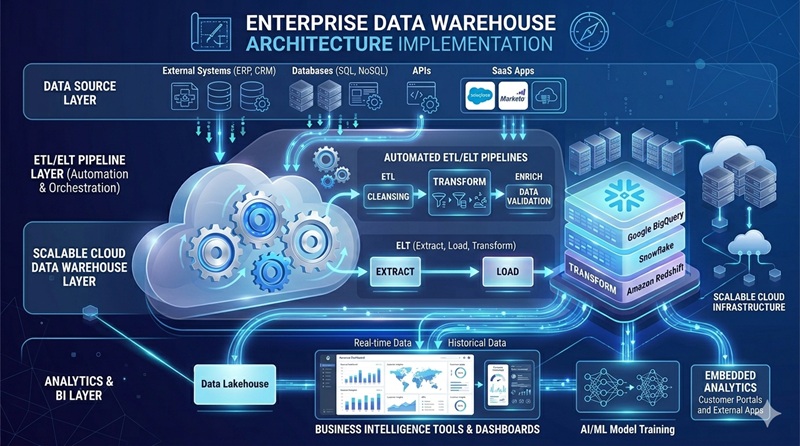
2. ETL vs ELT Support and Automation
Look for a service that supports both ETL (Extract, Transform, Load) and ELT (Extract, Load, Transform) workflows. Modern data warehouses offer ETL automation tools to move data efficiently, reduce errors, and enable real-time data pipelines. This flexibility ensures your business can handle batch or streaming data depending on your operational needs.
3. Data Security and Compliance
Security is critical when storing sensitive business and customer data. A secure data warehouse should offer features like encryption at rest and in transit, robust access controls, and audit logging. Compliance with regulations such as GDPR, HIPAA, and SOC 2 ensures your data practices meet legal requirements and build trust with stakeholders.
4. Performance and Scalability
The performance of your data warehouse affects how quickly you can access and analyse data. Key considerations include query speed, storage options, and auto-scaling capabilities. A high-performance warehouse allows teams to run complex queries without delays, while scalable storage ensures the platform grows with your business needs, accommodating increasing volumes of structured and unstructured data.
5. Analytics and BI Tool Compatibility
A modern data warehouse should connect effortlessly with popular analytics and business intelligence tools like Power BI, Tableau, and Looker. This compatibility enables teams to create dashboards, visualise KPIs, and extract actionable insights without complex configurations. Integration with BI tools ensures your business can transform raw data into meaningful, real-time decisions.
5. Popular Data Warehousing Platforms
Selecting the right data warehousing platform is crucial for businesses looking to manage data effectively, scale operations, and gain actionable insights. The market offers several leading platforms, each with unique strengths. Here’s a detailed look at the most popular options:
1. Snowflake Data Warehouse
Snowflake is a cloud-native data warehousing platform designed for scalability and performance. It allows businesses to store and analyse massive datasets without worrying about infrastructure limits. Snowflake is AI/ML-friendly, supporting machine learning workflows and predictive analytics. Its separation of storage and compute resources ensures cost efficiency, as you pay only for what you use. Snowflake’s flexibility makes it suitable for businesses of all sizes, from startups to enterprise-level organisations.
2. AWS Redshift
AWS Redshift is an enterprise-grade data warehouse that integrates seamlessly with the broader AWS ecosystem. It supports large-scale analytics and real-time querying, making it ideal for organisations already using AWS services. AWS Redshift offers powerful security features and auto-scaling, ensuring high performance even as data grows. Understanding AWS Redshift pricing is essential, as it depends on the storage and compute resources your business consumes. Redshift is widely used for complex analytics and business intelligence workflows.
3. Databricks
Databricks is a unified analytics platform that combines data engineering, data science, and machine learning. It excels at real-time data processing, allowing businesses to handle streaming data from IoT devices, web apps, or transactional systems. Databricks integrates with cloud storage services and popular analytics tools, providing a flexible environment for predictive analytics and AI-driven insights. This platform is ideal for organisations that require advanced analytics and want to implement AI workflows efficiently.
4. Comparison Table
| Platform | Cost Model | Performance | AI/ML Capabilities | Best Use Case |
| Snowflake | Pay-per-use | High, scalable | AI/ML-ready | Flexible cloud analytics, startups to enterprise |
| AWS Redshift | Pay-as-you-go | Enterprise-grade | Moderate | Large-scale BI, AWS-centric organisations |
| Databricks | Subscription-based | Real-time processing | Advanced AI/ML support | Unified analytics, streaming data, predictive analytics |
Choosing the right platform depends on your business goals, data volume, and analytics needs. Snowflake is perfect for scalable cloud analytics, AWS Redshift suits AWS-integrated enterprises, and Databricks excels for AI-driven, real-time insights.
6. How to Choose the Right Data Warehousing Service
Choosing the right data warehousing service is one of the most important decisions for any business looking to manage and analyze data effectively. The right solution can make your data easy to access, secure, and ready for insights, while the wrong choice can slow down operations and waste resources. Here’s a step-by-step guide to help you pick the perfect data warehouse.
1. Evaluate Your Business Needs
Start by understanding what your business really requires:
- Data Volume – Estimate how much data you generate daily, weekly, and monthly. Some warehouses handle large volumes better than others.
- Data Complexity – Do you have structured, semi-structured, or unstructured data? Choose a service that supports your data types.
- Real-Time Needs – If you need live dashboards or instant analytics, focus on warehouses offering real-time data processing.
- Growth Plans – Consider future growth. Pick a scalable solution that can handle increasing data without slowing down performance.
By clearly defining your business needs, you narrow down options and avoid paying for unnecessary features.
2. Check Integration Capabilities
Your data warehouse should connect seamlessly with your existing tools:
- ETL/ELT Pipelines – Ensure the service supports easy data extraction, transformation, and loading from your sources like CRM, ERP, or IoT systems.
- Analytics & BI Tools – It should integrate with Power BI, Tableau, Looker, or other reporting tools for smooth analytics.
- Cloud & On-Premise Options – Depending on your setup, choose a service that works with your preferred cloud provider like AWS Redshift, Snowflake, or Databricks, or on-premise infrastructure.
Integration flexibility is key to saving time and avoiding complicated workarounds.
3. Evaluate Performance and Speed
Performance matters when running large queries or generating reports:
- Query Speed – Fast query processing ensures users can access insights quickly.
- Concurrency – If multiple teams need access simultaneously, make sure the warehouse can handle many users without lag.
- Storage vs Compute – Some warehouses separate storage and compute, which can improve efficiency and reduce costs.
A high-performing warehouse helps teams make data-driven decisions faster.
4. Consider Security and Compliance
Data security is non-negotiable:
- Encryption – Check if the service encrypts data at rest and in transit.
- Access Control – Ensure role-based access for different team members.
- Compliance – Look for warehouses compliant with standards like HIPAA, GDPR, or SOC 2 if your industry requires it.
A secure warehouse protects sensitive business data and ensures regulatory compliance.
5. Review Cost and Pricing Model
Cost varies widely depending on features and usage:
- Pay-As-You-Go vs Fixed Pricing – Decide which model fits your business budget.
- Hidden Costs – Watch out for extra charges for storage, compute, or data transfer.
- ROI – Compare costs with the business value the warehouse provides. A slightly higher cost may be worth it if it offers better performance and insights.
Transparent pricing helps avoid surprises and ensures long-term affordability.
6. Look for Support and Community
Even the best warehouse can face issues. Good support makes a big difference:
- Customer Support – Check if the provider offers 24/7 support, live chat, or dedicated account managers.
- Documentation – Detailed guides and tutorials can speed up onboarding.
- Community & Ecosystem – A strong user community, forums, and plugins/extensions can add value.
Support ensures smooth operations and faster problem resolution.
7. Test Before Committing
Finally, always test the service before full adoption:
- Free Trials or Demos – Use trial periods to evaluate speed, integrations, and ease of use.
- Proof of Concept – Run a small project with real data to see if it meets your expectations.
- Feedback from Teams – Gather input from analysts, IT, and business users for a well-rounded assessment.
Testing helps you make a confident, informed decision.
Key Takeaway: Choosing the right data warehousing service is not just about technology; it’s about matching the warehouse capabilities with your business needs, performance expectations, budget, and future growth. Services like Snowflake, Databricks, and AWS Redshift offer flexibility, scalability, and integrations that most modern businesses need—but the perfect choice depends on your unique requirements.
7. Data Warehousing Implementation Best Practices
Implementing a data warehouse correctly is essential for turning raw data into actionable insights. Following best practices ensures your data is clean, secure, and easily accessible for analytics, reporting, and business decision-making. Here’s a complete guide for successful data warehousing implementation.

1. Define Clear Business Goals
Start with a strong foundation:
- Identify Objectives – Determine why you need a data warehouse: reporting, analytics, real-time dashboards, or machine learning.
- Align With Strategy – Ensure the warehouse supports your company’s overall business goals.
- Prioritize Use Cases – Focus on high-impact use cases first for faster results and early wins.
Clear goals prevent wasted resources and guide your implementation process.
2. Choose the Right Data Warehouse Architecture
The architecture impacts performance, scalability, and cost:
- Cloud vs On-Premise – Cloud solutions like Snowflake, AWS Redshift, or Databricks provide flexibility and scalability. On-premise may be necessary for sensitive or regulated data.
- Data Modeling – Use star schema or snowflake schema to organize data efficiently for faster analytics.
- Separate Storage & Compute – Cloud warehouses that separate storage and compute allow you to scale each independently, improving cost efficiency.
A well-planned architecture supports growth and high performance.
3. Implement Robust ETL/ELT Processes
Data pipelines are the heart of your warehouse:
- Extract Data Accurately – Gather data from ERP, CRM, IoT, and other sources.
- Transform Data Effectively – Clean, normalize, and enrich data for reliability.
- Load Efficiently – Keep the warehouse updated without slowing performance.
- Automate Workflows – Automation reduces errors and saves time.
Reliable ETL/ELT processes ensure your analytics are always based on accurate data.
4. Maintain Data Quality and Governance
Trustworthy data requires strong governance:
- Accuracy & Consistency – Standardize formats, naming conventions, and metrics across all sources.
- Security & Compliance – Implement role-based access, encryption, and meet regulations like GDPR, HIPAA, or SOC 2.
- Documentation & Metadata – Keep clear records of data lineage and definitions for transparency.
Good governance ensures users can trust and confidently use your data.
5. Optimize Performance and Scalability
Performance is key for large datasets and many users:
- Query Optimization – Use indexing, partitioning, and caching for faster queries.
- Concurrency Management – Ensure multiple teams can access data simultaneously without delays.
- Scalable Infrastructure – Cloud warehouses allow independent scaling of compute and storage.
- Monitoring Tools – Track query speed, storage, and usage for continuous optimization.
High performance ensures your data warehouse supports timely insights.
6. Enable User-Friendly Access
A warehouse is valuable only if it’s usable:
- BI Tools Integration – Connect seamlessly with Power BI, Tableau, or Looker.
- Self-Service Analytics – Empower business users to explore data without IT help.
- Training & Support – Provide guidance so teams can generate insights effectively.
Easy access increases adoption and accelerates data-driven decisions.
7. Plan for Continuous Improvement
A data warehouse is never truly “finished”:
- Regular Updates – Refresh data models, ETL pipelines, and analytics dashboards regularly.
- Feedback Loop – Collect input from users to improve functionality.
- Adopt New Technologies – Consider AI, machine learning, or real-time streaming as your data needs evolve.
Continuous improvement ensures long-term value and business agility.
Key Takeaway: Following data warehousing implementation best practices—from defining goals and choosing the right architecture to building strong ETL pipelines, ensuring data quality, optimizing performance, and enabling easy access—creates a powerful data platform that drives smarter decisions and measurable business growth. Cloud solutions like Snowflake, Databricks, and AWS Redshift provide scalable, flexible, and high-performance options for modern businesses.
8. Conclusion
Choosing the right data warehousing service is a critical step for any business that wants to turn data into actionable insights. This data warehousing guide has shown that success depends on evaluating your business needs, understanding costs, ensuring scalability, and preparing for AI-driven analytics.
Before you hire a data warehouse service, consider factors like data volume, integration with your current systems, real-time analytics needs, and long-term growth plans. A carefully chosen platform ensures your business can access reliable, accurate, and timely data for smarter decisions.
Selecting the right solution also means thinking about cost efficiency and performance. Cloud-based platforms such as Snowflake, AWS Redshift, or Databricks provide flexibility and scalability, while strong data governance and security protect your most valuable asset: information.
When you select a data platform, it’s essential to work with a trusted provider who can guide you through implementation, ETL/ELT pipelines, and ongoing optimization. Expert support ensures smooth adoption, faster insights, and measurable ROI.
Take action today: Don’t wait to unlock the full potential of your data. Reach out for a consultation or assessment to choose the best data warehouse service tailored to your business. Making an informed choice now sets the foundation for better analytics, stronger decisions, and long-term growth.
FAQ
What is a data warehouse, and why is it important for businesses?
A data warehouse is a centralized platform that stores structured and unstructured data from multiple sources for reporting, analytics, and decision-making. It allows businesses to access historical and real-time insights in one place. By consolidating data from ERP, CRM, and IoT systems, companies can make smarter decisions, improve efficiency, and identify growth opportunities. A well-designed data warehouse ensures data accuracy, consistency, and security, making it essential for data-driven organizations.
How does a data warehouse differ from a database?
A data warehouse is designed for analytical processing, handling large volumes of historical data and complex queries. A database, on the other hand, is optimized for transaction processing, managing daily operations like sales or inventory. Data warehouses focus on reporting, business intelligence, and analytics, while databases are used for real-time transactions. This distinction allows businesses to analyze trends and patterns without affecting operational systems.
What are the main benefits of using a data warehouse?
A data warehouse provides fast, accurate, and centralized access to data from multiple sources. It enables better decision-making, predictive analytics, and real-time insights, helping businesses identify trends and opportunities. Other benefits include improved data quality, consistency, and security, along with seamless integration with BI tools like Power BI and Tableau. Using a data warehouse also reduces reporting time and supports long-term scalability for growing organizations.
How do I choose the right data warehouse for my business?
To choose the right data warehouse, evaluate your data volume, complexity, and real-time analytics needs. Consider cloud vs on-premise solutions, integration with existing systems, scalability, and cost. Look for platforms like Snowflake, AWS Redshift, or Databricks that align with your business goals. Security, data governance, and support are equally important. Testing a trial or pilot project can ensure the warehouse meets your performance and usability requirements.
What is the role of ETL/ELT processes in a data warehouse?
ETL (Extract, Transform, Load) and ELT (Extract, Load, Transform) are critical for preparing data before analysis. They collect data from multiple sources, clean and normalize it, and load it into the warehouse for reporting and analytics. ETL is often used in traditional warehouses, while ELT is popular for cloud data warehouses due to scalable compute. These processes ensure data quality, consistency, and readiness for decision-making and BI tools.
How do I select the right data platform for my business needs?
Selecting the right data platform requires assessing business goals, data volume, and analytics requirements. Consider the type of data—structured, semi-structured, or unstructured—and whether you need real-time or batch processing. Evaluate cloud vs on-premise options, scalability, integrations, security, and vendor support. A trusted platform should provide flexibility, cost-efficiency, and easy integration with BI tools and AI analytics for actionable insights.
What are the benefits of a cloud data warehouse?
A cloud data warehouse offers scalability, flexibility, and lower upfront costs compared to on-premise systems. It allows businesses to scale storage and compute independently, handle large datasets, and support real-time analytics. Cloud warehouses also simplify maintenance, provide high availability, and integrate easily with BI tools and ETL pipelines. Companies benefit from reduced infrastructure overhead, faster deployment, and better support for AI and machine learning applications.
How does Snowflake differ from AWS Redshift or Databricks?
Snowflake is a fully-managed cloud data warehouse with separate compute and storage, offering near-infinite scalability. AWS Redshift is tightly integrated with AWS services and excels in high-performance SQL queries. Databricks combines a data lake and warehouse for big data and machine learning workflows. Snowflake emphasizes simplicity and multi-cloud support, Redshift focuses on AWS ecosystem efficiency, and Databricks is ideal for advanced analytics and AI-driven projects.
What is the difference between SaaS and PaaS data warehouses?
A SaaS (Software-as-a-Service) data warehouse is fully managed, ready to use, and requires minimal IT maintenance. A PaaS (Platform-as-a-Service) data warehouse provides infrastructure and tools, giving businesses more control over customization and deployment. SaaS is ideal for fast deployment and ease of use, while PaaS is suited for companies needing tailored solutions, complex pipelines, or integration with multiple cloud services.
Case Study: https://coradvancesolutions.com/unified-data-warehouse-for-a-retail-business/